The L9110S is a dual-channel push-pull power amplifier integrated circuit designed for controlling and driving motors. It integrates discrete circuits into a single IC, reducing the cost of peripheral components and improving overall reliability.
This chip has two TTL/CMOS compatible inputs with good anti-interference capability; the two output terminals can directly drive the forward and reverse motion of the motor. It has a large current driving capacity, with each channel capable of sustaining a continuous current of 750-800mA, and a peak current capability of 1.5-2.0A. Additionally, it features a low output saturation voltage and static current. The built-in clamp diodes can release the reverse impact current of inductive loads, making it safe and reliable for driving relays, DC motors, stepper motors, or switching power transistors.
The L9110S is widely used in circuits for toy car motor drives, automatic valve motor drives, electromagnetic door lock drives, and more.
Basic Parameters:
- Limit Parameters: 800mA / 2.5V-12V
- Low Static Operating Current: 0.00 uA
- Wide Power Supply Voltage Range: 2.5V-12V;
- Each channel has an 800mA continuous current output capability, allowing precise and rapid forward and reverse control;
- Ultra-low saturation voltage drop;
- TTL/CMOS output level compatible, can be directly connected to CPU;
- Output has built-in clamp diodes, suitable for inductive loads;
- Precise pulse width control and downstream drive integrated into a single IC;
- Features pin high voltage protection;
- Operating Temperature: -30 ℃ to 80 ℃.
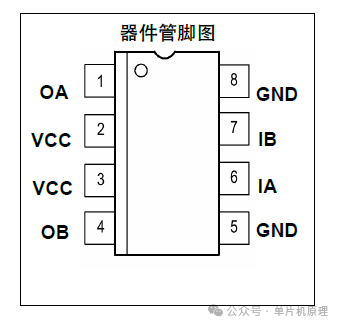
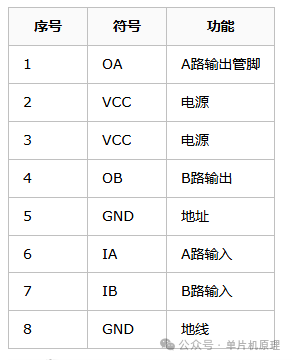
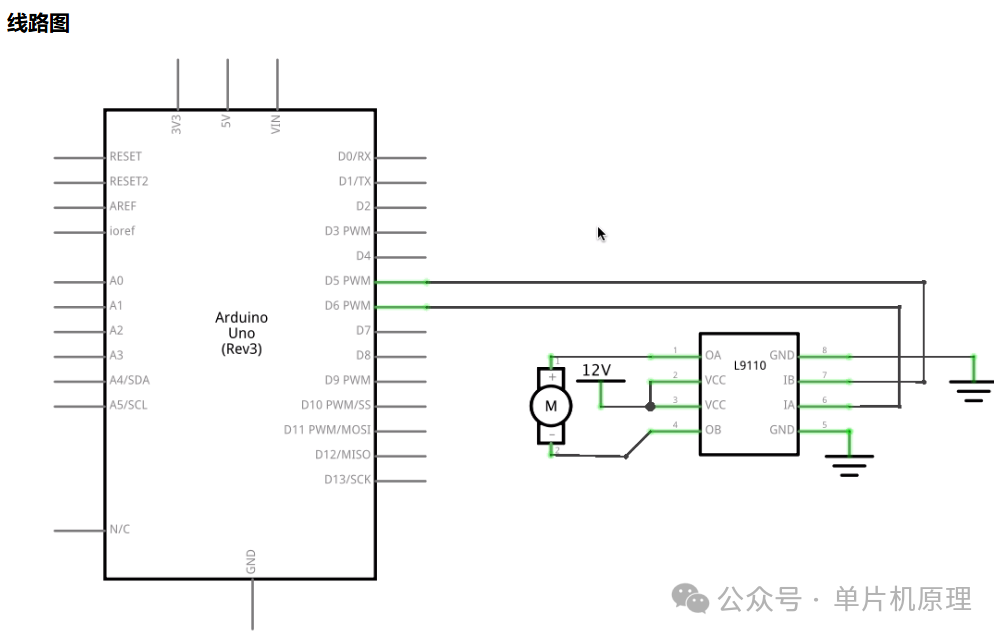
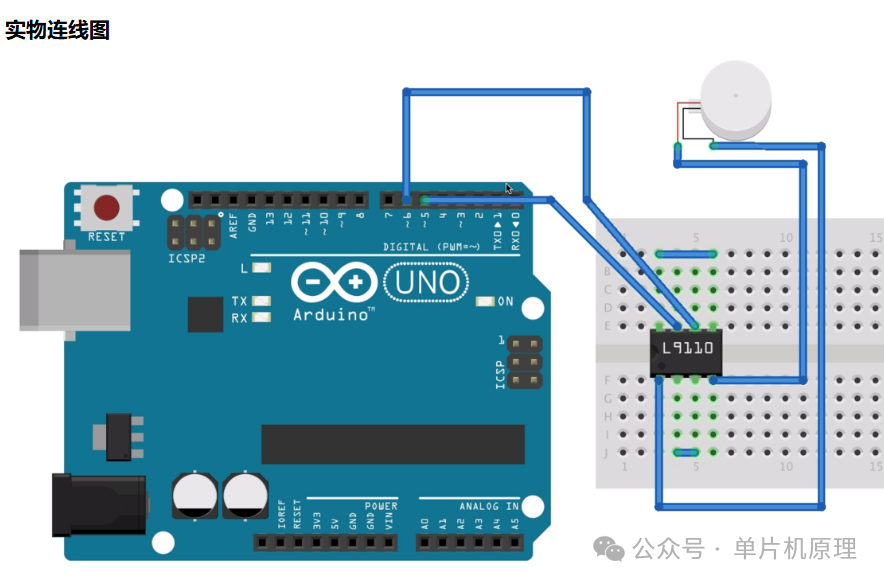
/* L9110 Control Small DC Motor Experiment Experiment Objective: Control the direction and speed of the DC motor through simple connections of the L9110. Experiment Design: Joystick acts as the throttle and control for forward and backward direction, with the control stick increasing speed from low to high as it moves in the direction. Note: One L9110 can only control one motor, and IA and IB need to be connected to Arduino */const int IA = 5; // pin 5 connected to pin IAconst int IB = 6; // pin 6 connected to pin IBbyte speed = 255; // change this (0-255) to control the speed of the motorvoidsetup() { pinMode(IA, OUTPUT); // set pins to output pinMode(IB, OUTPUT); Serial.begin(9600); }voidloop() { int offsetX=525; // The analog input value when the control stick is in the center position; different control sticks may have different offsets.int x =analogRead(A0); bool isFoward = x <= offsetX; speed = x==offsetX ? 0: (isFoward ? (255– map(x,0,offsetX,0,255)): map(x,0,1024,0,255)); Serial.println(speed); isFoward ? forward() : backward(); }voidbackward(){ analogWrite(IA, 0); analogWrite(IB, speed); }voidforward(){ analogWrite(IA, speed); analogWrite(IB, 0); }
ESP32 Development BoardThree Days to Master MicrocontrollersArduino Development Board
STM32 Development Board