Recently, the German industrial giant Bosch Group announced the completion of its acquisition of Johnson Controls’ residential and light commercial HVAC business for $8 billion (approximately €7.4 billion), marking the largest acquisition in Bosch’s 137-year history. This acquisition also includes the equity of the Johnson Controls-Hitachi Air Conditioning joint venture, signaling a reshaping of the global HVAC industry landscape.
This move signifies Johnson Controls’ formal divestiture from traditional HVAC operations, focusing on innovative building solutions that are “smart, safe, healthy, and sustainable”; meanwhile, Bosch completes a key layout of its 2030 strategy, becoming a core player in the global residential and light commercial HVAC market.
Core of the DealDual Pursuit of Strategic Transformation and Ecological Expansion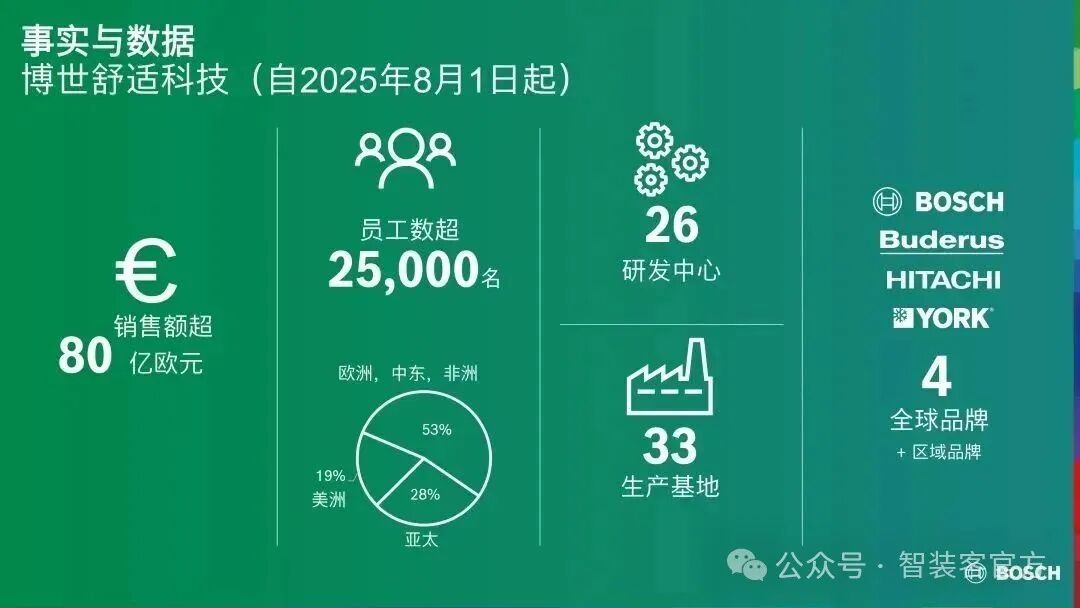
According to the agreement, Bosch acquires Johnson Controls’ North American ducted air conditioning business and the global residential business in joint venture with Hitachi for $8 billion (€7.4 billion), while Hitachi retains the ductless assets in Japan. Johnson Controls is expected to receive approximately $5 billion in net cash proceeds and will return value to shareholders through a $5 billion accelerated share repurchase program, demonstrating its determination to transform into a “lighter” entity.
Through this acquisition, Bosch’s Comfort Technology division doubles in scale, with over 25,000 employees and sales exceeding €8 billion. By integrating brands like York and Hitachi, its global production bases increase from 17 to 33, and R&D centers expand to 26, particularly strengthening its market presence in the Americas and Asia. Bosch predicts that by 2030, the global HVAC market will grow at an average annual rate of 5%, with annual air conditioning unit sales expected to exceed 200 million, a nearly 20% increase from 2024.
Global Management Structure UpgradeLocalized Decision-Making Accelerates Smart ImplementationBosch has established three regional headquarters in the Americas, Asia-Pacific, and Europe/Middle East/Africa, led by former Johnson Controls executives David Budzinski for the Americas and Ulrich Lissmann for the Asia-Pacific region. This structure facilitates the rapid adaptation of smart products to local needs: for instance, promoting high-efficiency air conditioning and water heater integration solutions in the Middle East, and accelerating the intelligent linkage of heat pumps and photovoltaic systems in Europe.Smart Home PerspectiveThree Major Leapfrogs from Devices to Ecosystems
By integrating technologies from York and Hitachi, Bosch can develop cross-brand compatible smart temperature control systems. For example, users can control Hitachi’s efficient split air conditioning units and Bosch heat pumps through a single app, achieving intelligent regulation of the entire home’s climate, and even linking with home energy management systems to optimize electricity costs.
For the North American central air conditioning market, Bosch can combine York’s ducted technology to launch AI algorithm-equipped smart central air conditioning that automatically learns user habits; in the Asian market, it can provide precise temperature control commercial solutions for hotels and hospitals using Hitachi’s ductless VRF systems, deeply integrated with smart building systems.
Leveraging the expanded R&D centers, Bosch can integrate operational data from various brand devices to develop predictive maintenance algorithms. For instance, by analyzing vibration data from air conditioning compressors, it can provide early fault warnings and, in conjunction with Bosch’s service network, offer automatic dispatch for repairs, shifting from “selling equipment” to “selling services”.
Smart Headlines Perspective
This acquisition is not just a reshuffling of assets among giants; it reveals a deeper transformation in the smart home industry: HVAC is evolving from a “functional product” to a “smart central hub for the entire home”.
For users, after Bosch integrates York and Hitachi, they can control temperature, humidity, fresh air, and energy consumption through a unified platform, ending the chaos of multiple brand remote controls; its regional strategy will further promote the realization of “climate adaptability” scenarios—such as time-based zoning temperature control in Asian households and heat pump linkage with photovoltaics in European residences, shifting environmental regulation from “manual settings” to “seamless collaboration”.
In the future, air conditioning may no longer just be a temperature control tool but a node in the home energy internet, capable of responding to grid demands for electricity adjustment and automatically optimizing comfort through AI learning. As global warming drives a surge in air conditioning demand, Bosch is expected to redefine the standards of smart comfortable living through a “hardware + software + service” model.