
Cost Structure of Copper Foil
The three core raw materials for copper-clad laminates arecopper foil, resin, and glass fiber cloth, accounting for 42%, 26%, and 19% of the cost, respectively, totaling 87%.In previous articles, we have focused ontwo of the three cores: electronic glass fiber cloth and electronic resin. The remainingcopper foil has not been discussed, so in this issue, we will introduce copper foil.
Copper-clad laminates account for40% of the total production cost ofPCBs, and electronic copper foil accounts for42% of the production cost of copper-clad laminates. Therefore, copper foil has the largest cost share in copper-clad laminates.

Classification of Copper Foil Products
According to application fields, copper foil can be divided into lithium battery copper foil and electronic copper foil. Lithium battery copper foil is used in the manufacturing of various lithium batteries, while electronic circuit copper foil is the main raw material for copper-clad laminates in PCBs.With the push for high-end PCBs driven by AI servers and distributed computing clusters, integration, high performance, and high density are important trends in technological development. In this context, the demand for high-performance copper foil will continue to expand,and domestic high-end copper foil has enormous development potential.
The core characteristics are low signal loss, high flatness, ultra-thin/thick specifications, excellent thermal and electrical conductivity, and high compatibility with substrates, making it a key raw material for manufacturingcopper-clad laminates(CCL) and PCBs, directly affecting the efficiency, reliability, and power carrying capacity of circuit signal transmission.High-end copper foil is mainly composed of:
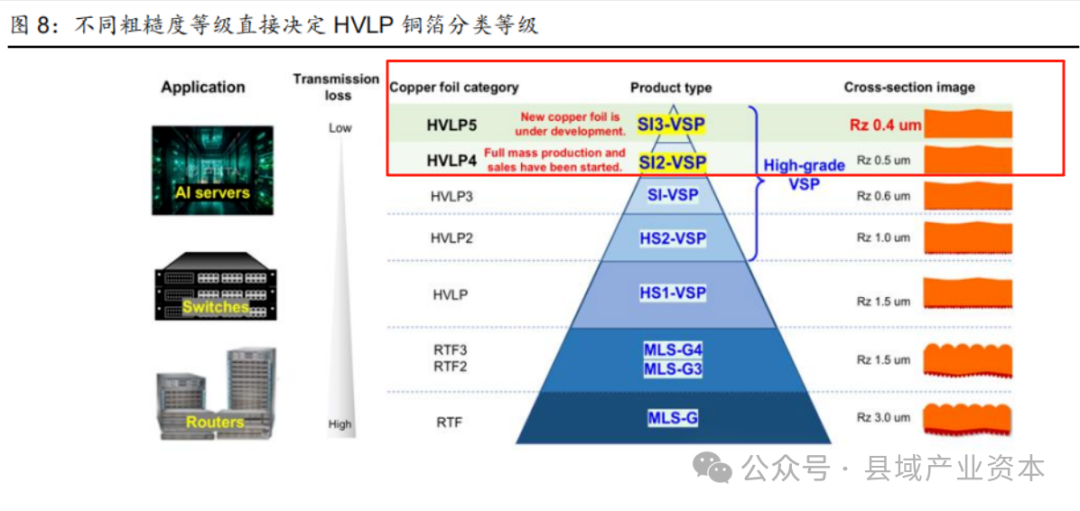
RTF:Special surface treatment reduces roughness and enhances bonding strength with substrates, commonly used in high-end HDI and packaging substrates, with technology evolving from RTF generation 1 to generation 5.
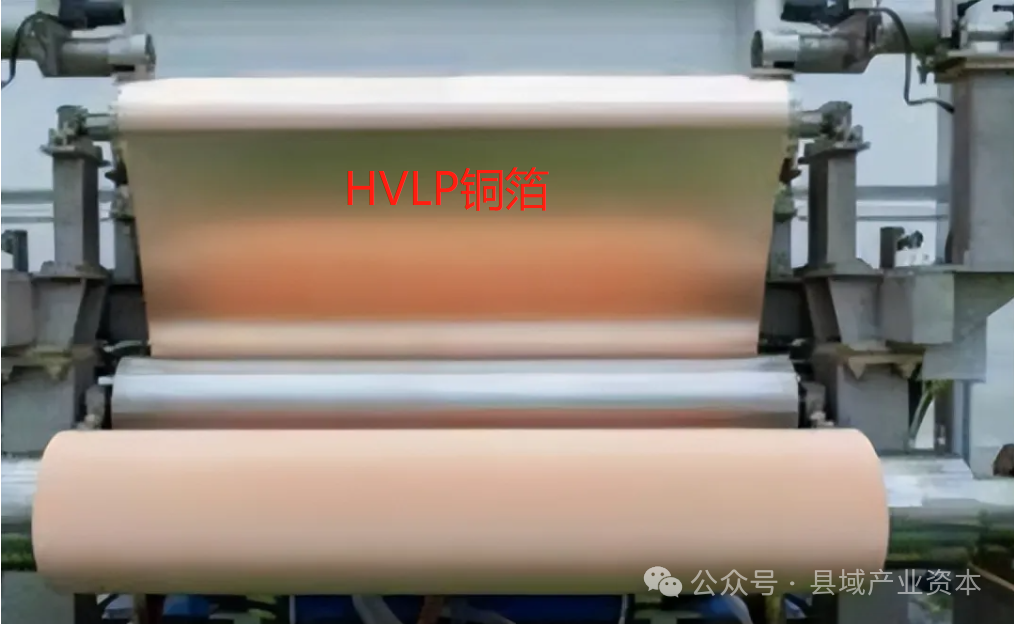
HVLP:Surface roughness ≤ 0.6μm, which can reduce skin effect losses in high-frequency signal transmission, suitable for scenarios such as 5G communication, AI servers, and high-speed data centers (e.g., HVLP generation 5 copper foil paired with NVIDIA’s next-generation AI chips).
High-end copper foil fields such as HVLP are mainly dominated by overseas companies from Japan and South Korea.ForeignHVLP copper foil suppliers include Mitsui Mining & Smelting, Fukuda Metal, Nippon Denkai, and Furukawa Electric from Japan, as well as Doosan Group and Solus Advanced Materials from South Korea,with Japan and South Korea dominating 85% of the global HVLP copper foil market.Among them,Mitsui Mining & Smelting is the global leader in HVLP copper foil, holding the largest market share.DomesticHVLP copper foil is limited by technical barriers and verification cycles, still on the eve of volume production, and is the most critical aspect of the entire PCB high-end material chain.
From generation 1 to generation 5 of HVLP copper foil, surface roughness gradually decreases, performance continuously improves, and application scenarios expand from 5G communication to high-end fields such as AI servers and semiconductor packaging. With technological advancements, HVLP generation 5 will become a key material for the next generation of AI computing infrastructure.
To put it simply, by processing in a vacuum environment and using special surface treatment processes, copper foil can become smoother, reducing data loss during transmission and improving reliability.From the changes in HVLP generations, it can be seen that high-end production capacity is in HVLP generations 4-5, while generations 2-3 belong to mid-to-low-end production capacity.

Company Comparison
In summary, the two companies with confirmed domestic shipments are Tongguan Copper Foil and Defu Technology.
Tongguan Copper Foil:A “national team” player backed by a major copper industry giant, with the controlling shareholder being the Anhui Provincial State-owned Assets Supervision and Administration Commission. Over 70% of the copper raw materials are purchased from Tongling Nonferrous Metals, providing a certain cost advantage in raw materials.The business spansstandard copper foil (for PCB circuit boards) andlithium battery copper foil (for batteries). PCB copper foil accounts for about 60%, while lithium battery copper foil accounts for about 30%.The company has production capacity for 1-4 generation HVLP copper foil, currently mainly shipping generation 2 products.
Defu Technology:Very focused, investing all resources and energy intolithium battery copper foil in this sector, especially leading in technology for ultra-thin copper foil and other high-end products. Like aneurosurgeon specializing in heart surgery.Lithium battery copper foil accounts for over 70% of revenue,while PCB copper foil is less than 30%.Defu Technology mainly produces lithium battery copper foil and is a major player in this field. However, this field is not technically difficult, and there is currently an oversupply in the industry, so they are working hard to transform. They are putting some effort into PCB copper foil (related to AI), but transformation requires significant investment in R&D, which poses considerable challenges.The company has been committed to the transformation of high-end electronic circuit copper foil since 2018,announcing the full acquisition of Luxembourg Copper Foil, which mainly engages in the R&D, production, and sales of high-end IT copper foil in electronic circuit copper foil.Luxembourg Copper Foil has now obtained supply qualifications from the top four global high-speed copper-clad laminate companies.

Conclusion
Defu Technology’s profit for the first half of the year was approximately 38.7 million, a year-on-year increase of 136%, and it is expected to reach around 80 million to 100 million for the entire year, with a current total market value of about 22 billion, and the price-to-earnings ratio is expected to exceed 200 times, which is indeed quite exaggerated. Currently,the biggest variable for Defu Technology is whether the acquisition can be completed smoothly and whether the subsequent business integration will go smoothly.There is an oversupply of lithium battery copper foil, putting pressure on profits, but if the transformation to HVLP copper foil is successful, it could enter the high-end market, and if the Luxembourg acquisition is completed, it will enhance overseas competitiveness.
Profit for Tongguan Copper Foil in the first half of the year was 34.95 million, with both companies’ profits being similar, both around 30 million, and the expected annual profit is also similar, estimated at around 80 million to 100 million. The current total market value is 27.8 billion, and the price-to-earnings ratio is also alarmingly high.
In summary, Defu Technology is a battery expert, while Tongguan Copper Foil is a circuit board expert. With the rise of AI, Tongguan Copper Foil has a better starting point.If seeking short-term certainty,Tongguan Copper Foil has more advantages, as its HVLP copper foil mass production capacity has been validated, and performance growth is clear. If optimistic about long-term transformation potential,Defu Technology‘s transformation to HVLP copper foil, if successful, is expected to achieve a valuation leap, but it carries higher risks. Investors need to choose based on their own risk preferences and investment timelines.
Given the current valuation situation, I think both are quite high, and I believe it is better to wait for now.
Follow me to focus on the development of the technology industry and explore the technology industry in China!