
Matter is an open-source interoperability standard developed by international tech giants such as Amazon, Apple, and Google in collaboration with the CSA Alliance (formerly Zigbee Alliance) for the smart home industry. It allows smart home devices of different categories and brands, operating under various communication protocols, to communicate and control each other within the same home environment. It is currently the mainstream solution in the smart home industry to eliminate issues such as fragmented communication protocols and disjointed multi-device collaboration experiences.
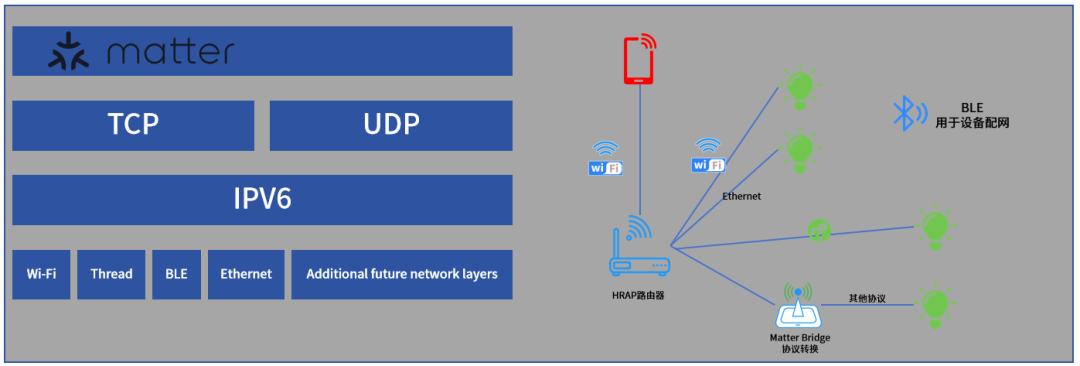
Protocol Stack and Network Topology Diagram of the Matter Standard
As shown in the figure above, the Matter standard is an application layer protocol that does not define new communication protocols but reuses the mature TCP/IP protocol suite (TCP/UDP as transport layer protocols and IPv6 as the network layer foundation). Therefore, smart home devices adopting the Matter standard only need to follow a unified application layer specification to be compatible with underlying communication protocols based on IP technology, such as Wi-Fi, Thread, BLE, and Ethernet.
01
How Does the Matter Standard Achieve Ecological Compatibility?
Previously, due to the different operational logics of various communication protocols, smart home devices using different protocols often found it difficult to communicate with each other, much like people speaking different languages. The Matter standard addresses this by specifying a unified data model and interaction model at the application layer, effectively providing smart home devices with a set of mandatory universal syntax rules for seamless interaction.
As illustrated in the figure below, comparing the industry-standard OSI (Open System Interconnect) reference model, the application layer defined by the Matter standard corresponds to the highest layers (Layer 5 to Layer 7) of the OSI model. It is primarily used for communication and instruction transmission between devices, directly providing network services to users, including application selection and invocation, as well as data processing and exchange.
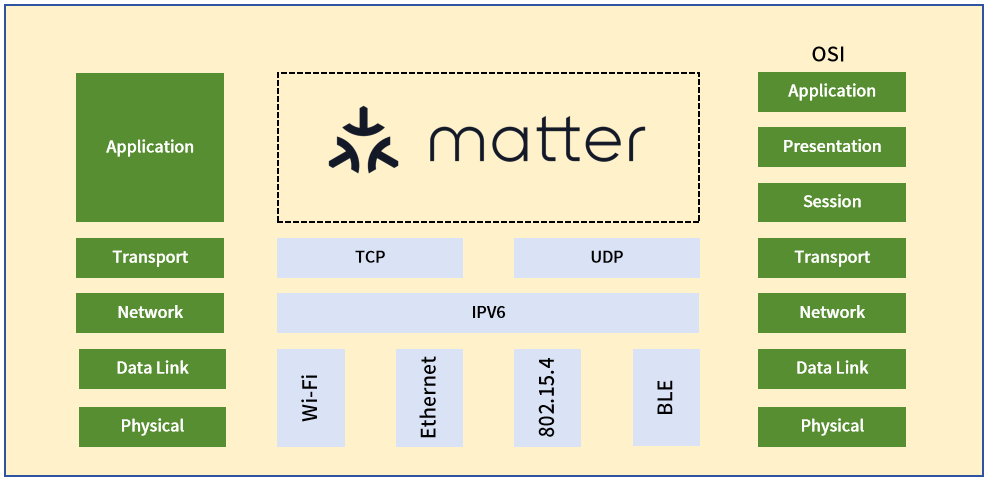
Comparison of the Matter Protocol Stack and the Standard OSI Model
The specific role of the application layer is to define what devices “can do” and “how they collaborate”. For example, in a Matter network, when a temperature and humidity sensor using the Thread communication protocol detects that the humidity level in the home exceeds the normal threshold set by the homeowner, it will automatically send a “turn on” command to a dehumidifier using the Wi-Fi communication protocol. The application layer will facilitate the sending of the “turn on” command and its response action without any user intervention, demonstrating the functionality of the application layer.
It is worth mentioning that the application layer specifications defined by the Matter standard are applicable not only to device interactions but also to homeowner control over devices. The logic of the temperature and humidity sensor triggering the dehumidifier’s “turn on” command is entirely consistent with the homeowner issuing a “turn on” command to the dehumidifier through a smart home ecosystem app—this is the core of the Matter standard’s ability to achieve cross-scenario collaboration.
02
How to Quickly Develop Smart Home Devices Compliant with the Matter Standard?
By adopting the Matter standard, smart home devices can seamlessly integrate into various home ecosystems, sharing the future trillion-dollar market with all ecological giants. So, how can smart home device manufacturers enter the Matter industry and quickly develop smart home devices compliant with the Matter standard?
The answer is clear: as a key hardware unit supporting the implementation of the Matter standard, choosing a mature, reliable, and easily integrable Matter module has become a common “weapon” for all smart home device manufacturers to quickly enter the Matter arena.
For example, the HM-MT2401 developed by Hoperf is a Matter over Thread wireless communication module based on the 2.4GHz band, which has been widely used in various smart home devices such as LED lights, smart switches, smart sockets, smart locks, smart curtain motors, smart doorbells, smart thermostats, and smart sensors.
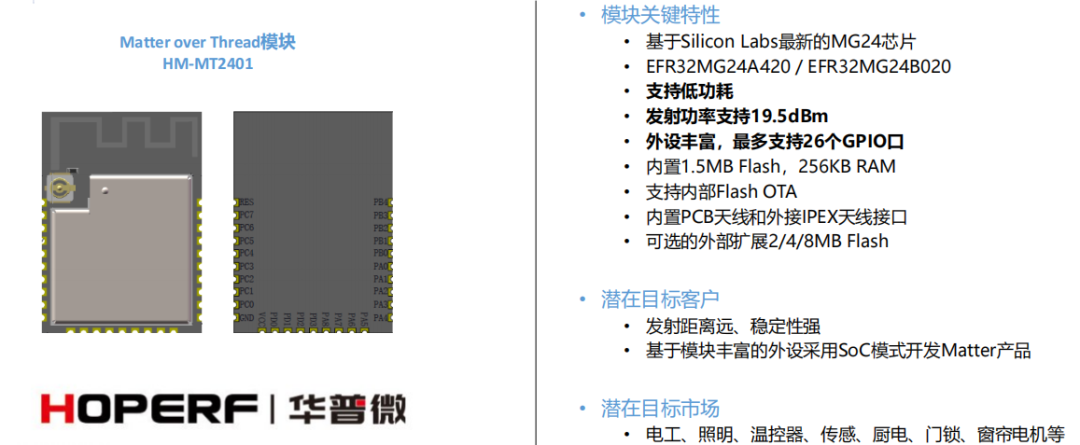
The HM-MT2401 is equipped with a high-performance, highly integrated EFR32MG24 RF processing chip, which features a low-power 32-bit ARM® Cortex®-M33 processor core, 1536kB Flash, and 256kB RAM, along with a rich set of peripheral interfaces.
For smart home device manufacturers, engineers only need to integrate the HM-MT2401 into the smart home terminal devices through simple interface design to upgrade existing terminal devices to Matter-compliant devices. This not only significantly reduces the difficulty of developing Matter products and shortens the development cycle but also accelerates the time-to-market for Matter products.
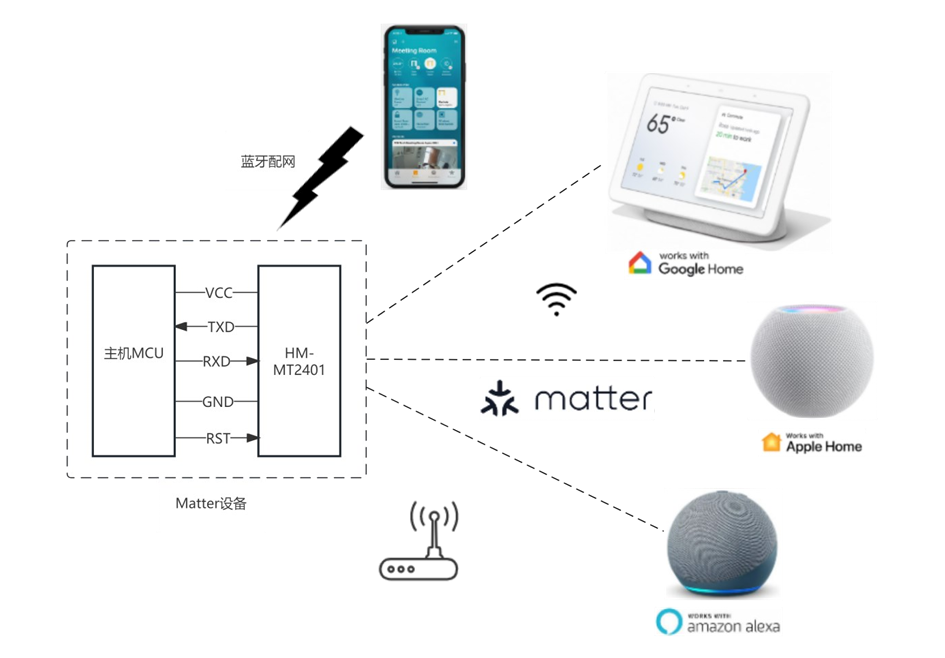
Application Diagram of the HM-MT2401 Module
For consumers, after selecting their favorite devices from any brand that supports the Matter standard, they only need to open the smart home app on their smartphone (such as the Apple Home App), scan the QR code of the Matter device, and follow the intuitive and easy-to-understand guidance process to complete the device networking and integration operations using Bluetooth technology, achieving seamless interconnection with major global smart home platforms such as Amazon Alexa, Apple HomeKit, Google Home, and Smart Things.
1
END
1

About Hoperf
Shenzhen Hoperf Microelectronics Co., Ltd. (hereinafter referred to as Hoperf) was established in 2004 and is a national high-tech enterprise focused on independent innovation and product development of core IoT components.
Over the past 20 years, Hoperf has expanded its development from Sub-GHz wireless communication RF chips and modules to high-precision MEMS sensors and digital isolators, forming a product layout that integrates information perception and information interaction.After years of accumulation, Hoperf has developed into a system-level service provider for IoT wireless communication, integrating RF chip design, firmware and protocol design, application development, and testing.
As one of the well-established IoT wireless RF chip brands in China, the company has accumulated a large number of high-quality customer resources and brand recognition both domestically and internationally, thanks to its solid R&D capabilities, reliable product quality, cost-effectiveness, and system-level service capabilities.
If you have any needs, please contact us immediately!
Phone: 400-1189-180
Email: [email protected]
Website: https://hoperf.cn/
For more information, please follow 【Hoperf】
↓↓↓↓
Group
Like

Share

Like