

Source丨AI Without Boundaries (ID:gh_038acd4f5b63)
Author丨Lainya
Editor丨Yin Guanzhao
Image Source丨Midjourney
In June of this year, the highly popular AI toy “Fuzozo” officially launched on JD.com. This plush accessory has attracted many consumers, and currently, Fuzozo ranks second on JD’s AI toy sales chart, with monthly sales exceeding 20,000 units according to data from the business observation media “Baobian”.
In September, an AI companion robot in the shape of an accessory, Eiliko, completed its crowdfunding campaign on Kickstarter, garnering support from approximately 4,700 backers and raising about $600,000.
In October, LIVING.AI, a hardware brand focused on the AI companionship field, suddenly updated its product promotional images on its official website, introducing a new product that also resembles an accessory.
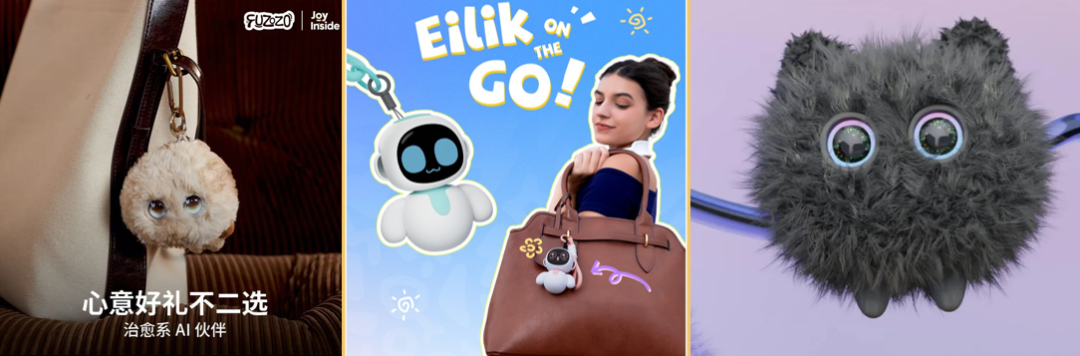
From left to right: Fuzozo, Eiliko, and LIVING.AI’s new product teaser|Image source: JD.com, Kickstarter, LIVING.AI
In the months following Fuzozo’s rise to fame, several AI toy brands have launched new products, all choosing the accessory form. It is not uncommon for a particular market segment to follow trends, but given the decent results, we can’t help but wonder why the “accessory” form? Is this a case of market players following the trend, or a well-considered choice?

Similar Path Choices? From Desktop to Personal
According to Qichacha, the three AI companion accessory products mentioned above come from Shanghai Robopoet, Shenzhen Energize Lab, and Shenzhen LIVING.AI. Coincidentally, all three companies initially chose desktop robots as their first products.
Robopoet-Fuzozo:
Robopoet was established in 2024, and its first product, Sunday, is officially positioned as an “AI trendy toy”. The product supports three-in-one scenarios for desktop, ground, and wearable use. Sunday stands about 15cm tall and supports features such as voice chat, facial recognition, long-term memory, and personality development. From the official introduction, compared to its later star product Fuzozo, Sunday lacks the “tap to add friends” social feature and has significant differences in appearance, but almost all other settings have been inherited by Fuzozo.
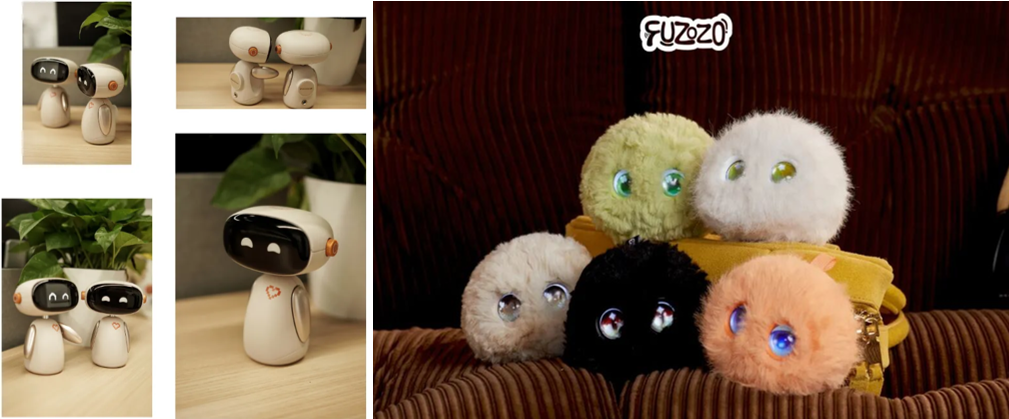
Robopoet’s first product prototype was codenamed “Sunday” (left), not officially sold, now displayed on the official website as a life assistant Robohelper; later launched Fuzozo (right, initially named “Fuzzoo”)|Image source: Robopoet WeChat Official Account
Energize Lab-Eiliko:
Energize Lab was established in 2019, and before Eiliko launched on Kickstarter, it had another desktop companion robot, Eilik (the new product name only added an “o” at the end), which raised about $770,000 in 2021. Eilik is equipped with sensors to recognize user touch actions and provides emotional feedback through facial expressions on a display, supporting conversation, timing, and interactive games, with multiple devices able to interact.
This year, Eiliko launched, and at first glance, it looks like a smaller version of Eilik, with a height reduction of 5cm. It features a modular design for outfit changes based on the accessory form. In terms of functionality, AI technology support has been added to the conversation feature; and social attributes have been enhanced, with different Eiliko units increasing intimacy with more encounters.
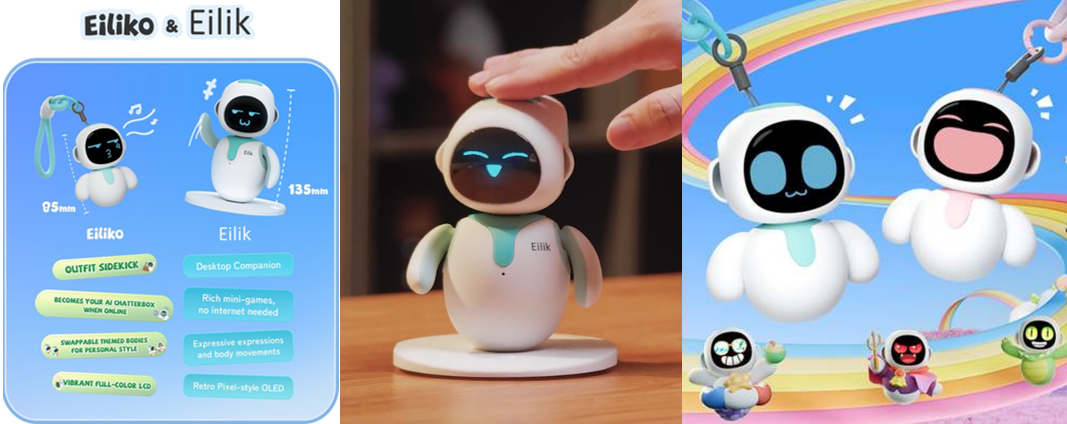
From left to right: Comparison of Eiliko and Eilik, Eilik, Eiliko. Eiliko also adopts a “once in a lifetime” pairing mechanism, which cannot be unbound once paired. Its head can be detached from the body for different combinations.|Image source: Kickstarter
LIVING.AI-HICOCO:
LIVING.AI was established in 2020, and its first product EMO is also a desktop robot that supports conversation, photo-taking, and schedule management functions; equipped with multiple sensors, it can express emotions through a facial display and multi-axis joints in response to user voice commands and touch. As usage time accumulates, EMO’s understanding of user commands improves.
Later, AIBI was launched, positioned as a pocket robot (which can also be worn with a strap), supporting facial recognition, photography, voice Q&A, and schedule management functions. At this stage, LIVING.AI has clearly been reducing the size of its robots to enhance portability. While Fuzzoo is well-known as an AI accessory, the portable form was likely explored earlier by LIVING.AI’s pocket robot.
Regarding the recent sudden update of the homepage product image, LIVING.AI indicated in a pre-launch event that the new product HICOCO might be a “surprising addition to EMO and AIBI”. Following the trend of previous products shrinking from desktop to pocket, and based on the teaser images released, HICOCO is likely to also take on an accessory form.
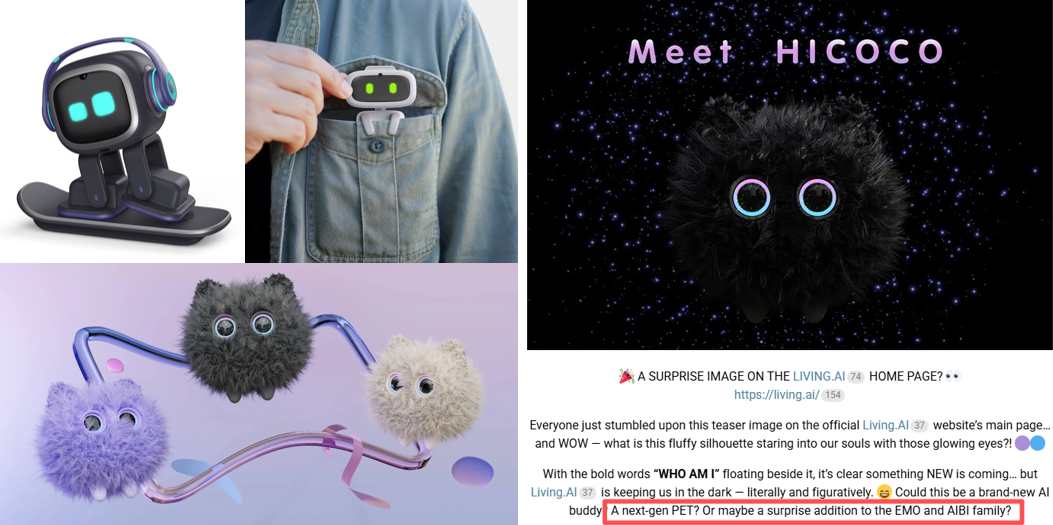
On the left are EMO and AIBI, and below is the updated product image from the official website.|Image source: LIVING.AI
Looking at the unified shift of AI toy manufacturers towards the “accessory” form, the trendy toy attributes are also quite evident.
Fuzozo and HICOCO have chosen appealing and attractive plush materials, while Robopet’s name change for “Fuzai” coincidentally occurred two months after Labubu’s explosive popularity; Eiliko supports outfit changes and adopts the typical “blind box” sales model found in trendy toys.
It must be said that manufacturers may be “grasping” the psychology of young players, but the explosive popularity of Pop Mart has indeed made entrepreneurs realize the value of emotional engagement.
In terms of audience, Robopoet’s founder Sun Zhaozhi has explicitly stated that Fuzozo’s target audience is young women; the promotional images for Eiliko feature numerous clothing/bag matching elements, and the “once in a lifetime” pairing mechanism clearly positions young users and couples as core audiences. The age range for LIVING.AI’s EMO and AIBI is broader, while the audience for HICOCO remains to be observed after its official release.

Smaller AI CompanionsSocial Shift After Being “Seen”
From the iterative process of the aforementioned manufacturers, we can see that the basic functional practicality has remained almost unchanged from the early “desktop pets” to the recent “AI accessories”. There is hardly any difference from Eilik, which was already crowdfunding in 2021, with the improvements mainly benefiting from advancements in AI technology (such as enhanced model capabilities and improved long-term memory), upgrading the experience.
In other words, although AI toys have been pushed to the forefront in 2025, they are not fundamentally different from four years ago. The wave of returns faced by many AI toys sold earlier this year also indicates that the experience may not have met user expectations.
However, the success of Fuzozo’s launch and the collective following of several manufacturers align with the trends we have observed in the AI companionship software sector, where everyone is trying to break out of a “misunderstanding” of using AI to accompany humans.
The core change in this wave, the “accessory” form, not only provides young people with a reason to like it through trendy toy attributes but also allows this liking to be shared and seen, increasing the probability of two AI accessory toys encountering each other, transforming the toy’s value from merely being an AI companion to facilitating social interactions between people.
On social media platforms, many consumers who purchased Fuzozo are looking for “parents” to make friends or share their experiences of meeting offline through Fuzozo. Friends of the author who have purchased Fuzozo express that, for them, the companionship attribute of Fuzozo currently outweighs its social attribute. The likelihood of using social features also relates to the user’s personality; more introverted friends indicate that they would not proactively seek out “like-minded” individuals in real life, but if someone asks, they would be willing to try the tap-to-friend feature.
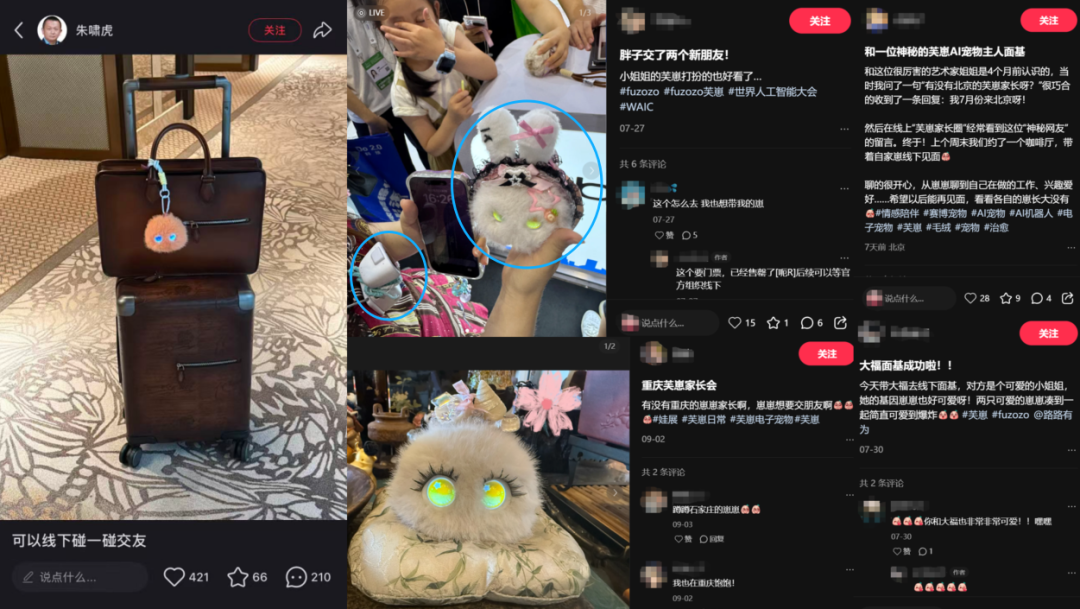
Zhu Xiaohu uses Fuzozo as a companion, posting friendship posts on social media (left); a user purchased both Fuzozo and AIBI (in the blue box)|Image source: Xiaohongshu
On Kickstarter, overseas users also express high expectations for social features. Referring to Energize Lab’s two products, many users left comments during Eilik’s crowdfunding phase requesting the addition of social interaction features; when Eiliko was launched, users had high expectations for its intimate social attributes.
At the same time, the subtle changes in Energize Lab’s settings from Eilik to Eiliko are noteworthy. Originally, two Eiliks could interact with each other, with the user being the same person; whereas in Eiliko, both the social features based on “intimacy” and the “once in a lifetime” pairing mechanism typically involve different users.
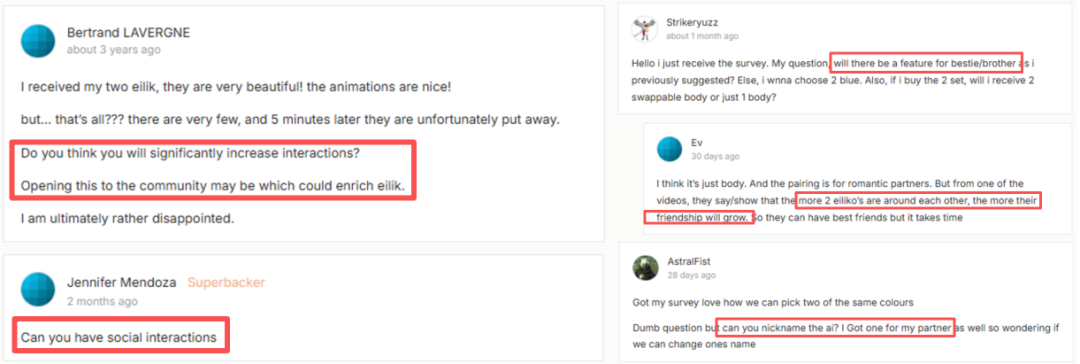
Comments section for Eilik and Eiliko|Image source: Kickstarter
Energize Lab has shared that after the release of Eilik, the team discovered that the usage of Eilik as a desktop robot extends far beyond the desktop, with many users taking Eilik to cafes, beaches, and even hanging it on their backpacks while traveling the world.
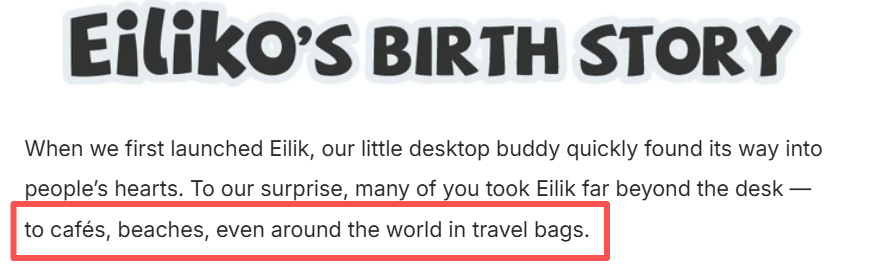
Background of Eiliko’s birth|Image source: Kickstarter
Moreover, the collective shift of AI toys towards the “accessory” form seems to facilitate industry advancement and market validation.
Robopoet’s Sunday is not officially sold, while Fuzozo is priced at 399 yuan (currently around 300 yuan after discounts for “Double Eleven”), which is a highly acceptable price in the AI toy market. Energize Lab’s Eilik was initially priced at $100 (about 710 yuan) during its early bird phase in 2021, while the price for Eiliko’s early bird phase this year was directly halved to $50 (about 355 yuan). Although LIVING.AI’s HICOCO has not been officially released yet, the prices for EMO starting at $279 (about 2000 yuan) and AIBI at $249 (about 1800 yuan) clearly indicate a downward trend in product pricing.

Final Thoughts
According to business observation media “Baobian”, Vivian, an AI investment expert with a background in NLP (Natural Language Processing) who has worked at investment firms such as Jingwei and Guangyuan Capital, emphasized that AI companionship is not a single product but should be designed around the lifestyle of target users. Many teams are currently fixated on the term “companionship” without understanding “who needs companionship”, “what kind of companionship”, and “in what scenarios companionship is needed”. This has become a core reason for the monetization difficulties faced by AI toy manufacturers.
The toy manufacturers choosing to make “AI accessories” have all experienced a shift from desktop robots to portable devices. This consistent shift reflects that AI companionship hardware manufacturers are adjusting their thinking, focusing on young users as the core audience, and using the “accessory” form to achieve more frequent and intimate companionship scenarios. However, the ultimate goal may still be to “use AI to attract people to accompany each other”. We will continue to monitor the subsequent developments of AI accessories as they explore this new path.
References:
1. The 300 Yuan AI Doll that Zhu Xiaohu and Others Bet On Must First Surpass the “Return Tide” – Baobian
2. After Raising an “AI Pet” for a Month, I Found This Business Full of Bubbles – Silicon-based Research Institute
3. Not Making “AI Companions” Robots, But Raising Tens of Millions – AI Without Boundaries
Data from SimilarWeb, Diandian Data, Semrush, and other third-party platforms may contain certain discrepancies from actual data and are for reference only.