Recently, I acquired a domestic open-source logic analyzer: the PX Logic logic analyzer produced by Octopus.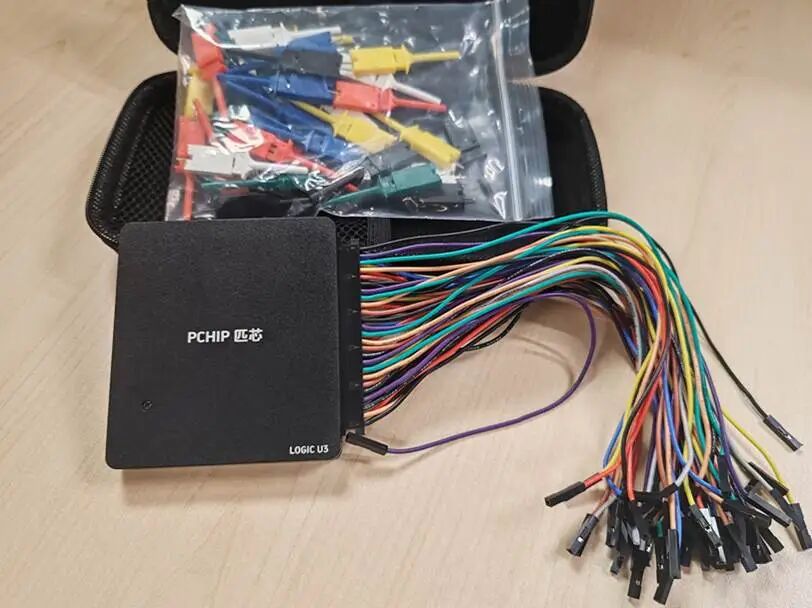 This logic analyzer focuses on high-speed acquisition, with the following performance specifications:• Maximum 32-channel logic analyzer• In buffer mode, supports up to 8 channels at 1G, total bandwidth 8G, storage depth 4Gbits• Under USB3.0 stream mode, supports up to 2 channels at 1G, total bandwidth 2G, storage depth 1024Gbits• Sampling via USB3.0 for transmission, compatible with USB2.0• Input sampling threshold adjustable from 0-6V• Open-source decoding protocol library with over 200 protocols, developed using Python, allowing for custom developmentThe core hardware components use domestic devices:USB3.0 PHY uses the WCH569W from Nanjing Qinheng MicroelectronicsFPGA uses the domestic FPGA PGL22G from UnisocThe buffer mode means that it has built-in buffering, allowing the collected signals to be directly transmitted and stored internally; the amount of data stored depends on the current sampling quantity and the size of the onboard memory; stream mode means that the currently sampled data can be sent to the computer at any time, theoretically allowing continuous sampling as long as your computer’s performance is sufficient.I acquired the mid-range 16-channel model priced at 599:
| Model | PX Logic 32 | PX Logic 16 Pro | PX Logic 16 Plus | PX Logic 16 Base | |
| Description | 32channels1Gsampling4Gstorage | 16channels1Gsampling4Gstorage | 16channels500Msampling2Gstorage | 16channels250Msampling1Gstorage | |
| Base Price | 999 | 599 | Not available at this stage | 399 | |
| USBInterface | USB3.0 (Type-C supports reversible insertion) supportsUSB3:5G gen1 and USB2.0: 480mbps | ||||
| Number of Channels | 32 | 16 | 16 | 16 | |
| Maximum Sampling Rate | Buffer | 1GHz (8ch) | 1GHz (8ch) | 500MHz (16ch) | 250MHz (16ch) |
| Stream | 1GHz (2ch) | 1GHz (2ch) | 500MHz (4ch) | 250MHz (8ch) | |
| Maximum Storage Depth | Buffer | 4G (bit) | 4G (bit) | 2G (bit) | 1G (bit) |
| Stream | Maximum 1024G(bit) depends on computer memory | ||||
| Minimum Capture Pulse Width | 2ns | 2ns | 4ns | 8ns | |
| Data Buffering Mode | Buffer (higher capture rate)/Stream (longer storage depth)/Roll rolling mode (real-time monitoring) | ||||
| Sampling Accuracy | One sampling cycle | ||||
| Trigger Type | Internal Trigger | Rising Edge/High Level/Falling Edge/Low Level/Any Edge up to 32 channels can be set to trigger simultaneously | |||
| External Trigger | Rising Edge/High Level/Falling Edge/Low Level/Any Edge dedicated hardware IO trigger input for external device synchronization | ||||
| Trigger Output | Trigger signal output to IO for external device synchronization | ||||
| Protocol Support | 200+ protocols (open protocol decoding library, customizable for any protocol) | ||||
| Input Voltage Tolerance | -40V to + 40V | ||||
| Input Impedance | 200K/1pf | ||||
| Threshold Range | 0~6V (0.1V step) | ||||
| Waveform Output | 1 channel PWM | ||||
| Channel Interface | 2.54mm Dupont wire interface (50Pin gold-plated connector) | ||||
| Power Supply Voltage | 5V/USB power supply | ||||
| Power Supply Current | 300mA (@5V) | ||||
| Power Supply Power | 1.5W | ||||
| Dimensions | Length x Width x Height:80*74*13.5 (mm) | ||||
| Operating Temperature | 0~85 degrees Celsius |
Just had a compatibility issue, used this to capture the SPD waveform: This product is very useful for analyzing motherboard timing, and I will further research and attempt to write decoding functions to support more buses.