 C-Reactive Protein (CRP) is an acute-phase protein synthesized by hepatocytes, with very low expression levels in healthy human serum. Its expression significantly increases during trauma, infection, etc., mainly regulated by inflammatory factors such as tumor necrosis factor and interleukins. It is synthesized by the liver and is a non-specific acute-phase response protein. The expression of CRP is sensitive after human infection but lacks specificity.What situations can CRP reflect?1. Assessing Disease Activity and Monitoring Treatment Efficacy
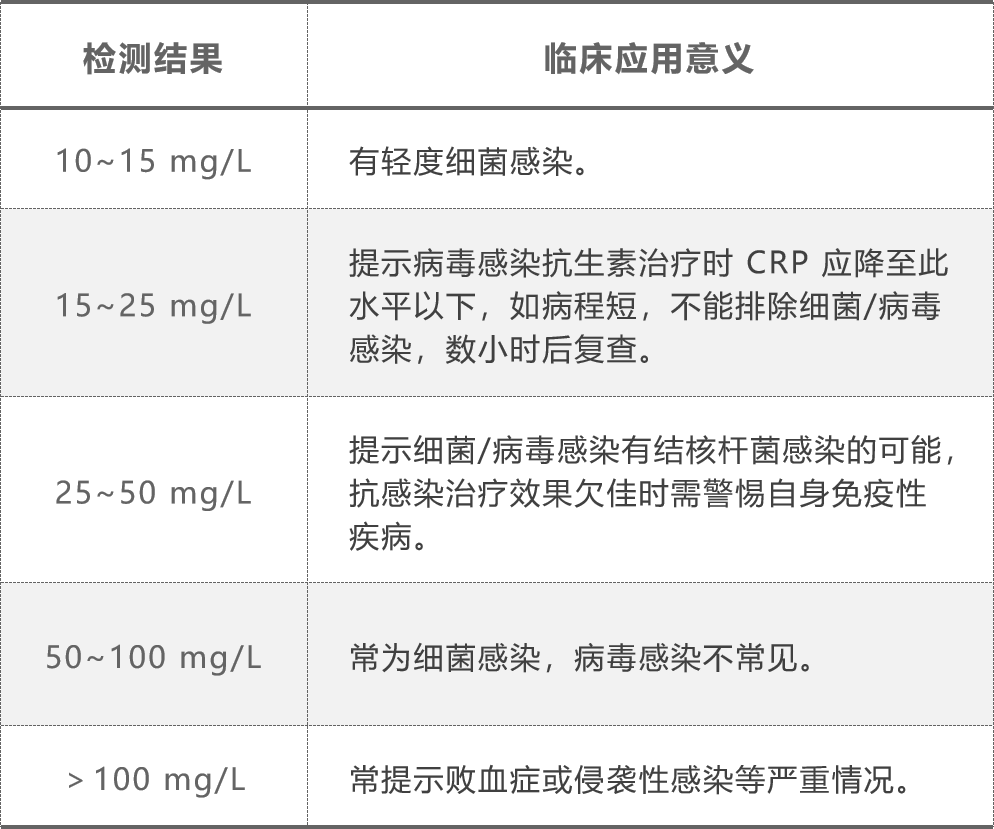 2. Postoperative Monitoring in Adults❶ All types of surgeries can cause an inflammatory response, and CRP levels are positively correlated with the degree of tissue damage;❷ In cases without complications post-surgery, CRP reaches 10 mg/L within 6 hours and rarely exceeds 150 mg/L at the peak 48 hours later, decreasing to baseline within 7 to 10 days. If postoperative complications arise, such as infection, tissue necrosis, or hematoma, CRP will remain elevated or lead to secondary elevation after 48 hours;3. Colorectal Cancer❶ Colorectal cancer is the third most common malignant tumor worldwide and ranks fourth in cancer-related mortality [1]. CRP can serve as an independent indicator for the prognosis of colon cancer [2];❷ Elevated CRP levels create a tumor microenvironment conducive to continuous growth, invasion, and metastasis of tumors [3];❸ Patients at risk of infection (over 10% are patients with partial colectomy) should monitor CRP daily to assess the occurrence of infection.4. Septicemia❶ During septicemia, coagulation imbalance leads to the consumption of endogenous anticoagulants, with suppressed fibrinolytic activity forming microcirculatory thrombi, resulting in tissue hypoxia and organ dysfunction. Septicemia is not only an inflammatory disease but also a type of coagulopathy;❷ Although CRP is not a specific indicator of septicemia, it can better reflect the degree of improvement during clinical antibiotic treatment;❸ Serum CRP is an important infection indicator in late septicemia, with a decrease in CRP levels negatively correlated with clinical symptoms.5. Myocardial Infarction and Stroke❶ Recent studies have found that inflammation plays an important role in the occurrence and development of atherosclerosis, and CRP has been widely used in various cardiovascular events; [4]❷ After acute myocardial infarction, myocardial tissue is damaged, and after a stroke, brain tissue is instantaneously damaged, leading to elevated CRP levels due to the large amount of inflammatory factors produced in the body post-onset, causing various proteases to hydrolyze, thus leading to vascular instability; plasma CRP levels can reflect changes in the patient’s condition, and the more severe the patient’s condition, the higher the CRP level;❸ In terms of atherosclerosis, the body’s immune system is activated due to damage to the arterial intima, causing an immune response that leads to the accumulation of white blood cells at the injury site,and during any disease-induced damage, the CRP content will significantly increase due to the inflammatory response.6. Metabolic SyndromeMetabolic syndrome can be categorized based on CRP levels as follows:(1) Low-risk group, 1 mg/L;(2) Moderate-risk group, 1 to 3 mg/L;(3) High-risk group, 3 mg/L.7. Premature Rupture of Membranes and Intrauterine Infection❶ Premature rupture of membranes is a condition where the fetal membranes rupture before labor, which can occur during pregnancy or labor. Various factors can cause premature rupture of membranes, such as infection of the reproductive tract by pathogenic microorganisms, leading to ascending infections;❷ Studies show that CRP levels in the blood of pregnant women with intrauterine infections before, during, and after delivery are significantly higher than those in the control group [5];❸ Currently, it is believed that amniotic fluid CRP originates from the fetus [6]:1) When subjected to inflammatory attacks, the fetal liver has the ability to produce acute-phase proteins;2) CRP is a large molecular weight protein and cannot cross the placental barrier;3) The concentration of CRP in amniotic fluid is unrelated to the concentration of CRP in maternal serum. If inflammation occurs in the amniotic cavity early in pregnancy, the fetus can also initiate a subclinical inflammatory response and produce CRP, which has predictive value for intrauterine inflammation and preterm birth.8. Meningitis❶ Bacterial meningitis: CRP levels significantly increase, and the extent of CRP elevation is positively correlated with the state of infection in the body;❷ CRP can enhance the ability of white blood cells to eliminate pathogens like Neisseria meningitidis and other pathogens, thereby boosting the immune cells in the body;❸ Serum CRP is a good biomarker for distinguishing between bacterial and viral meningitis. In bacterial meningitis patients, ferritin levels in serum increase, indicating a strong systemic inflammatory response, which aligns with related research reports [7];❹ Tuberculous meningitis: CRP levels between 20 to 60 mg/L, successful treatment can reduce CRP to normal levels within a week; ❺ CRP > 20 mg/L suggests a possibility of bacterial infection, and values > 100 mg/L have diagnostic value for bacterial infections.9. Systemic Lupus Erythematosus❶ Systemic lupus erythematosus (SLE) is a complex autoimmune disease, and the treatment approaches for SLE patients vary based on different activity levels and immune function states;❷ CRP serves as an inflammatory indicator for SLE, as CRP can precipitate with C polysaccharides on the cell wall of Streptococcus pneumoniae, and in multiple disease studies, it is considered to reflect the systemic immune and inflammatory status;❸ In SLE patients, autoantibodies can cause neutrophils to release specific complexes, increasing the levels of related inflammatory cells in the body, thus leading the immune system to produce circulating immune complexes, resulting in inflammation and a significant increase in CRP levels [8];In summary: CRP is a non-specific marker of acute-phase systemic inflammatory response, and its serum levels are closely related to various infections, tissue damage, and immune responses. Monitoring the dynamic changes of CRP in clinical work has practical significance for disease outcomes.First published: DXY Lab TimeSubmission address: [email protected]Scientific reviewDeputy Chief Physician Li ZigangSecond Affiliated Hospital of Bengbu Medical College, Department of Respiratory and Critical Care Medicine
 References[1] Torre LA, Bray F, Siegel RL, et al. Global cancer statistics, 2012. CA Cancer J Clin 2015; 65: 87-108 [PMID: 25651787 DOI: 10.3322/caac.21262][2] KØSTNER AH, KERSTEN C, LÖWENMARKT, et al. The prognostic role of systemic inflammation in patients undergoing resection of colorectal liver metastases: C-reactive protein (CRP) is a strong negative prognostic biomarker [J]. J Surg Oncol, 2016, 114(7): 895-899.[3] WONG VK, MALIK H Z, HAMADYZZ, et al. C-reactive protein as a predictor of prognosis Following curative resection for colorectal liver metastases [J]. Br J Cancer, 2007, 96(2): 222-225.[4] Zhu Qiling, Lin Zengwen. High-sensitivity CRP – An independent risk factor for cardiovascular diseases. Foreign Medical Clinical Biochemistry and Laboratory Medicine, 2004, 25: 7274[5] Bartkeviciene D, Pilypiene I, Ramasauskaite D, et al. Significance of C-reactive protein in predicting fetal inflammatory response syndrome [J]. Ginekol Pol, 2015, 86(12): 926-931[6] Ghezzi F, Franchi M, Raio L, et al. Elevated amniotic fluid C-reactive protein at the time of genetic amniocentesis is a marker for preterm delivery [J]. Am J Obstet Gynecol, 2002, 186(2): 268-273.[8] Zhang Zongwei, Chen Cheng, Wang Huiming, et al. Study on the correlation between serum β2-microglobulin levels and disease activity and renal damage degree in systemic lupus erythematosus [J]. Chinese Journal of General Practice, 2019, 22(17): 2058-2063[7] Liu Dajun, Xia Yan, Zhang Dan, et al. The significance of serum ferritin and serum iron detection in pediatric intracranial infections [J]. Chinese Medical Guide, 2015, 17(8): 845-846.