
👆Click the image to learn for free👆
What is the Insulin and C-Peptide Release Test?
The insulin and C-peptide release test is a quantitative oral glucose (or steamed bun meal) test that raises blood sugar levels, stimulating the insulin β-cells to release insulin and C-peptide. By measuring the plasma insulin and C-peptide levels and their changes at various time points after fasting and glucose ingestion, we can understand the secretion and reserve function of the β-cells, which helps in determining the clinical classification of diabetes and evaluating the therapeutic effects of insulin treatment.
Additionally, the measurement of C-peptide is not affected by exogenous insulin, making the changes in C-peptide more reflective of the function of β-cells in patients receiving insulin therapy.
Insulin and C-Peptide Release Test Procedure
After fasting for 8 to 10 hours without any food intake, blood is drawn to test fasting insulin and C-peptide levels. Then, 75 g of anhydrous glucose is dissolved in 250 to 300 ml of water and consumed within 5 minutes (or 100 g of steamed bun made from standard flour is eaten), which raises blood sugar levels and stimulates the β-cells to release insulin and C-peptide. Timing starts from the first sip of glucose or bun, and plasma insulin and C-peptide levels are measured at 30 min, 60 min, 90 min, 120 min, and 180 min.
Considerations for Insulin and C-Peptide Release Test
-
Discontinue medications that may affect glucose metabolism
Discontinue medications that may affect glucose metabolism, such as glucocorticoids, contraceptives, thiazide diuretics, sulfonamides, and propranolol, 3 to 7 days prior to the test.
-
Control carbohydrate intake
From 3 days prior to the test, the subject’s daily carbohydrate intake should be no less than 150 g but controlled between 250 and 300 g to meet normal activity needs.
-
Fasting blood glucose < 10 mmol/L
Generally, it is required that the subject’s fasting fingertip blood glucose be < 10 mmol/L. Due to the toxic effects of high blood sugar, insulin and C-peptide secretion is suppressed, affecting the authenticity of the test results. Additionally, high blood sugar levels may further increase blood sugar after oral glucose intake, posing a risk of diabetic ketoacidosis.
-
Others
During the test, the subject should not drink tea or coffee, smoke, engage in strenuous exercise, maintain a calm mood, and avoid mental stimulation.
Interpretation of Insulin Release Test Results
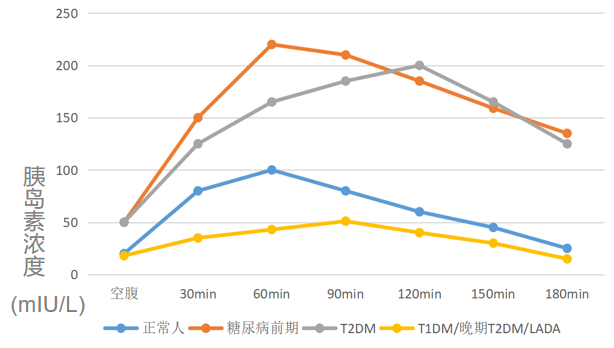
Insulin release curve
Normal Individuals
The fasting baseline plasma insulin level is 5 to 20 mIU/L, reaching a peak (5 to 10 times the baseline) 30 to 60 minutes after oral glucose intake, and returning to baseline levels after 180 minutes.
Prediabetic Patients
Fasting insulin levels are higher than those of normal individuals, significantly increasing after oral glucose intake, and remaining elevated after 180 minutes, indicating that the insulin secretion curve is consistently above normal levels. Furthermore, the glucose tolerance test indicates impaired glucose regulation (IFG, IGT, or both), which is characteristic of prediabetes.
Treatment Recommendations: Lifestyle intervention, dietary and exercise guidance, and active weight loss should be prioritized, with insulin sensitizers added if necessary.
T2DM Patients
Fasting insulin levels are normal or above the normal range, with a delayed peak after oral glucose intake, possibly reaching a peak at 120 minutes, indicating a delay in insulin secretion peak, which does not return to normal levels after 180 minutes.
Treatment Recommendations: Combined lifestyle management and oral hypoglycemic drug treatment. As the disease progresses, the function of β-cells gradually declines, ultimately relying on insulin therapy.
T1DM/Late-stage T2DM/LADA Patients
The insulin secretion curve is low and relatively flat, with a gentle rise after glucose ingestion, almost forming a straight line with no peak, indicating typical diabetic patients.
Treatment Recommendations: Insulin therapy should be the main treatment.
Interpretation of C-Peptide Release Test Results
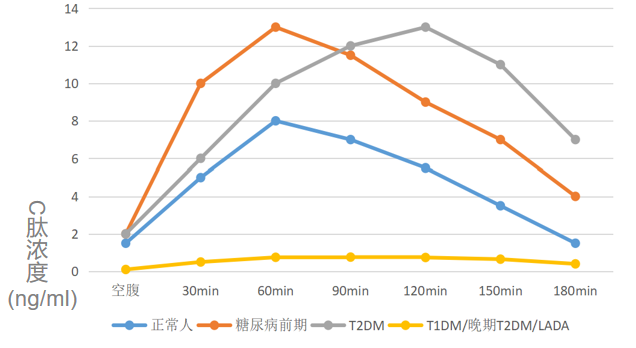
C-peptide release curve
Normal Individuals
The fasting C-peptide level is 1.1 to 4.4 ng/ml, peaking 30 to 60 minutes after oral glucose intake (5 to 6 times the baseline), and returning to baseline levels after 180 minutes.
Prediabetic Patients
Fasting C-peptide levels are elevated, peaking at 30 to 60 minutes, with peak values exceeding 5 times the fasting level, but remaining high after 180 minutes without returning to fasting levels.
Treatment Recommendations: Lifestyle intervention, dietary and exercise guidance, and active weight loss should be prioritized, with insulin sensitizers added if necessary.
Typical T2DM Patients
Fasting C-peptide levels may be normal, slightly elevated, or slightly low, with a slow rise in the release curve after glucose intake, delayed peak, and the release curve not returning to fasting levels after 180 minutes.
Treatment Recommendations: Combined lifestyle management and oral hypoglycemic drug treatment. As the disease progresses, the function of β-cells gradually declines, ultimately relying on insulin therapy.
T1DM/Late-stage T2DM/LADA Patients
Fasting C-peptide levels are low, with a gentle rise after oral glucose intake, almost forming a straight line with no peak characteristics.
Treatment Recommendations: Insulin therapy should be the main treatment.
Clinical Significance of C-Peptide Testing
-
Can reflect the secretion function of β-cells, especially in patients receiving insulin therapy;
-
Guides the classification of diabetes and the differentiation of hypoglycemia;
-
Can monitor the efficacy after pancreatic surgery, serving as a quantitative indicator of residual β-cell secretion function;
-
Used to understand the secretion function of transplanted β-cells;
-
Assesses liver and kidney function;
-
Determines the efficacy of insulinoma surgery.
 ExercisesPractice
(Answers can be found at the end of the article)
1. The most valuable test for classifying diabetes is ()
A Fasting blood glucose + insulin
B Postprandial blood glucose + insulin
C 75 g Oral glucose tolerance test + insulin or C-peptide release test
D Glycated hemoglobin
E Postprandial blood glucose + C-peptide release test
2. The significance of C-peptide measurement includes ()
A Assessing fasting hypoglycemia
B Evaluating the patient’s insulin secretion status
C Differentiating types of diabetes
D Monitoring the effects after pancreatic surgery
E Diagnosing complications of diabetes
Source: China Medical Forum “Diabetes Diagnosis and Treatment Practical Tips”
Click here to view more featured articlesExpert Profile

Professor Liu Jianping
Deputy Director of the Endocrinology Department, Second Affiliated Hospital of Nanchang University, Chief Physician
Postdoctoral Fellow at Harvard Medical School, PhD, Doctoral Supervisor
Jiangxi Province’s Top Talent Program
Selected for Jiangxi Province’s 5511 Talent Project
Third Prize of the PLA Medical Achievements Award
Second Prize of Jiangxi Province Medical Science and Technology Award and Third Prize of Jiangxi Province Natural Science Award
Three projects funded by the National Natural Science Foundation
Six projects funded by the Science and Technology Department’s Natural Fund and Key Topics
Chairman of the Diabetes Branch of Jiangxi Medical Association
Chairman of the Diabetes Branch of Jiangxi Research Hospital Association
Standing Committee Member of the Diabetes Branch of the Chinese Research Hospital Association
Member of the Osteoporosis Branch of the Chinese Geriatric Health Research Association
Committee Member of the Biological Therapy Committee of the Chinese Research Hospital Association
Member of the Neuropathy Complications Group and Grassroots Group of the Chinese Diabetes Society
Standing Committee Member of the Endocrinology and Diabetes Branch of Jiangxi Integrated Medicine Association
Member of the Endocrinology Branch of Jiangxi Province
Reviewer for the “Chinese Journal of Diabetes” and “International Journal of Endocrinology and Metabolism”
Published 25 SCI papers and over 41 papers in core and national journals
☟Selected Content Recommendations
Historical articles
Fasting blood glucose consistently high? 8 common factors help you quickly identify the cause
Is it better to inject basal insulin before bed or in the morning? The latest guidelines provide 8 recommendations
Do you start dieting as soon as you gain weight? For some obesity, identifying the cause is more important | World Obesity Day

Exercise Answers: C; ABCD