(Report Author: Open Source Securities, Ren Lang, Zhao Xu Yang)
1. Best Aid for Visual Perception – 4D Imaging Millimeter-Wave Radar
1.1. Perception is the Primary Step in Autonomous Driving, and High-Performance Sensors are Essential
The perception phase is responsible for detecting, identifying, and tracking targets, marking the first step in achieving autonomous driving. To realize autonomous driving, it is crucial to accurately understand driving environment information, effectively capturing information on traffic subjects, traffic signals, and environmental objects. Based on real-time perceived environmental information, the autonomous driving system can complete subsequent decision-making, planning, and control phases. The performance of sensors directly affects the quality of perception information. Currently, widely used sensors include cameras, LiDAR, millimeter-wave radar, and ultrasonic radar.
Tesla’s visual perception solution has ushered the autonomous driving industry into a new chapter. In 2021, Tesla utilized the Transformer algorithm to construct the BEV (Bird’s Eye View) space, addressing the deep detection challenges of traditional visual perception, allowing for relatively accurate distance estimation through vision. Additionally, the Transformer algorithm is more compatible with the fusion of multiple sensors and offers greater scalability. In 2022, Tesla used the BEV+Transformer and occupancy network to enhance the perception capabilities for general obstacles. Tesla’s FSD function, relying on cameras for perception, has already achieved near-complete coverage of driving scenarios, with cumulative mileage exhibiting exponential growth.
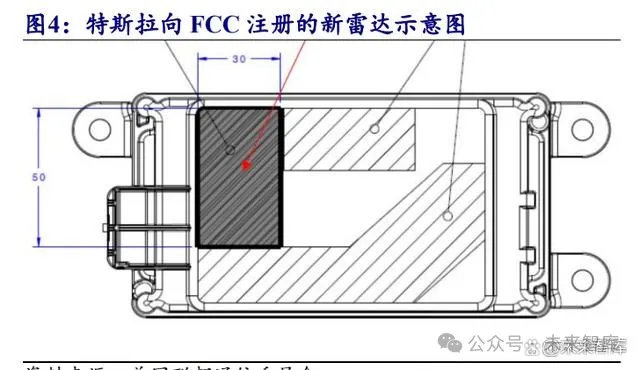
Tesla has reintroduced millimeter-wave radar to assist cameras in enhancing perception capabilities. In 2021, Tesla abandoned millimeter-wave radar to focus resources on improving visual perception capabilities. In February 2022, Musk stated that only radar with very high resolution is meaningful, attributing the cancellation of millimeter-wave radar to “insufficient resolution”; in June of the same year, Tesla registered a new high-resolution radar device with the U.S. Federal Communications Commission (FCC). According to the automobile heart public account, in February 2023, foreign blogger Greentheonly exposed that Tesla’s new computing platform HW4.0 reserved an interface for millimeter-wave radar; in June of the same year, the blogger released physical images of Tesla’s new millimeter-wave radar. It can be inferred that the new millimeter-wave radar that Tesla is set to equip will be a high-resolution 4D imaging millimeter-wave radar. The 4D imaging millimeter-wave radar possesses many excellent characteristics, which can better assist visual perception solutions.
1.2. Millimeter-Wave Radar Has “All-Weather Properties” but Suffers from Insufficient Resolution
Millimeter-wave radar perceives obstacles through modulation, transmission, and signal processing. Millimeter waves are electromagnetic waves with a frequency range of 30-300GHz, classified as “extremely high frequency,” and have strong resistance to environmental noise interference; the wavelength of millimeter waves ranges from 1 to 10 millimeters, which is longer than the wavelengths of laser beams typically ranging from hundreds to thousands of nanometers, allowing for longer transmission distances, stronger diffraction capabilities, and better penetration. Radar operating in the millimeter-wave band is referred to as millimeter-wave radar and is widely used in the field of autonomous driving.
Millimeter-wave radar mainly consists of a radar front-end transceiver module, a digital signal processing unit, and an interface module. The radar front-end transceiver module modulates, transmits, and receives millimeter-wave signals, including antenna arrays, RF front-end, intermediate frequency circuits, and analog-to-digital converters; the digital signal processing unit processes signals and data, including DSP (Digital Signal Processor), MCU (Microcontroller Unit), or FPGA (Field Programmable Gate Array); the interface module is responsible for data communication and integration with other systems. Millimeter-wave semiconductor technology is already mature and widely applied in autonomous vehicles.
Signal transmission and signal processing are the key aspects of millimeter-wave radar operation. (1) First, the RF transmitter generates and transmits electromagnetic wave signals, which reach the target object; (2) the object reflects or scatters the signal, forming an echo signal that the receiver collects; (3) the mixer combines the echo signal with the original signal, filtering it through a filter to obtain an intermediate frequency signal (which is actually the frequency difference between the radar transmission signal and the echo signal, containing information about the object’s position, speed, etc.); (4) the intermediate frequency signal is input to the processing backend for modulation, demodulation, FFT (Fast Fourier Transform), etc., to extract target information and analyze it, achieving target detection, distance measurement, speed measurement, and azimuth estimation; (5) finally, the results are output for subsequent perception processing.
Millimeter-wave radar typically modulates FMCW (Frequency Modulated Continuous Wave) waveforms, allowing for simultaneous speed and distance measurements. The Doppler effect refers to the change in wavelength emitted by an object due to relative motion. For example, the sound of a train whistle becomes sharper as it approaches us because the wavelength of the sound waves we receive shortens, increasing the frequency, which can be used for speed measurement. Millimeter-wave radar is usually FMCW radar, where FMCW is continuous frequency modulation, with frequency increasing and decreasing linearly. Based on this characteristic, the radar can effectively separate time and distance information from the changes in the FMCW echo signal, accurately calculating the relative speed and distance of obstacles.
Millimeter-wave radar can also measure azimuth and identify multiple objects, making it suitable for vehicle applications. By increasing the number of separate antennas, millimeter-wave radar can obtain azimuth information based on the phase differences between echo signal arrays; by processing multiple echo signals to obtain different intermediate frequency signals, millimeter-wave radar can also effectively distinguish multiple objects. Millimeter-wave radar can measure distance, speed, direction, and distinguish multiple objects, and the technologies for modulation and processing of FMCW waveforms are relatively mature, with low power consumption and cost, making millimeter-wave radar suitable for vehicle applications.
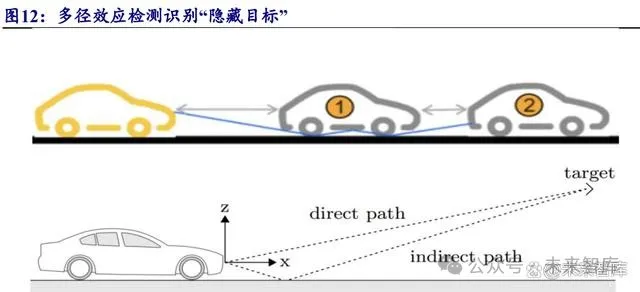
Millimeter-wave radar has various excellent characteristics that are indispensable for intelligent driving. (1) “All-weather”: Compared to light waves with nanometer-level wavelengths, millimeter waves have longer wavelengths, easily penetrating obstacles smaller than their wavelength. Generally, the average diameter of raindrops and snowflakes is below 5mm, so millimeter-wave radar operates with minimal impact from rain, snow, fog, and other weather, exhibiting “all-weather” characteristics; (2) Speed information: Based on the Doppler effect of millimeter waves, millimeter-wave radar can obtain high-precision speed information, which is crucial for autonomous driving perception; (3) Identifying occluded objects: Millimeter-wave signals exhibit multipath effects, and signals can be detected through reflection, diffuse reflection, diffraction, and other methods, allowing detection of occluded objects in some scenarios. Continental Group has mentioned that based on its ARS430 millimeter-wave radar, this type of occluded vehicle can be detected in about 40% of scenarios. Of course, the performance in detecting occluded objects also depends on conditions such as road surface conditions, the position of the vehicle in front, and the position of the occluded vehicle. Algorithms are particularly important for detection in such scenarios, as emphasized by Huawei at the launch of its 4D millimeter-wave radar.
Cameras and millimeter-wave radar can form a complementary advantage in perception systems. Cameras are passive perception sensors, characterized by low cost, easy integration, and rich semantic information. Additionally, cameras are one of the highest bandwidth vehicle sensors, capable of providing high-resolution images and real-time visual information. However, cameras are easily affected by adverse weather conditions and glare, lacking precise object depth and speed information. Millimeter-wave radar can effectively supplement the deficiencies of cameras, and the fusion of the two types of sensors can achieve better performance in autonomous driving perception at a lower cost.
Traditional millimeter-wave radar cannot measure height, limiting its role in autonomous driving. Traditional millimeter-wave radar can only detect distance, angle, and speed information. Due to the lack of elevation information, objects like height-limiting rods and overpasses can easily trigger obstacle feedback from millimeter-wave radar. Therefore, in practice, it can only retain dynamic target tracking results or reduce the weight of millimeter-wave radar perception, resulting in the radar being unable to recognize stationary objects during daily use. For instance, a Tesla’s driver assistance system failed to recognize a stationary white truck, leading to a collision, because the camera could not distinguish between the white truck’s body and the sky, while the millimeter-wave radar failed to accurately identify the overturned stationary truck. To address this issue, millimeter-wave radar needs to enhance its capability to perceive pitch angles.
1.3. 4D Millimeter-Wave Radar Adds Height Dimension Information, Forming Precise Perception Capabilities
4D millimeter-wave radar adds pitch angle information, enabling the identification of object heights. As mentioned above, millimeter-wave radar cannot discern height dimension information, which lowers the confidence level for recognizing stationary objects in use. Without other reliable sensors, this may lead to false braking or missed braking, resulting in poor driving experiences and even threats to driving safety. However, by increasing the arrangement of antennas in the pitch direction, millimeter-wave radar can measure height information, overcoming the aforementioned adverse situations, leading to the emergence of 4D millimeter-wave radar. The “4D” in 4D millimeter-wave radar refers to distance, azimuth, speed, and height. 4D millimeter-wave radar not only inherits the advantages of millimeter-wave radar, including effective “all-weather” operation and the ability to perceive occluded objects, but also further improves in resolution and accuracy, allowing for the identification of smaller objects, stationary objects, and aerial obstacles. As an upgrade to millimeter-wave radar, 4D millimeter-wave radar exhibits superior performance and demonstrates stronger adaptability to complex road conditions.
4D imaging millimeter-wave radar further enhances clarity, capable of outputting three-dimensional point cloud images. By improving recognition algorithms and increasing radar aperture, 4D millimeter-wave radar can output relatively dense three-dimensional point clouds, outlining the shapes of objects for identification, possessing high-definition characteristics. The angle between two adjacent point clouds represents the angular resolution, with smaller angular resolution indicating higher radar clarity; the angular resolution of 4D imaging millimeter-wave radar can reach as high as within 1°, meaning that at a distance of 200m, the radar can distinguish two objects that are approximately 3.5 meters apart or more, with clearer recognition of nearby objects. Since 4D imaging millimeter-wave radar generates three-dimensional point clouds, it is often compared to LiDAR rather than traditional millimeter-wave radar.
Millimeter-wave radar has demonstrated cost-effectiveness over years of development, with point cloud performance comparable to low-line count LiDAR. LiDAR exhibits excellent performance, widely used in the 905nm and 1550nm bands, capable of emitting numerous laser beams for road condition scanning and forming high-resolution point cloud images, while also providing preliminary judgments on road conditions and outputting information on target distance, azimuth, height, speed, and shape. However, due to the short wavelengths of LiDAR, its penetration is weak, and detection distances are limited under the same power, making it susceptible to adverse weather interference. The point cloud performance of 4D imaging millimeter-wave radar has reached a level comparable to that of low-line count LiDAR, exhibiting high sensitivity and high-resolution characteristics, while overall costs are lower. In vehicles equipped with LiDAR, 4D imaging millimeter-wave radar can function as a safety redundancy, enhancing the safety of autonomous driving. In vehicles without LiDAR, 4D imaging millimeter-wave radar can serve as a substitute sensor for LiDAR, enabling autonomous driving functions and facilitating the popularization of intelligent driving. Mobileye proposed at CES that by 2025, L4 level autonomous driving perception solutions will only be equipped with one forward-facing LiDAR, while six 4D millimeter-wave radars will replace two LiDARs on the sides to achieve L4 level perception functions, significantly reducing costs.
4D imaging millimeter-wave radar is an excellent auxiliary sensor for autonomous driving. Tesla constructs BEV space using the Transformer algorithm, effectively perceiving dynamic and static objects, while the occupancy network enhances its perception capabilities for general obstacles. Regarding 4D millimeter-wave radar, in terms of performance, compared to pure visual solutions that predict distance information rather than obtaining true values, the true distance information obtained by LiDAR and 4D millimeter-wave radar means higher safety assurance; the speed information detected by millimeter-wave radar is more accurate than that of LiDAR, aiding in the identification of object motion trajectories and directions. At the algorithmic level, various multi-sensor fusion perception algorithms, such as BEVFusion, have emerged, effectively assisting players in integrating 4D millimeter-wave radar information into perception systems. Therefore, 4D millimeter-wave radar is expected to become an important component of autonomous driving perception, facilitating the realization of product functionalities.
2. Multiple Solutions to Enhance Key Performance, 4D Millimeter-Wave Radar Continues to Evolve
2.1. Diverse Hardware and Software Technical Paths, Enhancing 4D Millimeter-Wave Radar Resolution
Resolution is a key indicator for 4D millimeter-wave radar. Currently, the industry promotes performance enhancement through both software and hardware routes. Under the condition of unchanged channel quantity (the number of transmitting antennas multiplied by the number of receiving antennas), increasing pitch angle measurement capability will reduce the detection capability for azimuth angles, while resolution is a critical factor affecting the performance of 4D millimeter-wave radar. To enhance the resolution of 4D millimeter-wave radar, it is necessary to increase the radar aperture (the size of antennas in the radar system or the layout of antenna arrays), which can be achieved through hardware improvement or algorithmic enhancement to provide more effective perception for autonomous driving. Currently, multiple technologies are used to enhance the resolution of 4D millimeter-wave radar, which can be broadly categorized into hardware solutions and software solutions. The former includes chip cascading, chip integration, and supermaterial-improved antennas, while the latter includes virtual aperture imaging and super-resolution algorithm enhancements.
2.1.1. Chip Cascading Solutions: Fast Implementation
Cascading millimeter-wave radar RF chip solutions can increase the number of antennas, thereby increasing the radar aperture. 4D millimeter-wave radar chips consist of RF chips and data processing chips, where RF chips, also known as MMIC (Monolithic Microwave Integrated Circuit), are responsible for modulating, transmitting, receiving millimeter-wave signals, and demodulating echo signals. By cascading MMICs, the number of radar transceiver antennas can be increased, and combined with MIMO (Multiple Input Multiple Output) systems to enhance communication capacity.
Cascading can increase the number of physical antennas, thereby enhancing the radar’s angular resolution. Cascading involves connecting multiple physical antennas to increase the number of antennas, thereby improving product performance. Cascading can be done in two-way, four-way, and eight-way configurations. For example, in a two-way cascade, two 3T4R (3 transmitting antennas + 4 receiving antennas) MMICs are connected to form a 6T8R radar transceiver. The cascading solution is based on millimeter-wave radar chips, with radar chip suppliers such as Texas Instruments (TI), NXP, and Infineon providing supporting technology and underlying software. MIMO antenna systems can increase the number of virtual channels, enlarging the radar’s aperture. The MIMO antenna system is an upgrade of SIMO (Single Input Multiple Output) technology (for instance, a 3T1R chip is SIMO, while a 3T4R chip is MIMO; the former can have a maximum of 3×1 channels, while the latter can form a maximum of 3×4 channels). By implementing multi-antenna system reception channel separation, virtual channels can be formed on a single chip without increasing the number of physical antennas, thereby achieving increased virtual aperture and improved angular resolution.
Cascading and MIMO antenna technologies can work together to provide higher resolution and positioning accuracy for radar systems, thereby improving imaging quality. Suppliers of millimeter-wave radar, such as Continental, ZF, and Bosch, adopt this method to manufacture high-resolution and high-performance 4D imaging millimeter-wave radar. Cascading solutions may lead to higher radar system power consumption, relatively larger sizes, and lower signal-to-noise ratios. However, cascading solutions have a lower initial development difficulty and a mature industrial chain, allowing for rapid product implementation. From the dismantling image of Tesla’s new millimeter-wave radar, it can be seen that Tesla uses a two-chip MMIC cascading solution to achieve improved resolution through increased antenna numbers and special antenna arrangements.
2.1.2. Chip Integration Solutions: High Integration, High Design Difficulty
Chip integration is also an important solution, gathering a large number of “new forces” in 4D millimeter-wave radar. The chip integration solutions for 4D imaging millimeter-wave radar have two directions: on one hand, more antennas can be integrated on the MMIC and then cascaded; on the other hand, MMIC can be integrated with antennas/radar processors and other devices to form dedicated imaging radar chips, such as those from companies like Vayyar and Uhnder, achieving higher integration levels. (1) Arbe: Typically, millimeter-wave radar signals are transmitted and received on a single MMIC. However, Arbe’s RF chip and receiving chip are separate. Arbe’s transmitting chip integrates 24 transmitting channels, while the receiving chip integrates 12 receiving channels. Its dedicated imaging radar processing chip supports a maximum of 2 transmitting chips and 4 receiving chips, forming a total of 48T48R ultra-large-scale virtual array, capable of improving radar performance while controlling radar size; (2) Vayyar: Vayyar’s self-developed MMIC integrates a digital signal processor DSP and MCU; (3) Uhnder: Uhnder’s 4D imaging radar on-chip (RoC) integrates processing units such as DSP, MCU, etc., forming a chip for millimeter-wave radar. Integration and chipization have become new trends in millimeter-wave radar development.
2.1.3. Supermaterial-Based Solutions: Enhancing Antenna Performance
Improving antennas through supermaterials and phased arrays can also enhance the clarity of millimeter-wave radar. Supermaterials are engineered materials created by mixing various materials, embedding microstructures on the surface of supermaterials, and combining electromagnetic wave propagation technology to create circuits that are much smaller than traditional circuits, enhancing antenna radiation power and performance while reducing size. Metawave’s early product WARLORD has explored using supermaterials, and the current electronically controlled phased array AiP (Antenna in Package) also applies supermaterials in beam control imaging radar SPEKTRA. EchoDyne applies supermaterials to ESA (Electronically Scanned Array) for beamforming and beam control, maintaining acceptable bandwidth while enhancing antenna power, resulting in clearer radar imaging. Antenna arrays constructed from supermaterials exhibit outstanding performance and reliability, and when combined with phased array technology, can significantly enhance angular resolution. However, this solution currently has high costs, and EchoDyne focuses solely on defense and security sectors, not involving automotive millimeter-wave radar business.
2.1.4. Software Algorithm-Based Solutions: Algorithm Empowerment Enhances Radar Performance
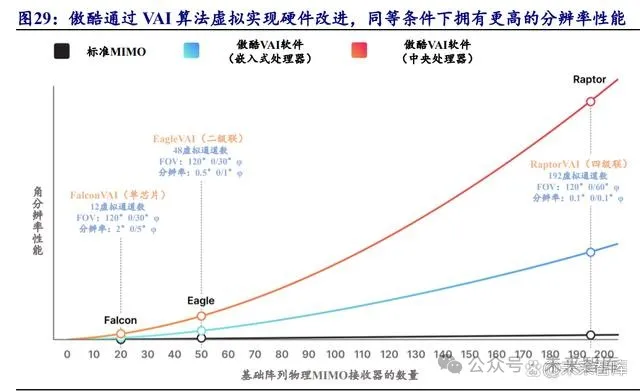
By virtually implementing hardware improvements or optimizing signal processing algorithms in the processing flow, radar resolution can be further enhanced. (1) Virtual hardware improvements: Oculii’s artificial intelligence virtual aperture imaging (VAI) algorithm can create high-multiplicity virtual MIMO based on existing mainstream automotive-grade standard chips through adaptive phase modulation and software simulation, virtually expanding the aperture of antennas, generating dozens of times the number of virtual antennas on the basis of the original physical antenna count. Moreover, it can adapt to different road conditions through machine learning and deep learning, greatly enhancing radar angular resolution. The more MIMO virtual channels, the stronger VAI’s performance. Based on the cascading of millimeter-wave radar and MIMO, a two-way cascade can achieve the effect of other companies’ six-way cascades. (2) Optimizing signal processing algorithms: For example, super-resolution algorithms replace traditional algorithms such as FFT (Fast Fourier Transform) in processing. Software algorithms assist self-developed or other manufacturers’ hardware, improving hardware performance while maintaining clear imaging for vehicle millimeter-wave radar, reducing power consumption and size. However, algorithm development has high technical barriers, and the level of software algorithm development is crucial, posing higher demands on information processing hardware and algorithms.
2.1.5. Numerous Implementation Solutions for 4D Imaging Millimeter-Wave Radar, Yet Technical Routes Remain Ununified
Hardware and algorithms are both crucial components for enhancing the overall performance of 4D imaging millimeter-wave radar. To improve the resolution of 4D imaging millimeter-wave radar, different radar manufacturers expand on microwave antenna technology, MIMO array design, signal processing hardware, and algorithms in one or several aspects. Multiple solutions drive the enhancement of 4D imaging millimeter-wave radar resolution, allowing 4D imaging millimeter-wave radar to play an increasingly important role in autonomous driving solutions.
4D imaging millimeter-wave radar is still in the early stages of its product lifecycle. On one hand, 4D imaging millimeter-wave radar has diverse technical implementation paths, providing a wide range of choices for OEMs and radar manufacturers, allowing them to focus on different characteristics when selecting radar to adapt to various vehicle types, indicating significant market potential. On the other hand, 4D imaging millimeter-wave radar is still in the early stages of its product lifecycle, with multiple technical routes yet to converge, increasing the time and cost of verification testing for OEMs, which may delay the time for 4D imaging millimeter-wave radar to be deployed in vehicles.
2.2. Gradual Breakthroughs in 4D Millimeter-Wave Radar Challenges, Rapid Iteration of Performance Enhancements and Cost Reduction
2.2.1. On the Hardware Level, Technological Iteration Leads the Industry in Cost Reduction and Efficiency Improvement, Promoting Higher Penetration Rates.
Looking back at the development history of millimeter-wave radar, advancements in semiconductor processes have led to product form iterations, resulting in a continuous increase in product penetration rates. The application of millimeter-wave radar in automobiles can be traced back to the early 1980s, when many exploratory studies had already begun. In 1999, the Mercedes-Benz S-Class was the first vehicle to feature adaptive cruise control based on millimeter-wave radar, officially marking the implementation of millimeter-wave radar in vehicles. However, at that time, radars were mainly based on gallium arsenide technology, requiring multiple RF chips in radar, and due to operating in the 24GHz frequency band, the radar antennas were large, making the overall product bulky and expensive, thus not widely promoted. Since 2000, the development of silicon-germanium (SiGe) technology has significantly improved the performance of millimeter-wave radar chips, with SiGe having low noise, large dynamic range, and mature processes, greatly reducing the cost of RF chips and rapidly promoting the penetration rate of millimeter-wave radar. In 2016, Texas Instruments launched a high-integration 77GHz millimeter-wave radar chip based on RFCMOS technology, integrating all RF components into a single MMIC chip, further reducing the cost of millimeter-wave radar compared to previous-generation SiGe products. Other chip manufacturers have followed suit, and nearly all new products from major manufacturers are now developed based on RFCMOS technology, further driving down costs in the millimeter-wave radar industry, making the widespread adoption of 4D millimeter-wave radar, which is relatively expensive, possible. The development of radio frequency semiconductor technology has led millimeter-wave radar to become increasingly “democratized,” laying the foundation for its widespread adoption.
2.2.2. Signal Processing and Data Processing Algorithms are Becoming Increasingly Rich and Mature, Continuously Improving Performance with Neural Network Support
4D imaging millimeter-wave radar algorithms can be divided into signal processing, data processing, and other algorithms. For 4D millimeter-wave radar, algorithms are typically divided into two parts. Signal processing algorithms mainly include converting microwave signals received by millimeter-wave radar into point clouds and other information, while data processing algorithms analyze point clouds or results from previous signal processing to derive object profiles, categories, and even posture behaviors. (1) Signal processing algorithms: As mentioned earlier, millimeter-wave signals are received through MMIC and mixed to synthesize intermediate frequency signals. Subsequently, multiple fast Fourier transforms (FFT) can resolve RAD (Range-Angle-Doppler) data blocks containing distance, angle, and speed information, which then undergo CFAR (Constant False-Alarm Rate) detection to filter out noise, clutter, and interference, generating sparse point clouds containing three types of information: distance, speed, and angle. (2) Data processing algorithms: Data processing algorithms include point cloud clustering, target tracking, target classification, and target recognition algorithms, achieving precise object identification and trajectory judgment. Currently, data processing algorithms for 4D imaging millimeter-wave radar often utilize point cloud processing algorithms from LiDAR. (3) Other algorithms: Some ADAS algorithms (such as ACC, AEB, etc.) and some extended functions (such as SLAM) are also included.
Algorithms are becoming increasingly rich, and the performance of millimeter-wave radar perception is further enhanced with the support of neural networks. Currently, the algorithms for millimeter-wave radar are maturing, with both signal processing and data processing algorithms continuously diversifying, and the algorithm architectures becoming increasingly mature. Additionally, advancements in neural networks have further improved the perception capabilities of millimeter-wave radar. For example, in signal processing algorithms, due to multipath effects of electromagnetic waves, in certain scenarios, electromagnetic waves may reflect and diffract multiple times, causing interference when arriving at the receiver, affecting point cloud quality. Traditionally, CFAR algorithms are used to process interference, but this algorithm may also filter out some useful information. Therefore, players are exploring the use of learning-based algorithms to process radar signals, resulting in more precise detection outcomes.
2.2.3. The Autonomous Driving Algorithm System is Maturing, and Millimeter-Wave Radar is Riding the Wave
For 4D millimeter-wave radar, perception functions are typically divided into two categories: (1) using only radar to directly generate perception results; (2) fusion methods that generate comprehensive perception results together with other sensors. Early automotive functions were primarily based on the first method, where early ACC (Adaptive Cruise Control), AEB (Automatic Emergency Braking), etc., only utilized millimeter-wave radar to recognize vehicles and pedestrians to achieve corresponding functions. Currently, as automotive intelligence and centralized electronic and electrical architectures advance, the logic of autonomous driving functions is gradually changing from a traditional state of separate functions to a unified perception, decision-making, and execution system, with urban NOA, highway NOA, and integrated parking functions gradually incorporating the most basic L1 and L2 assisted driving functions. At NIO’s Technology Innovation Day, the company mentioned adopting a unified algorithm architecture to support urban NOP, parking, active safety, and intelligent vehicle control applications. Huawei also mentioned that its ADS2.0 effectively enhances the overall active safety capabilities of the vehicle. Based on this, how a specific type of sensor can better fuse with other types of sensors becomes crucial for its widespread application. Fusion frameworks can be categorized into early fusion, mid-fusion, and late fusion. The core idea of fusion is “cross-verification,” which means using information from multiple sensors to cross-check, avoiding the inadequacies and failures of single sensors, allowing the driving system to make judgments closest to real conditions.
Early fusion has minimal information loss but requires high processing algorithms and computing power
Early fusion is suitable for centralized architectures, where sensors collect information and undergo direct fusion processing, outputting results after recognizing road conditions. As illustrated in Figure 31, 4D millimeter-wave radar, especially 4D imaging millimeter-wave radar, possesses rich pre-data, such as raw ADC data, distance-Doppler spectrograms, and 4D tensor graphs. During early fusion, it can output based on more raw data, retaining more information. In terms of computing power, performing early fusion operations on large data volumes requires more powerful processing chips, with data processing often located in the vehicle’s central domain controller; in terms of algorithms, early fusion processing may encounter joint calibration issues, where different sensors’ input information can produce different perception results for the same object, requiring high-precision spatiotemporal synchronization of information from different sensors and demanding high-precision algorithm processing.
Late fusion has good decoupling but may lose significant information during compression
Late fusion is suitable for distributed architectures, where different sensors independently perceive and complete recognition before fusing results to determine the best road conditions. In the late fusion process, sensors independently process information, meaning that even if individual sensors fail to obtain effective data or calibration is biased, it may not affect the operation of the driving system. During late fusion, a significant amount of compression is applied to the data from 4D millimeter-wave radar, and since the results are point cloud data, if contradictions arise between data from different sensors, improper confidence levels may lead to serious safety issues.
Mid-fusion may become the direction for fusing 4D imaging millimeter-wave radar with cameras
Mid-fusion is between the first two types of fusion, also known as feature-level fusion, where sensors perform some processing first and then fuse outside the sensors. Mid-fusion primarily relies on learning methods. Different sensors collect data and decompose targets into features for extraction, which are then fused into feature vectors. The advantage is that target information can be more easily associated. Target-level fusion has gradually evolved into feature-level fusion, with algorithm maturity reducing fusion difficulty. In the traditional automotive market, many sensors primarily adopt target-level fusion, resulting in complex algorithms and lower accuracy. In recent years, under Tesla’s leadership, algorithms such as BEV+Transformer and occupancy networks have gained widespread acceptance in the industry. Driven by this algorithm paradigm, multi-sensor fusion is transitioning to a predominantly feature-level fusion approach. Millimeter-wave radar, with its all-weather capabilities and precise speed information, has become an important component among various sensors. Although players find it easier to fuse LiDAR and visual information, whether utilizing algorithms for processing LiDAR point clouds or developing new data processing algorithms for millimeter-wave radar, both academia and industry have focused significant attention on emerging solutions, with fusion methods maturing and accelerating the penetration of millimeter-wave radar.
3. The 4D Imaging Millimeter-Wave Radar Industry Chain is Gradually Maturing, and Players are Welcoming Development Opportunities
4D imaging millimeter-wave radar provides new market opportunities, and the market landscape is yet to be defined. 4D imaging millimeter-wave radar belongs to automotive components, with a relatively mature market. The industry chain manufacturers can be divided into upstream radar component suppliers and midstream radar manufacturers: the core technology of 4D imaging millimeter-wave radar resides in the upstream, where radar component suppliers provide various solutions; midstream radar manufacturers manufacture 4D imaging millimeter-wave radar based on downstream demand; and downstream are the vehicle manufacturers that use 4D imaging millimeter-wave radar, achieving the optimal combination of cost control and perception capabilities by selecting sensors.
3.1. Upstream: High Technical Barriers for Radar Chip Groups, Deep Integration of Software and Hardware
There are many products in the upstream of 4D imaging millimeter-wave radar. The upstream of 4D imaging millimeter-wave radar mainly includes MMIC (Monolithic Microwave Integrated Circuit), digital signal processing chips, high-frequency PCBs, mechanical structural components, and some radar processing algorithms. The early production and research and development costs of radar chip groups are high, with traditional giants and startups both laying out their strategies, and domestic players also entering the market. There are many domestic and foreign manufacturers of high-frequency PCBs, with fierce competition and significant opportunities for domestic replacements. Radar processing algorithms are mainly supplied by chip manufacturers or jointly developed with midstream manufacturers, with some specialized algorithm design manufacturers also involved.
3.1.1. MMIC: The Core Link Driving Millimeter-Wave Radar Development, High Market Concentration
The technological development of millimeter-wave chips is the core factor driving the millimeter-wave radar industry. Every major product change in millimeter-wave radar is based on the technological transformation of millimeter-wave RF chips. The technological evolution of RF chips is profoundly influenced by the development of the RF semiconductor industry, with past and current giants such as IBM, Freescale, Texas Instruments, NXP experiencing cycles of prosperity and decline influenced by global mobile, automotive, and communication industry cycles and technological advancements.
Millimeter-wave radar’s transition to 4D imaging is inseparable from the development of MMIC technology. As the core component of 4D imaging millimeter-wave radar, MMIC manufacturing is complex, requiring high standards in manufacturing processes, signal transmission and reception technologies, and anti-interference technologies. (1) Manufacturing processes: RF transceiver chips, or MMICs, have transitioned from compound semiconductor processes such as gallium arsenide (GaAs) or silicon-germanium (SiGe) to CMOS processes. Under CMOS processes, more components are increasingly integrated into a single MMIC, reducing size while improving performance. NXP has already released a 28nm CMOS millimeter-wave radar chip, significantly enhancing performance compared to the previous 45nm product, making chip manufacturing a crucial aspect of MMIC. (2) Complex design and development processes: Millimeter-wave radar SOCs integrate MIMO transceivers, high-speed ADC chips, radar signal processors, and general processors, involving complex software and hardware and electromagnetic environments. The integration of analog and digital components, algorithm merging, and even antenna design require comprehensive consideration, testing the core technical capabilities of MMIC chip companies. (3) Anti-interference technology: Integrated MMICs have high background noise, necessitating complex waveform designs to reduce mutual interference between antennas. As the number of vehicles equipped with millimeter-wave radar increases, interference between radars during operation is also becoming more serious. Suppliers like Uhnder use DCM (Digital Coding Modulation) technology to generate nearly unique phase-coded detection signals to eliminate mutual radar interference. In addition, breakthroughs have been achieved in MMIC packaging, MIMO array design, and waveform design technologies.
Traditional millimeter-wave MMIC suppliers are sequentially laying out their strategies, promoting the development of 4D imaging millimeter-wave radar. MMIC is the core component of 4D millimeter-wave radar, with operating frequency bands generally above 77GHz, with major suppliers including NXP and TI. (1) TI: TI is a promoter of 4D millimeter-wave radar. In 2018, TI launched a complete design solution for 4D imaging millimeter-wave radar based on the AWR2243 FMCW single-chip transceiver, including reference hardware designs, software drivers, example configurations, API guidelines, and user documentation, while providing two-chip and four-chip cascading solutions. The AWR 2944 SoC (System on Chip) released in 2022 further enhances performance. (2) Infineon: Infineon has a leading position in the automotive millimeter-wave radar 77GHz chip field. In early 2020, Infineon collaborated with Oculii, launching a cascading chip series RASIC RXS816xPL for 4D imaging millimeter-wave radar, officially entering the automotive imaging radar market that same year. (3) NXP: In late 2020, NXP announced the launch of the TEF82xx single-chip solution, a fully integrated RFCMOS chip that supports MIMO modulation and beam steering; in fact, in mid-2020, the first 4D imaging millimeter-wave radar ARS540 had already utilized the NXP MR3003 four-chip cascading solution. (4) Renesas: In late 2022, Renesas launched the newly developed RAA270205, equipped with a 4T4R antenna, which will enter commercial mass production in 2024.
Startups are emerging rapidly, leveraging new technologies to enter the competition. Traditional MMIC suppliers have deep technological accumulation and mature design experience, making it difficult for new suppliers to compete directly. Many 4D millimeter-wave radar startups differentiate themselves through new technologies, such as the integrated chip solutions mentioned above. Currently, the main competitors include Arbe, Vayyar, and Uhnder.
MMIC suppliers are mainly foreign companies, but domestic players are also entering the market. Before 2018, the core technologies of millimeter-wave radar were held by foreign giants, and Chinese companies lacked experience and capability in designing millimeter-wave radar systems operating at 77GHz and above. Only in recent years have a few companies achieved mass production. Overall, domestic MMIC companies in the millimeter-wave radar field started late, with insufficient technological accumulation and no scale effect. However, the development time for 4D imaging millimeter-wave radar MMICs is not long, and foreign companies are also in the exploration and verification stages, providing a window for domestic MMIC suppliers to catch up. Major domestic 4D millimeter-wave radar MMIC suppliers include Gateron Microelectronics. Gateron Microelectronics was established in 2014 and released its high-end and imaging radar chip Andes at the end of 2022, using a 4-core CPU, 4T4R, supporting flexible cascading of multiple chips, while integrating DSP (Digital Signal Processor) and RSP (Radar Signal Processor). The Andes series SoC chips began sampling in 2023.
Chip manufacturers are strengthening their industrial positions, and companies with strong technologies are likely to emerge in this field. Millimeter-wave radar chip players have transitioned from producing discrete RF components to developing MIMC, integrating all RF components into a single chip, and are now gradually integrating DSP/MCU and other processing chips, with companies like Gateron integrating antennas through AIP (Antenna in Package) processes into a single chip, continuously expanding their product lines. Software portions of chip manufacturers are also gradually providing various SDKs for developers. Overall, the industrial position of chip players is gradually strengthening. Given that MMICs involve a wide range of technical fields, especially requiring high technical accumulation in RF fields, players typically have strong technical backgrounds, such as NXP, TI, and Infineon, all possessing a history in RF components and chip development. Gateron and other domestic companies also have deep technical backgrounds. TI quickly occupied a place in the millimeter-wave radar chip market in 2017 due to the application of RFCMOS. In the future, we believe that technology will continue to dominate the millimeter-wave radar chip market, and companies with deep accumulations will continue to expand their market share.
3.1.2. Digital Signal Processing Chips: Suppliers Overlap Highly with MMIC Suppliers, High Foreign Monopoly
Traditional processors cannot handle the tasks of 4D imaging millimeter-wave radar, and processor upgrades are a necessary requirement. In terms of data volume, the vertical angle measurement capability of 4D imaging millimeter-wave radar brings a substantial increase in data volume, requiring real-time and accurate signal processing. In terms of data processing, as point cloud densities increase, data processors must perform high-throughput computational analyses. Xilinx believes that 4D imaging millimeter-wave radar faces multi-signal interference issues, and large-scale data parallel processing can help solve this problem. Currently, the performance of radar processing chips is continuously improving, promoting the realization of 4D imaging millimeter-wave radar.
4D imaging millimeter-wave radar digital signal processing requires faster rates and higher precision processing chips. Digital signal processing chips can embed different processing algorithms, analyzing signals collected by the RF front end that contain target information, completing target recognition and judgment functions, mainly including DSP, MCU, and FPGA. DSP (Digital Signal Processor) has high computing performance and parallel processing capabilities, efficiently executing signal processing algorithms; MCU (Microcontroller Unit) possesses strong data computation capabilities, executing target recognition, tracking, and information fusion algorithms for complex signal and image processing. The overall information processing of 4D imaging millimeter-wave radar includes two major segments: signal processing and data processing. Signal processing primarily occurs in DSP, from intermediate frequency signal processing to point cloud information acquisition. Data processing occurs after signal processing, including tasks such as target tracking, recognition, and information fusion, mainly in MCU. Additionally, FPGA can perform signal processing and control, and Xilinx’s FPGA Zynq UltraScale+ MPSoC has high performance, flexible development, and a large number of parallel structures, making it suitable for high-throughput computations in 4D imaging millimeter-wave radar.
Overall, suppliers of processing chips overlap highly with MMIC suppliers. (1) TI: The reference design provided on their website indicates that the AWR2243 MMIC can work in conjunction with the AM2732R radar processing chip, where AM2732R is a dual-core MCU integrated with DSP. (2) NXP: The TEF82xx MMIC can be paired with S32R45, S32R41, and other integrated DSP MPUs (Micro Processing Units) or S32R29x series MCUs for imaging radar solutions. (3) Infineon: The RASIC RXS816xPL MMIC is equipped with multi-core AURIX TC3xx MCUs to complete environmental imaging. (4) Renesas: The RAA270205 MMIC can connect to the central processing unit based on the company’s R-Car V4H SoC, which has deep learning performance of up to 340 trillion operations per second, capable of high-speed image recognition and processing of surrounding objects.
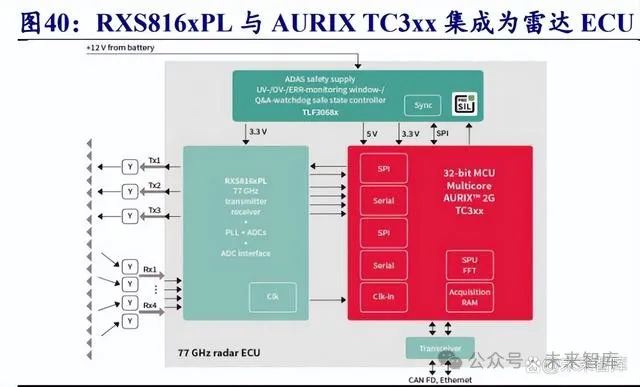
Chip manufacturers are introducing integrated products of MMIC, MCU, and DSP. On one hand, integration can control the cost and size of radar, reducing latency in signal transmission; on the other hand, companies with strong R&D capabilities can also enhance product unit prices through integrated products. Depending on the system’s integration method, radar chip groups can be categorized into three modes: (1) discrete mode: MMIC, MCU, and DSP are separate, forming three modules; (2) modular combination: MMIC is combined with DSP or DSP with MCU to form two modules; (3) SoC integration: MMIC, DSP, and MCU are all integrated into a radar SoC, forming a single module. Already, several manufacturers are developing SoCs, such as TI’s AWR2944, Gateron’s Andes series, Uhnder’s RoC (Radar on Chip), and NXP’s SAF85xx currently under development, indicating that SoC integration is becoming a trend.
Overall, millimeter-wave radar is in its early development stages, and changes in downstream vehicle manufacturers’ demands will ultimately influence the product routes of chip manufacturers. On one hand, chip manufacturers are gradually introducing products with higher integration to achieve better cost-performance ratios, assisting downstream millimeter-wave radar manufacturers in reducing development difficulties and enhancing their product competitiveness. On the other hand, the changes in the autonomous driving industry require the algorithm side to incorporate more underlying data and apply various neural network algorithms to enhance perception effects, meaning that some OEMs hope to obtain basic data output from DSP or even MMIC without extensive development of post-processing algorithms. Therefore, the products of chip manufacturers currently exhibit a coexistence of multiple routes, with players like Under focusing on integrated products that enhance detection capabilities by increasing channel counts, while traditional RF + DSP and MCU products are provided separately to facilitate the assembly of cascaded radar forms by companies like NXP and TI. Additionally, chip players can also provide standalone RF MMIC products for customer deep custom development. Furthermore, some high-performance chips can also integrate corresponding radar signal processing units to realize new ADAS functions and optimize millimeter-wave radar module costs, such as Ambarella’s acquisition of Oculii leading to the launch of the CV3 chip, which includes a dedicated hardware computing unit for millimeter-wave radar signal processing.
3.1.3. High-Frequency PCB: Numerous Domestic and Foreign Manufacturers, Competitive Landscape is Relatively Dispersed
High-frequency PCBs are the support for electronic components of 4D imaging millimeter-wave radar. PCBs are the carriers for electrical interconnections of electronic components, with high-frequency PCBs operating at electromagnetic frequencies above 1GHz, classified as high-difficulty substrates, and are primary raw materials for 4D millimeter-wave radar. In 4D imaging millimeter-wave radar, high-frequency PCBs need to support MMICs, processors, power management circuits, flash memory, peripheral interface devices, and antennas. High-frequency PCBs require small and stable dielectric constants, low impedance, low dielectric loss, and long-term reliability, with production costs typically higher than those of standard PCBs of the same area.
Antennas’ integration may reduce high-frequency PCB usage, lowering 4D millimeter-wave radar costs. Based on the integration method of the front-end transceiver module, three modes can be categorized: (1) discrete mode: antennas are designed separately from RF modules; (2) on-chip integration: antennas are integrated with chips based on packaging materials and processes; (3) on-package integration: antennas are designed on the top layer of chip packaging molding. Currently, antenna technologies are mainly discrete and on-chip integration. The former separates radar antennas from MMICs, while the latter integrates radar antennas with MMICs. Both require high-frequency PCBs for power support, but on-chip integration will reduce the area of high-frequency PCB usage. In the future, on-package integration may become the mainstream method, designing antennas on the top layer of chip packaging molding, directly bypassing the demand for expensive high-frequency substrate materials, further reducing costs.
3.1.4. Software Algorithms: Signal Processing Algorithms are Deeply Bound to Radar, Data Processing Algorithms Have High Customer Stickiness
4D imaging millimeter-wave radar signal processing algorithms are highly integrated with radar hardware. The signal processing algorithms for 4D imaging millimeter-wave radar are basic algorithms responsible for converting raw millimeter-wave signals. The processing flow and content of these algorithms are relatively fixed, generally embedded within radar signal processing hardware, leading to a high degree of software and hardware integration. Data processing algorithm development is complex, with a trend towards decoupling software and hardware. For downstream OEMs, self-developing data processing algorithms is challenging and costly, so they are generally provided by radar manufacturers or processing chip suppliers. However, compared to signal processing algorithms, data processing algorithms can be somewhat decoupled from hardware. For instance, companies like Oculii, Xinyi Road, Zadar, and Metawave view their software algorithm solutions as core competitiveness, aiming to supply their radar algorithms as standalone software to other manufacturers. Additionally, there are suppliers specializing in providing 4D radar prediction and perception technology algorithm solutions, such as BlueSpace.ai.
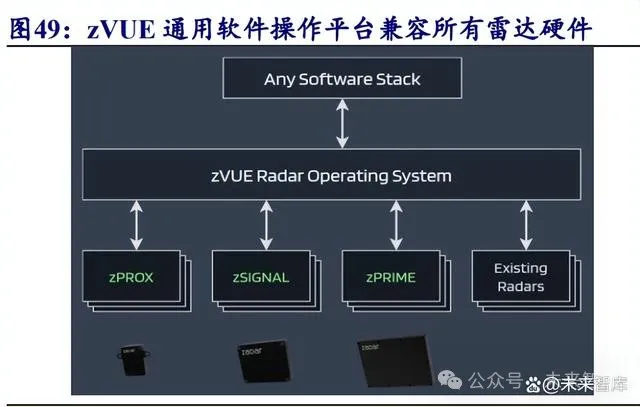
(1) Oculii: The company’s developed virtual aperture imaging algorithm allows each receiver to generate different phase waveforms at different times, creating a “virtual aperture” through interpolation and extrapolation of data while continually improving resolution and sensitivity through AI algorithms. Additionally, Oculii’s paired with Ambarella’s AI domain controller chip CV3 promotes deep integration of vehicle-mounted sensors. (2) Zadar: The company’s developed zVUE radar operating system’s random processing algorithm can detect and eliminate common radar point cloud defects, such as multipath detection and noise points, reducing false alarm situations; it also features high-definition mapping, scene segmentation, target clustering, and tracking functions, significantly enhancing the performance of its “software-defined imaging radar” by 250 times compared to ordinary radars. (3) Xinyi Road: By combining sparse array antennas with compressed sensing super-resolution algorithms, the performance of 4D millimeter-wave radar can match that of 64-line LiDAR. (4) Metawave: The company’s AWARE is an AI/machine learning fusion platform based on LiDAR and cameras, paired with SPEKTRA beam control imaging radar to achieve real-time object detection, classification, and tracking through adaptive attention networks, enhancing radar accuracy.
Data processing algorithm costs for 4D imaging millimeter-wave radar may further decline. Software algorithms account for 50% of the total cost of millimeter-wave radar. Compared to traditional millimeter-wave radar, the signal processing algorithms of 4D imaging millimeter-wave radar remain relatively unchanged, while the data processing algorithms often require complete redevelopment. As the computational complexity of 4D imaging millimeter-wave radar increases, the development costs for these algorithms are higher than those for traditional radar. However, due to rapid advancements in autonomous driving algorithms, various fusion algorithms like CenterFusion have emerged, and given that data processing algorithms are relatively decoupled from hardware, they are expected to bring about a decline in overall algorithm development costs.
3.2. Midstream: Intense Competition Among Radar Manufacturers, Vertical Integration Trends Exist Between Upstream and Midstream
4D imaging millimeter-wave radar players can be categorized into millimeter-wave radar manufacturers and other manufacturers (ADAS solution companies or millimeter-wave radar startups). The midstream of the 4D imaging millimeter-wave radar industry chain consists of radar manufacturers, with numerous domestic and foreign manufacturers. They can be divided into those expanding from millimeter-wave radar production to 4D millimeter-wave radar and those entering the 4D millimeter-wave radar track as ADAS solution providers and many startups.
Millimeter-wave radar manufacturers have deep manufacturing experience and industry chain advantages, making it easier for them to gain advantages in the 4D millimeter-wave radar field. Millimeter-wave radar manufacturers are actively laying out their strategies in the 4D millimeter-wave radar field. In mid-2020, German manufacturer Continental launched the market’s first 4D imaging millimeter-wave radar and announced mass production in 2021. Other manufacturers such as Bosch, Aptiv, ZF, and Hella have also entered the field. These manufacturers often have deep production experience, rich technological accumulation, and certain downstream customer resources, making it easier for them to establish a first-mover advantage in the market and promote the adoption of 4D imaging millimeter-wave radar.
New entrants and startups offer more flexible product combinations. Midstream suppliers include large millimeter-wave radar manufacturers like Continental and Bosch that are transitioning to 4D imaging millimeter-wave radar, as well as new entrants like Waymo and Mobileye, which are ADAS solution providers, along with a larger number of startups. Compared to large companies with deep foundations in millimeter-wave radar, new entrants have more flexible solutions and novel technological paths, with corresponding initial investment costs being relatively high. Among the new entrants are ADAS solution providers like Waymo and Mobileye, which have substantial funding and are using 4D imaging millimeter-wave radar in their respective Robotaxi services, pursuing safety, stability, and effectiveness in radar performance, representing a potential new direction for autonomous driving. Startups offer a wide range of technical solutions, and companies will choose different combinations of upstream software and hardware products based on various considerations, resulting in more flexible product combinations.
Software and algorithm solutions are also important products for 4D imaging millimeter-wave radar manufacturers. Upstream radar component suppliers will integrate some algorithms into their chips for delivery, while midstream radar manufacturers will redevelop algorithms based on product positioning and downstream needs, ultimately supporting the stable and reliable operation of 4D imaging millimeter-wave radar. TI, NXP, and other upstream manufacturers will also provide technical support, including reference software, design tools, communication frameworks, reference hardware designs, API guidelines, or user documentation, reducing the difficulty and cost of redevelopment. Midstream manufacturers are also enhancing their software algorithm capabilities through increased R&D or by acquiring/holding shares in related companies. As mentioned earlier, some 4D imaging millimeter-wave radar suppliers are also software providers, such as Oculii, Xinyi Road, and Zadar, whose radars paired with their self-developed software can exhibit stronger performance and more functionalities, with the accompanying software being regarded as the company’s core product. Under the trend of “soft-hard decoupling,” OEMs are also likely to lay out their software algorithms, potentially forming an ecological pattern of collaboration between OEMs and radar manufacturers in the software algorithm domain. Vertical integration will influence the competitive landscape among midstream manufacturers. Many companies are both upstream radar component suppliers and midstream 4D imaging millimeter-wave radar manufacturers, indicating a trend of vertical integration within the industry chain. Companies that span both upstream and midstream are often startups with higher integration levels in their products and higher completion levels in software algorithms. This allows them to control the costs of 4D imaging millimeter-wave radar while enhancing the stability of its operation and reducing compatibility issues between different hardware and between software and hardware. Manufacturers achieving vertical integration can leverage comparative advantages, forming their market competitiveness through superior performance or cost advantages, thus impacting the industry’s competitive landscape.
Domestic 4D imaging millimeter-wave radar manufacturers are likely to achieve a leapfrog advantage. Existing 4D imaging millimeter-wave radar technologies have multiple routes for improving resolution, and the varying demands of different manufacturers provide growth space for them, achieving the current stage of “a hundred flowers blooming” where various manufacturers can compete with differentiation. On the other hand, the diversity of technical routes increases the validation costs for downstream manufacturers, leading vehicle manufacturers to choose their solutions cautiously. Therefore, unlike the millimeter-wave radar era, domestic manufacturers are currently on the same starting line as foreign manufacturers, and they have the opportunity to catch up in terms of technological strength, allowing domestic 4D imaging millimeter-wave radar manufacturers to achieve a leapfrog advantage.
3.3. Mass Production and Integration Will Rapidly Reduce the Costs of 4D Imaging Millimeter-Wave Radar
4D imaging millimeter-wave radar is still in the market introduction stage, and costs are currently high. This is due to (1) the lack of scale mass production for 4D imaging millimeter-wave radar, where the upstream RF chips, processing chips, and midstream radar manufacturing costs have not formed a strong scale effect; (2) the lack of unified technical routes and unclear demand, resulting in no widely adopted market environment. Vehicle manufacturers pursue high cost-performance ratios, and currently, only a few models from manufacturers like SAIC, BYD, Li Auto, Geely, Hongqi, Changan, and Wenjie are specifically equipped with or set to use 4D imaging millimeter-wave radar, while most vehicle manufacturers are still in the validation or observation phases. According to data from Gao Gong Intelligent Automotive, the current cost of a four-chip cascading solution for 4D imaging millimeter-wave radar is approximately over a thousand yuan, while the cost of a two-chip cascading 4D millimeter-wave radar is around 500-1000 yuan.
As production increases to dilute costs and the trend of integration continues, the costs of 4D imaging millimeter-wave radar are expected to continue to decline. (1) Algorithms: As 4D imaging millimeter-wave radar reaches mass production, the marginal cost of algorithm development will rapidly decrease. (2) MMIC & Digital Signal Processors: The cascading solutions will increase the number of MMICs, thereby raising costs, while digital signal processors will also see cost increases due to performance upgrades. However, as the integration of 4D imaging millimeter-wave radar increases, MMICs and digital signal processors will be integrated, further reducing chip costs. (3) High-Frequency PCBs: The realization of 4D imaging millimeter-wave radar functions requires high-frequency PCBs for support, with unit area prices for PCBs increasing. However, as antenna integration and on-chip integration methods mature, the area of individual laser radar PCBs will decrease, and it is expected that the cost proportion of high-frequency PCBs will gradually decline. Although the costs of 4D imaging millimeter-wave radar remain higher than those of traditional millimeter-wave radar, with the gradual expansion of the market, the formation of scale effects in mass-produced chips, combined with the dilution of software development costs, the costs of 4D imaging millimeter-wave radar will gradually decline, allowing the market to further expand and enter a positive cycle of demand growth.
4. Multiple Factors Drive the Broad Growth Space for 4D Millimeter-Wave Radar
The deep development of automotive intelligence drives the rapid growth of 4D imaging millimeter-wave radar on vehicles. According to Yole Développement data, the overall market for automotive radar was $5.8 billion in 2021, and it is expected to reach $12.8 billion by 2027, with an average annual compound growth rate of 14%. The market growth mainly comes from 4D millimeter-wave radar and imaging radar, with market spaces of $3.5 billion and $4.3 billion, respectively, and average annual compound growth rates of 48% and 109%. The rapid growth of 4D imaging millimeter-wave radar is inseparable from upgrades in upstream chip technologies, the pull of downstream demand, the expansion of application scenarios, and updates in safety regulations.
4.1. Driving Factor One: Continuous Advancement of Autonomous Driving Technologies Provides Opportunities for Sensor Upgrades
4.1.1. The Role of 4D Millimeter-Wave Radar in the Realization of Autonomous Driving is Becoming Increasingly Important
Millimeter-wave radar acts as a guardian for autonomous driving, and the advantages of 4D millimeter-wave radar are becoming more evident. Millimeter-wave radars are divided into front radars and corner radars based on their placement positions, and into long-range radars (LRR), mid-range radars (MRR), and short-range radars (SRR) based on their maximum detection distances. Millimeter-wave radar can cover short, medium, and long distances, allowing it to function as both front and corner radars. Millimeter-wave radar can achieve key ADAS functions such as Adaptive Cruise Control (ACC), Automatic Emergency Braking (AEB), Forward Collision Warning (FCW), and Lane Change Assistance (LCA), making it a part of the ADAS and autonomous driving revolution. 4D millimeter-wave radar effectively overcomes the disadvantages of traditional millimeter-wave radar, significantly improving the practicality of AEB, FCW, ACC, and other ADAS system functions. 4D millimeter-wave radar will be an important support for the evolution of L2 level ADAS to L3 and even L4/L5 autonomous driving.
4.1.2. The Penetration Rate of 4D Millimeter-Wave Radar is Accelerating in the Second Half of Automotive Intelligence
The penetration rate of intelligent driving is gradually increasing, and the demand for sensors is steadily rising. The second half of automotive intelligence has already begun. According to Roland Berger’s estimates, by 2025, the penetration rate of L1+L2 intelligent driving functions in the three major global automotive production regions is expected to reach 76%, with China likely exceeding 65%, while the U.S. and EU are expected to reach 85%. The working process of ADAS is divided into perception, decision-making, and execution, with perception being one of the core links in ADAS, requiring sensors to input a large amount of driving environment data. Vehicle-mounted sensors are expected to benefit from the increased penetration rate of ADAS, leading to further volume growth.
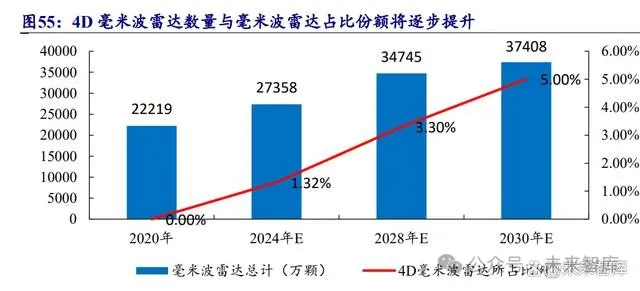
The penetration rate of 4D millimeter-wave radar is expected to continue to rise. Millimeter-wave radar possesses excellent characteristics not found in other sensors, making it an important part of multi-sensor fusion solutions. However, compared to traditional millimeter-wave radar, 4D millimeter-wave radar still has many deficiencies. The high performance of 4D millimeter-wave radar may replace some traditional millimeter-wave radar in a growing market, expanding demand. However, due to cost factors, in the short term, 4D millimeter-wave radar will only gradually be adopted in mid-to-high-end models, while low-end models will continue to use traditional millimeter-wave radar.
4.2. Driving Factor Two: Based on Traffic Scenarios, Expanding Multi-Field Application Scenarios
4.2.1. Roadside: Vehicle-Road Coordination Constructs Smart Traffic, SLAM Mapping Assists Intelligent Navigation
4D millimeter-wave radar can be applied in vehicle-road coordination scenarios. 4D millimeter-wave radar, installed overhead with high-definition cameras to monitor road conditions, can perform front/back fusion processing of the two to obtain real-time information, enabling tracking and classification of moving or stationary targets in road conditions, suitable for monitoring and tracking at intersections and highways, significantly enhancing performance in complex vehicle-road coordination scenarios, contributing to optimizing traffic flow and building smart cities. 4D millimeter-wave radar can also be applied in mapping. The positioning of 4D millimeter-wave radar can achieve 10cm accuracy, and it can perform dynamic-static segmentation and point cloud imaging, allowing for environmental detection, rejecting dynamic objects, and accumulating static objects to produce highly detailed maps for real-time positioning and mapping (SLAM). After post-noise processing, point cloud maps can be used for positioning and intelligent navigation.
4.2.2. Security, Logistics, Elderly Care, Retail, Construction, 4D Millimeter-Wave Radar Has Broad Application Prospects
4D millimeter-wave radar meets diverse scenario needs, with broad application prospects. The application range of millimeter-wave radar is not limited to automotive traffic fields; it has vast development space in retail, elderly care, drones, security, construction, industrial, and military sectors.
4.3. Driving Factor Three: Strategies, Standards, and Regulations Make High-Performance Sensors Essential
Strategies, standards, and regulations are conducive to the rapid and standardized development of 4D millimeter-wave radar. Domestic policies related to 4D millimeter-wave radar can be categorized into three types: (1) strategic planning encouraging the development of intelligent driving-related fields; (2) industry standards supporting the development of millimeter-wave radar; (3) safety regulations mandating the installation of related functions. The issuance and implementation of relevant policies provide a normative path for the development of 4D millimeter-wave radar. Safety regulations requiring the installation of certain autonomous driving functions further promote the emergence of 4D millimeter-wave radar with such capabilities in the market, such as South Korea’s mandatory installation of AEB in 2023 and the updates to E-NCAP regarding AEB and other active safety functions, providing a first-mover advantage for 4D millimeter-wave radar with AEB capabilities.
5. Key Company Analysis
5.1. Desay SV Automotive: Leading Smart Automotive Company Deeply Layouts, Benefiting from the Trend of Autonomous Driving Function Implementation
Desay SV Automotive, as a leading smart automotive company in China, covers core links such as smart cockpits, autonomous driving, and intelligent connectivity, and will fully benefit from the development of the smart automotive industry. In terms of intelligent driving, the IPU01-IPU04 range covers domain controllers from low to high computing power, with high-power domain controllers already in mass production in models from Li Auto, Lotus, SAIC, and more lightweight, cost-effective intelligent driving solutions receiving multiple project orders. As the maturity of autonomous driving accelerates, the penetration rate of high-computing power platforms is expected to rise further. In terms of cockpits, the company has a wide range of customers, helping to create a human-centered third living space, with the third-generation cockpit domain controller already in mass production in numerous customer models, and the fourth-generation cockpit domain controller has received multiple project orders. In intelligent connectivity, the Blue Whale system, digital key, and software service products continue to iterate. The company is deeply laying out the autonomous driving field, forming a complete solution encompassing domain controllers, sensors, intelligent connectivity, and algorithms. In terms of sensors, the company’s camera and millimeter-wave radar products have achieved mass production, and it has completed industrial technology layout in the field of 4D millimeter-wave radar. The company’s rich experience in software and hardware R&D and technological accumulation may assist in the rapid promotion of 4D millimeter-wave radar products.
5.2. Jingwei Hirain: Actively Laying Out 4D Millimeter-Wave Radar, Continuously Enriching Products and Solutions
The company is deeply engaged in the automotive electronics field, being a leading Tier 1 supplier of automotive electronics in China. The company has formed a three-in-one business pattern covering automotive electronic products, R&D services, and high-level autonomous driving. (1) In terms of automotive electronic products, the company covers six major categories: intelligent driving, intelligent connectivity, intelligent cockpits, body and comfort domains, chassis control, and new energy and power systems, with a complete range of products and continuous customer expansion. (2) In terms of R&D services, the company has long-term practical experience in electronic systems, with rich experience accumulation, providing full-cycle solutions and service businesses for automotive industry users, with strong R&D service barriers. (3) In terms of high-level autonomous driving, the company has proactively laid out unmanned driving at ports, already conducting regular operations at Tangshan Port, Rizhao Port, and Longgong Port. The company’s business continues to expand, with software and hardware products working synergistically, and its operational layout is gaining momentum, with performance consistently being released. The company is actively laying out 4D millimeter-wave radar, continuously expanding the categories of automotive electronic products. In 2021, the company reached a strategic cooperation with Arbe, and the developed 4D millimeter-wave radar significantly enhances radar information acquisition capability through the construction of 48T48R receiving channels; the maximum detection distance reaches 350 meters, achieving true aperture resolution of 1°/1.5° for azimuth/pitch; the point cloud imaging effect reaches the level of LiDAR, capable of meeting the needs of L3 and above intelligent driving systems, with port logistics likely becoming the first application scenario. The company’s 4D millimeter-wave radar has completed prototype development and is expected to achieve mass production by the end of 2024.
5.3. Weifu High Technology: Leading Fuel Injection System Manufacturer Enters New Energy Sector, Laying Out Millimeter-Wave Radar Business
The company is a leading fuel injection system manufacturer in China, actively laying out new business. The company’s main business includes the R&D, production, and sales of core automotive components, involving diesel fuel injection systems, exhaust aftertreatment systems, intake systems, and core components for fuel cells; at the same time, the company is gradually optimizing its strategic blueprint, actively laying out new energy business, forming a new strategic pattern of comprehensive development across four major sectors: “energy saving and emission reduction,” “green hydrogen energy,” “intelligent electric,” and “other core components.” The company possesses technological and product advantages, being recognized as a national high-tech enterprise with multiple research platforms and provincial engineering technology research centers and laboratories, achieving a high level of integration between production, learning, and research; it collaborates closely with international companies like Bosch, Autokem, and Schmidt, with its R&D processes, quality control, and production management capabilities reaching international advanced levels. The company implements a unified management model for the parent company and decentralized production for subsidiaries, effectively integrating manufacturer advantages and advanced technologies to stimulate operational vitality. The company began laying out its millimeter-wave radar business in 2018, forming a strategic partnership with Arbe to develop 4D millimeter-wave radar. In April 2022, it has already achieved sales of 4D millimeter-wave radar product samples and secured specific contracts for trunk logistics. Currently, the 4D millimeter-wave radar product is in a phase of rapid market application development. Its forward-looking layout and advanced solutions will help the company gain first-mover advantages and seize opportunities in new business fields.
5.4. Huayu Automotive: The Automotive Electronics Division Has Supplied High-Performance 4D Millimeter-Wave Radar Products
The company has a solid foundation in automotive business, with new business products continuously achieving breakthroughs. Founded in 1992, Huayu Automotive’s main business encompasses automotive interior and exterior parts, metal forming and molds, functional parts, electronic and electrical components, and thermal processing parts. The company has over 360 R&D, manufacturing, and service bases in China as of June 2023, with comprehensive layouts in the automotive parts business and deep operational capabilities. The company’s new business products are continuously achieving breakthroughs in intelligent directions, with millimeter-wave radar products, intelligent cockpit products, and intelligent vision system products continuously enriching. In terms of electrification, the iteration of electric drive system products is accelerating, with deep cooperation established with companies like Volkswagen, General Motors, and Great Wall Motors. The automotive electronics division of Huayu was established in 2017, formerly the Huayu Automotive Technology Center, with core products including domain controllers and automotive front/rear view cameras, pure solid-state LiDAR, and millimeter-wave radar, focusing on the R&D and production of multi-sensor and software-hardware integration systems for intelligent driving. In 2021, the company independently developed its first 4D imaging millimeter-wave radar product, LRR30, using two MMICs in cascade with an NXP processor, achieving a maximum detection distance of 300 meters and employing advanced phase coding technology with strong anti-interference capabilities. The company currently offers both LRR30 and LRR40 models of 4D millimeter-wave radar products, having achieved small batch supply to Youdao Zhitu in 2022. The company has robust R&D capabilities, an early layout, and a comprehensive sensor layout for intelligent vehicles, providing customers with system-level overall solutions.
5.5. Baolong Technology: New Business Layouts Developing 4D Millimeter-Wave Radar, Expected to Achieve Mass Production in 2024
The company is enhancing its product matrix around automotive intelligence and lightweighting, with business layouts spanning both domestic and international markets. The company’s main products include tire pressure monitoring systems (TPMS), air suspension systems, vehicle sensors (primarily for pressure, light, rainfall, speed, position, acceleration, and current), ADAS (Advanced Driver Assistance Systems), automotive metal pipes (lightweight chassis and body structural components, exhaust system pipes, and EGR components), valve stems, and balancing weights. In the first three quarters of 2023, the company’s total revenue/net profit reached 4.155 billion/339 million yuan, representing year-on-year growth of 29.20%/194.75%, with a gross margin of 27.92%. The company has excellent international operational capabilities, with comprehensive domestic and international layouts, establishing multiple production, R&D, and sales centers in China, North America, and Europe. In the first half of 2023, overseas business revenue accounted for 55.73% of total revenue. The company possesses industry-leading technologies and is recognized as a “National-level Intellectual Property Advantage Enterprise” and a “High-tech Enterprise.” In the first three quarters of 2023, R&D investment accounted for 7.48% of operating revenue, maintaining advanced technological levels. The company has begun laying out its 4D millimeter-wave radar business since the end of 2021 and is currently in the C sample (batch sample) stage, promoting it to customers.