Simmons-Smith Cyclopropanation Reaction
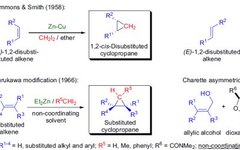
In 1958, H.E. Simmons and R.D. Smith discovered that in the presence of a zinc-copper couple, dichloromethane can convert alkenes (such as cyclohexene and styrene) into stereospecific cyclopropane derivatives. This reaction became one of the most effective methods for synthesizing cyclopropane derivatives, known as the Simmons-Smith reaction. The reaction was later improved for broader use: … Read more