In 1958, H.E. Simmons and R.D. Smith discovered that in the presence of a zinc-copper couple, dichloromethane can convert alkenes (such as cyclohexene and styrene) into stereospecific cyclopropane derivatives. This reaction became one of the most effective methods for synthesizing cyclopropane derivatives, known as the Simmons-Smith reaction. The reaction was later improved for broader use: using a zinc-silver couple to shorten reaction time and increase yield; using diethylzinc and dichloromethane to achieve more reproducible results (Furukawa modification); and achieving selectivity in the cyclization of allylic alcohols in the presence of other alkenes with the Molander improvement.
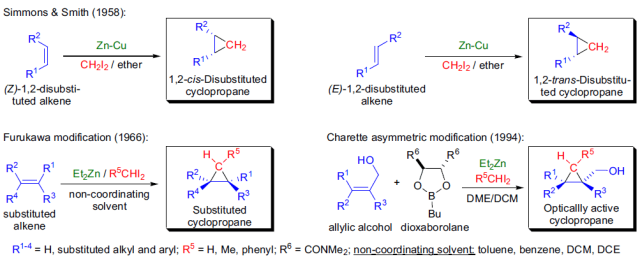
Reaction Mechanism
The Simmons-Smith reaction is a concerted process that undergoes a three-center butterfly transition state.

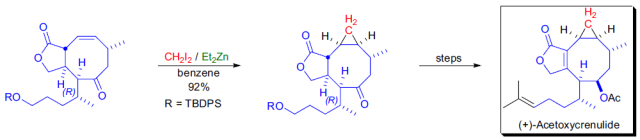
Reaction Examples



References
1. Simmons, H. E.; Smith, R. D. J. Am. Chem. Soc. 1958, 80, 5323-5324.
2. Limasset, J.-C.; Amice, P.; Conia, J.-M. Bull. Soc. Chim. Fr. 1969, 3981-3990.
3. Kitajima, H.; Ito, K.; Aoki, Y.; Katsuki, T. Bull. Chem. Soc. Jpn. 1997, 70, 207-217.
4. Shan, M.; O’Doherty, G. A. Synthesis 2008, 3171-3179.
5. Kim, H. Y.; Salvi, L.; Carroll, P. J.; Walsh, P. J. J. Am. Chem. Soc. 2009, 131, 954-962.
6. Swaroop, T. R.; Roopashree, R.; Ila, H.; Rangappa, K. S. Tetrahedron Lett. 2013, 54, 147-150.
This article is from Name Reactions: A Collection of Detailed Mechanisms and Synthetic Applications–Fifth Edition, Organic Name Reactions–Mechanisms and Applications Fourth Edition