
New Sensor Products
【Xi’an University of Technology: Development of Fiber Temperature Sensors for Real-Time Monitoring of Body Temperature】
Body temperature is an important indicator of human health. Traditional mercury thermometers and medical electronic thermometers have a slow response time (≥1 minute) and, due to their rigidity, cannot be worn for extended periods to achieve continuous temperature monitoring.
The research combines wet spinning technology with impregnation technology to prepare a skin-core structure of polyurethane (PU)/graphene encapsulated poly(3,4-ethylenedioxythiophene)-poly(styrenesulfonate) (PEDOT:PSS) temperature-sensing fiber in one step.
This composite fiber exhibits high sensitivity (-1.72%/°C), super-resolution (0.1°C), rapid response time (17 seconds), resistance to sweat interference, and high linearity (R² = 0.98) within a temperature sensing range of 30-50°C. The strength of this fiber is sufficient to be woven into temperature-sensing fabrics with commercial cotton yarn. This fabric offers good comfort and durability, allowing it to be placed in the underarm area of clothing for uninterrupted real-time temperature monitoring during daily activities. Through Bluetooth wireless transmission, body temperature can be monitored in real-time and displayed on a mobile phone for parents or guardians. In summary, the fiber temperature sensor, due to its sensing stability, comfort, and durability, will significantly enhance the practical application of wearable temperature sensors in the field of smart healthcare.
Illustrated Guide
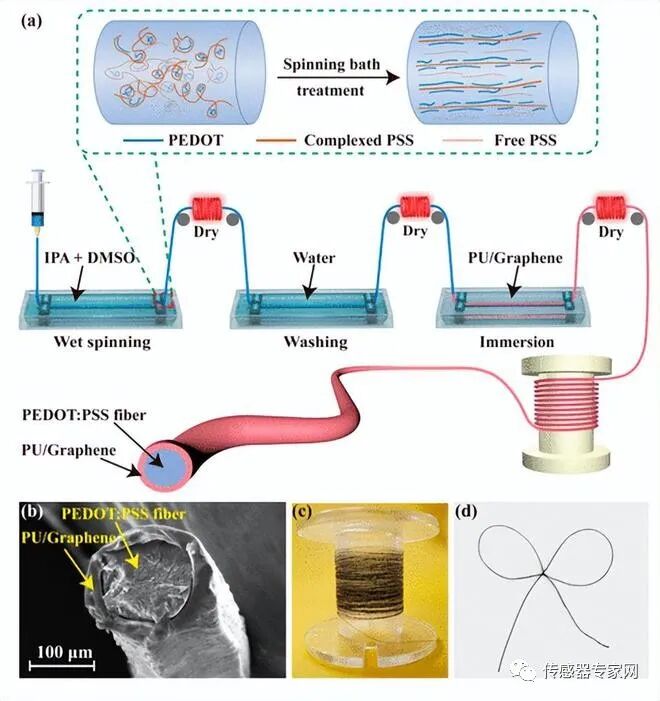
Figure 1. Preparation and characterization of PU/graphene encapsulated PEDOT:PSS fiber (composite fiber)
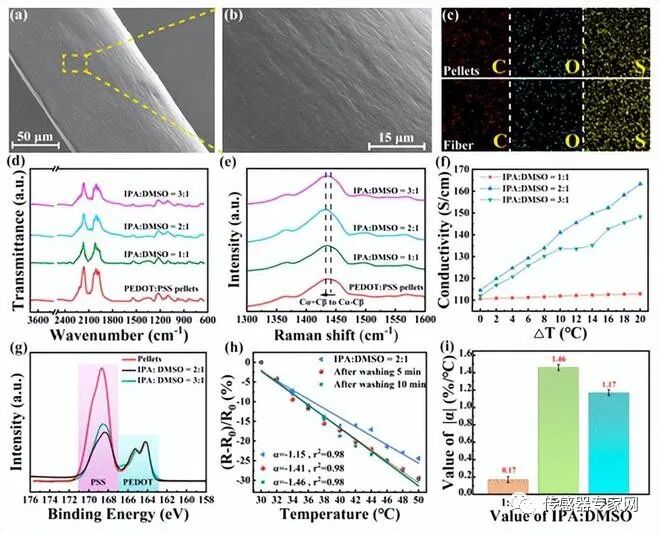
Figure 2. Performance of PEDOT:PSS fiber
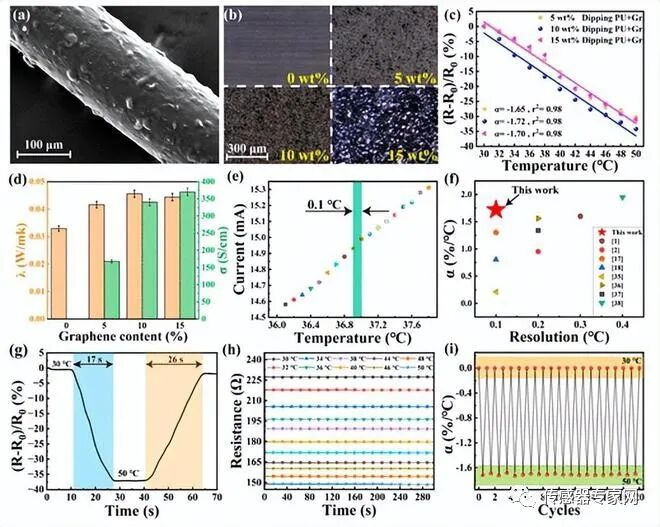
Figure 3. Characterization and sensing performance of composite fiber
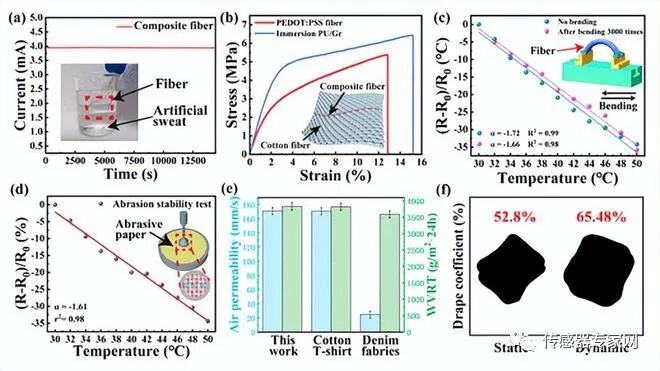
Figure 4. Wear resistance of PU/graphene encapsulated PEDOT:PSS fiber and its fabric
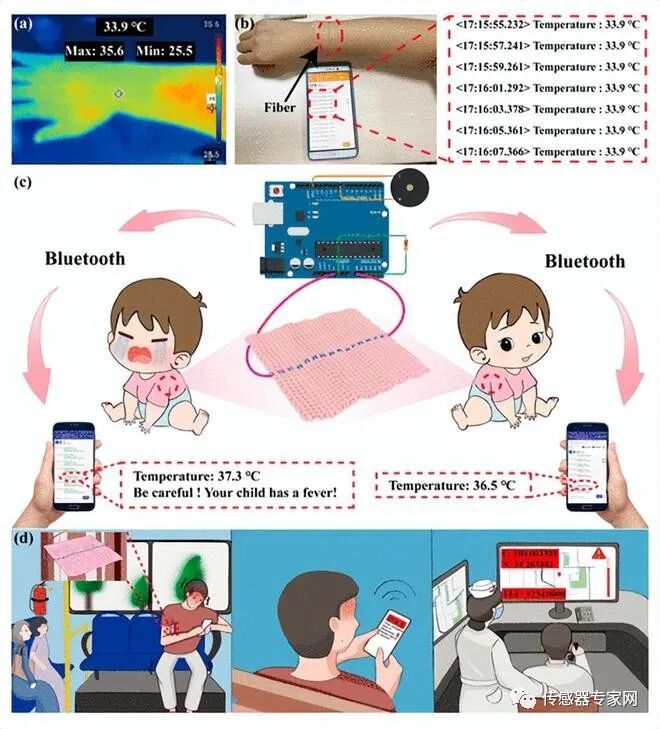
Figure 5. Infrared thermal imager (a) and composite fiber (b) detecting arm temperature; (c) example of fabric-based flexible temperature sensor using composite fiber; (d) example of fabric-based temperature sensor for smart healthcare applications.
Conclusion
This work combines wet spinning technology with impregnation technology to develop a PU/graphene encapsulated PEDOT:PSS fiber temperature sensor in one step, featuring resistance to sweat interference, high sensitivity, and good wear resistance. The temperature sensing capability of PEDOT:PSS fiber can be adjusted by changing the ratio of IPA and DMSO in the coagulation bath and the washing time with deionized water. When the ratio of IPA to DMSO is 2:1 and the washing time is 10 minutes, the sensitivity of PEDOT:PSS fiber reaches its optimal value of -1.46%/°C. Due to the synergistic effect of the conductivity and thermal conductivity of the PU/graphene layer, the sensitivity of the composite fiber is further improved to -1.72%/°C, with linearity of 0.98. The response time of the composite fiber is 17 seconds within the temperature range of 30-50°C, which is much faster than that of mercury thermometers (≥5 minutes) and electronic medical thermometers (≥1 minute). The sensing accuracy is 0.1°C, consistent with the accuracy of commercial thermometers, capable of measuring the smallest changes in body temperature. The strength of the composite fiber is sufficient to be woven with any commercial textile yarn to form temperature-sensitive fabrics. This fabric offers comfort and durability similar to commercial cotton T-shirts.
Moreover, due to the excellent hydrophobic properties of the PU/graphene skin layer, the sensitivity of the composite fiber is unaffected by moisture such as sweat, allowing it to be placed in the underarm area of clothing for real-time monitoring of body temperature. Additionally, we have developed a Bluetooth transmission system based on Arduino Uno and Bluetooth HC-06, which transmits data collected from the temperature-sensing fiber to mobile phones and the cloud in real-time. Therefore, fabrics containing temperature-sensitive fibers can be used for smart healthcare and disease monitoring, which is significant for long-term, stable, and remote monitoring of human physiological information.
Sensor Dynamics
【Optoelectronic Sensor Chip Design Company Shitong Microelectronics Receives Pre-A+ Round Investment from Yida Capital】
Recently, optoelectronic sensor chip design company Shitong Microelectronics received Pre-A+ round financing, with Yida Capital as the investor.
It is reported that this round of financing will mainly be used for product research and development and subsequent tape-out.
Shanghaishitong Microelectronics Technology Co., Ltd. was established in 2021. The founder and CEO, Li Qiang, studied undergraduate at Tsinghua University in the Department of Electronic Engineering and graduated from Tsinghua Microelectronics Institute with a master’s degree. He has many years of experience in pixel development for image sensors and has experience in productization of mobile image sensors for leading domestic companies. The company’s R&D team comes from several well-known domestic image sensor companies and research institutions, with many years of experience in chip design and pixel development. Currently, over 80% of the company’s employees hold master’s or doctoral degrees.
Shitong Microelectronics focuses on developing high-precision, low-power, and cost-competitive SPAD dToF 3D sensing chips.
dToF (direct Time of Flight) calculates the time of flight of light by measuring the time difference between the emission and reception of light beams, thus calculating distance. Therefore, dToF has the capability to construct 3D spatial images. Initially, in the consumer electronics field, dToF laser radar technology was introduced into smartphones, combined with RGB cameras, to perform 3D modeling of environmental objects and scenes, achieving functions such as augmented reality (AR) and photography optimization. In recent years, the industry has begun to explore the application of dToF in scenarios such as autonomous vehicles, laptops, robotic vacuum cleaners, and service robots.
Currently, Shitong Microelectronics has developed two products aimed at the smartphone and robotic vacuum cleaner markets. In the future, the company plans to expand into the automotive laser radar, AR, and VR markets. For the automotive laser radar market, Shitong Microelectronics is focusing on developing small-sized high-performance silicon photomultiplier tubes (SiPM) for the main radar; for the corner radar used for blind spot detection, Shitong Microelectronics hopes to establish blind spot flash LiDAR as an industry standard. For the AR and VR market, with the release of Apple’s MR glasses, confidence in the industry chain will increase, which will also strengthen the demand for dToF products.
Li Qiang believes that the smartphone, robotic vacuum cleaner, and laptop scenarios are still in the early stages of growth, and the automotive laser radar and AR/VR industries have not yet formed a clear technical path for the demand for SPAD array chips (dToF image sensors), thus Shitong Microelectronics has significant growth space and development opportunities.
【China Electronics Technology Group Corporation No. 27 Research Institute: Development of Shenzhou Spaceship Rendezvous and Docking Laser Radar from 0 to 100】
Imagine two small cars racing at a speed of 7.8 kilometers per second on a superhighway. If the second car accelerates forward, how can it precisely insert a thin line from the front of its car into the eye of the needle at the rear of the first car?
You might say, this is impossible.
However, the rendezvous and docking laser radar team of the China Electronics Technology Group Corporation No. 27 Research Institute (hereinafter referred to as “No. 27 Institute”) has made this impossible possible.
For this team, achieving the “needle threading” of the small car is actually the spaceship and space station in space, and the “eye of the needle” is the docking interface of the spacecraft. The “wise eye” guiding the spaceship to achieve rendezvous and docking with the space station in space is the rendezvous and docking laser radar.
Since its debut in 2011 on the Shenzhou 8, to assisting the Shenzhou 13 in achieving the first radial rendezvous and docking with the space station assembly in 2021, and to supporting the Shenzhou 17 in docking with the forward port of the core module of the space station on October 26 this year, the rendezvous and docking laser radar has repeatedly supported China’s manned space missions.
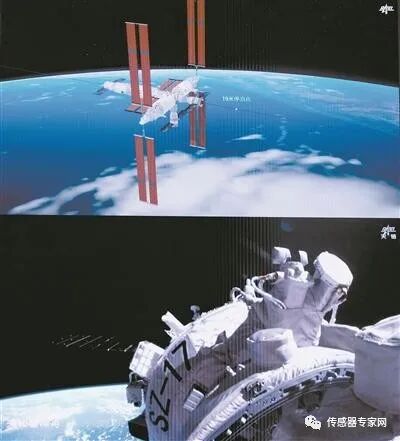
On October 26, under the guidance of the rendezvous and docking laser radar, the Shenzhou 17 manned spacecraft successfully docked with the forward port of the Tianhe core module of the space station. The image shows the docking process captured at the Beijing Aerospace Flight Control Center. Xinhua News Agency reporter Jin Liwang photographed it.
“Creating a Path at the Foot of the Snow Mountain”
Before the launch of Shenzhou 17, Wei Longchao’s heart was tense again.
As a senior engineer in the optoelectronic systems department of the No. 27 Institute, Wei Longchao has been on the road of developing rendezvous and docking laser radar for 10 years. Recalling the initial experiences of the R&D process, he feels a lot.
In 1995, the laser department of the No. 27 Institute drafted a feasibility report, and the “wise eye in space” moved from concept to scientific system verification; in 2005, the development project of rendezvous and docking laser radar was officially launched, with the application goal being the “Shenzhou 8” to be launched six years later.
At that time, rendezvous and docking laser radar was a new technology with no precedent, lacking a technical foundation, relevant literature, and practical testing conditions.
“To make a laser radar for use in space, but none of us have been to space,” Wei Longchao said. “We had no idea what the conditions in space were like.”
The R&D team could only refer to domestic and foreign materials, combined with ground tests, to simulate the conditions in space. The No. 27 Institute is located in Zhengzhou, Henan, which is at a low altitude and greatly affected by atmospheric circulation, making it unsuitable for ground testing. After several investigations, they chose Lijiang, Yunnan, as the testing site.
Senior engineer Feng Zhihua from the optoelectronic systems department of the No. 27 Institute still remembers that early spring in Lijiang—
In March 2011, less than a year before the launch of “Shenzhou 8”, the laser radar was in a critical period of verification and debugging. After two weeks of sleepless “devil-style” system integration, Feng Zhihua and a team of five brought the laser radar to Lijiang to test the signal reception and system detection tracking capabilities of the laser radar.
To simulate the rendezvous and docking environment in space, they set up the main laser radar equipment on the hotel rooftop and placed a signal capture target about 11 kilometers away on a mountain.
That was a small, desolate mountain at the foot of Yulong Snow Mountain, rarely visited by people. Feng Zhihua and two other designers carried two sets of receiving equipment weighing dozens of pounds on their backs, searching for suitable reception points on the rocky and uneven mountain.
“The search range of the laser radar is limited, so we had to keep moving with the receiver on the mountain, repeatedly changing positions and continuously adjusting to complete signal reception. There were no roads in the wild mountains, we had to forge our own path,” Feng Zhihua said. When the weather was clear, looking up at the nearby Yulong Snow Mountain, the steep peaks stood tall, like an exclamation mark drawn against the sky.
In Feng Zhihua’s memory, that spring under Yulong Snow Mountain was beautiful; the path he measured with his footsteps was long.
“From 0 to 100”
Although the R&D team of the No. 27 Institute was completely in a “zero foundation” state at the beginning of the development of the rendezvous and docking laser radar, the requirements from China Aerospace for the team were—”100%”.
“This is not ‘from 0 to 1’, but ‘from 0 to 100’,” Wei Longchao said. The quality management system of China Aerospace is extremely strict, and every product must be 100% assured by the technical staff before it is released.
“Once, during a system test, we found that the data was unstable, indicating system interference. There was no shortcut to locate the problem; we tested from subsystems to individual units, from circuit boards to tiny components one by one. There were many types of interference, and interference is an occasional phenomenon that requires continuous 24-hour testing. After continuous efforts, we finally found that an unreasonable circuit design caused electromagnetic interference,” Feng Zhihua recalled.
Finding the problem was only the beginning of the difficulty. The entire system is interconnected; changing one detail can affect the whole system. It is like building a tall building with blocks; changing one block requires considering the impact on the overall structure.
“A change the size of a fingernail seems trivial, but it requires constant balancing, reviewing, and testing, equivalent to rebuilding the entire system,” Feng Zhihua said. After the product was delivered, the stone in Feng Zhihua’s heart did not fall.
Would the radar complete its mission successfully after going to space? Would the calculations of the differences between space and ground be accurate? What if the spacecraft did not dock? Countless questions echoed in his mind.
“Aerospace operations are different from ground operations; they cannot be repaired or repeated. Rationally, all experiments have been conducted, and everything that can be verified has been verified, and many redundant designs have been made; emotionally, I cannot help but feel anxious and worried. It is like a mother worrying about her child going far away,” Feng Zhihua said. “Once, I had a nightmare where the director told me that our radar did not dock, and I woke up in shock. It took me a few minutes to recover, remembering that the spacecraft had not yet launched.”
On November 3, 2011, the Shenzhou 8 spacecraft successfully completed a rigid connection with the Tiangong 1, forming an assembly, and the rendezvous and docking laser radar achieved its first victory. However, the team members sitting in front of the big screen in the conference room did not erupt into the applause and cheers they had imagined. Wiping away tears and sweat, they felt more relaxed—tonight, they could finally get a good night’s sleep.
“Laser Radar Technology Never Matures”
As China’s aerospace technology continues to update and iterate, the challenges faced by the R&D team of the No. 27 Institute are also increasing. Radial rendezvous and docking has become a new task in front of the team.
“To put it figuratively, the original docking method was ‘two cars tailgating’, while radial rendezvous and docking is like the rear car ‘drifting’ over, making a sharp turn to precisely insert the ‘line’ into the eye of the needle at the front car’s head,” Feng Zhihua said.
In October 2021, the Shenzhou 13 manned spacecraft successfully launched with three astronauts and achieved the first connection with the Tianhe core module using radial rendezvous and docking.
“During this docking, the laser radar maintained stable tracking of the preset target under the complex transformation of the observation coordinate system, and quickly completed the rapid switching between different cooperative targets at the preset switching points, ensuring the stability and effectiveness of high-precision measurement data throughout the process,” Wei Longchao said proudly.
In May 2023, the aerospace rendezvous and docking laser radar launched simultaneously with the Shenzhou 16, successfully guiding the precise docking of the core module of the space station at the radial port, completing the first manned mission in the new phase of China’s space station application and development.
This time, during the approach and docking phases of the Shenzhou 17 spacecraft with the forward port of the space station core module, the laser radar successfully completed the search, capture, tracking, and measurement of the target space station, supporting the spacecraft’s GNC system to complete the space rendezvous and docking control task and form a “three modules and three ships” assembly, aiding the development of China’s space station application into a new phase.
“Does the repeated success of laser radar in space mean that this technology has matured?” a reporter asked Fan Haizhen, head of the optoelectronic systems department of the No. 27 Institute.
“No, laser radar technology will never mature. We always have new peaks to climb, new difficulties to overcome, and new paths to take,” Fan Haizhen said. Currently, the team has completed the subsequent laser radar equipment for the Shenzhou spacecraft and is simultaneously developing more advanced equipment to reserve technology for national lunar and Mars exploration strategies.
“Without a shape above and below, how can we test it? In the dark, who can reach the end?” Over two thousand years ago, Qu Yuan’s “Tianwen” was being answered by the scientific workers of the new era in China.
【Ministry of Industry and Information Technology: Focus on Humanoid Robot-Specific Sensors, Breakthrough Key Technologies in Vision, Hearing, Force, and Smell】】
Recently, the Ministry of Industry and Information Technology issued the “Guiding Opinions on the Innovative Development of Humanoid Robots” (hereinafter referred to as the “Guiding Opinions”). To better understand and implement the “Guiding Opinions”, the following interpretations are provided:
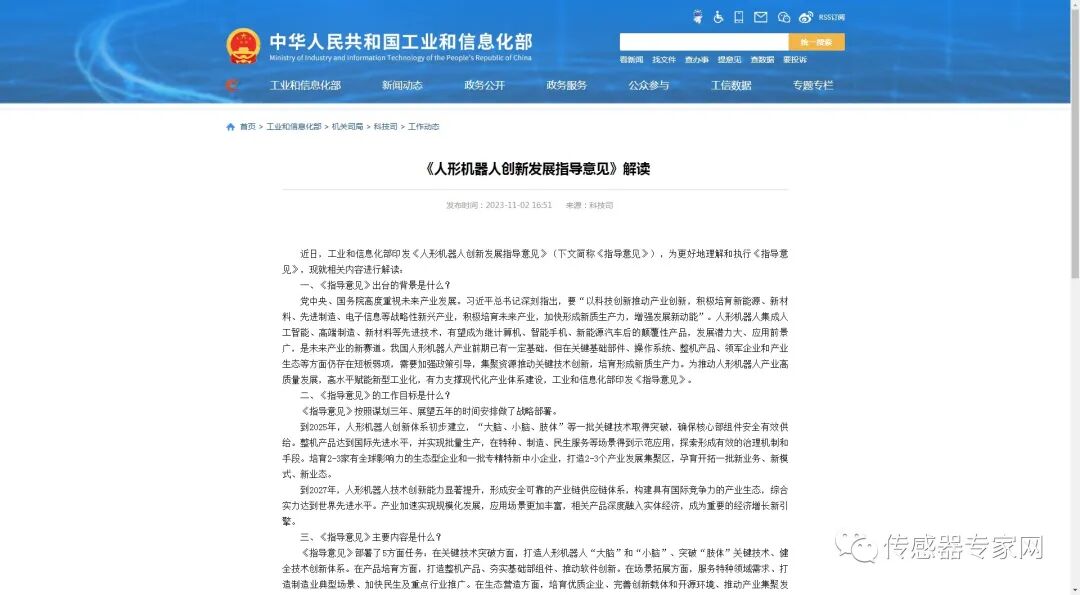
1. What is the background for the issuance of the “Guiding Opinions”?
The Party Central Committee and the State Council attach great importance to the development of future industries. General Secretary Xi Jinping pointed out that we should “promote industrial innovation through technological innovation, actively cultivate strategic emerging industries such as new energy, new materials, advanced manufacturing, and electronic information, accelerate the formation of new productive forces, and enhance new development momentum.” Humanoid robots integrate advanced technologies such as artificial intelligence, high-end manufacturing, and new materials, and are expected to become disruptive products following computers, smartphones, and new energy vehicles, with great development potential and application prospects, representing a new track for future industries. China’s humanoid robot industry has a certain foundation in the early stage, but there are still shortcomings in key basic components, operating systems, complete products, leading enterprises, and industrial ecology, which need to be strengthened through policy guidance and resource aggregation to promote key technological innovations and cultivate new productive forces. To promote the high-quality development of the humanoid robot industry and empower the new industrialization process, the Ministry of Industry and Information Technology issued the “Guiding Opinions”.
2. What are the work goals of the “Guiding Opinions”?
The “Guiding Opinions” have made strategic deployments according to a three-year planning and five-year outlook.
By 2025, an innovative system for humanoid robots will be initially established, with breakthroughs in key technologies such as “brain, cerebellum, and limbs”, ensuring the safe and effective supply of core components. Complete products will reach international advanced levels and achieve mass production, demonstrating applications in special, manufacturing, and livelihood service scenarios, exploring effective governance mechanisms and methods. Cultivate 2-3 globally influential ecological enterprises and a number of specialized and innovative small and medium-sized enterprises, create 2-3 industrial development clusters, and nurture a batch of new businesses, new models, and new formats.
By 2027, the technological innovation capability of humanoid robots will be significantly enhanced, forming a safe and reliable industrial chain supply chain system, constructing an internationally competitive industrial ecology, and achieving comprehensive strength at the world advanced level. The industry will accelerate its scale development, with more diverse application scenarios, and related products deeply integrated into the real economy, becoming an important new engine for economic growth.
3. What are the main contents of the “Guiding Opinions”?
The “Guiding Opinions” deploy five tasks: in terms of key technology breakthroughs, build the “brain” and “cerebellum” of humanoid robots, break through key technologies of “limbs”, and improve the technological innovation system. In terms of product cultivation, build complete products, solidify basic components, and promote software innovation. In terms of scene expansion, serve the needs of special fields, create typical manufacturing scenarios, and accelerate the promotion in livelihood and key industries. In terms of ecological cultivation, cultivate quality enterprises, improve innovation carriers and open-source environments, and promote industrial agglomeration development. In terms of supporting capabilities, improve the industrial standard system, enhance testing and verification capabilities, and strengthen safety governance capabilities.
The “Guiding Opinions” also set up three columns around task arrangements, including key technology breakthroughs, key products and component breakthroughs, and scene application expansion, to ensure that each task is implemented.
4. What key technologies are focused on for breakthroughs?
The “Guiding Opinions” propose to lead breakthroughs with artificial intelligence technologies such as large models, focusing on key technologies of humanoid robots’ “brain” and “cerebellum”, and “limbs”, and the technological innovation system. First, develop the “brain” of humanoid robots based on artificial intelligence large models, enhancing environmental perception, behavior control, and human-machine interaction capabilities, and develop the “cerebellum” that controls humanoid robot movement, building a motion control algorithm library and establishing a network control system architecture. Second, systematically deploy key technology groups for “robot limbs”, creating humanoid mechanical arms, dexterous hands, and legs, and tackling key technology groups for “robot bodies”, breaking through lightweight skeletons, high-strength body structures, and high-precision sensors. Third, construct a complete technological innovation system for humanoid robot manufacturing, supporting leading enterprises to lead the formation of innovation consortia with industry, academia, research, and application, accelerating the integration of humanoid robots with cutting-edge technologies such as the metaverse and brain-computer interfaces, and exploring interdisciplinary and cross-field innovation models.
5. What specific work deployments are there in cultivating key products?
The “Guiding Opinions” focus on building complete products, solidifying basic components, and promoting software innovation as the main directions. In terms of complete products, build a basic version of the complete machine, construct a general platform for humanoid robots, develop low-cost interactive, high-precision, and highly reliable humanoid robot products for extreme environments, and strengthen the mass production manufacturing capabilities of humanoid robot complete machines; in terms of basic components, develop humanoid robot-specific sensors, high-power density actuators, dedicated chips, and high-efficiency dedicated power components; in terms of software innovation, construct a high real-time, high reliability, and high intelligence dedicated operating system for humanoid robots, develop application software for various scenarios, and build a complete application development platform and toolkit for humanoid robots.
6. What application scenarios are proposed for expansion in the “Guiding Opinions”?
The “Guiding Opinions” propose measures for application expansion in three categories: special fields, typical manufacturing scenarios, and livelihood and key industries. First, accelerate the application of humanoid robots in special environments, enhancing capabilities for operation in harsh conditions and dangerous scenarios, such as complex environment control, rapid movement, and precise perception. Second, focus on key manufacturing fields such as 3C and automotive, enhancing the tool operation and task execution capabilities of humanoid robots, creating demonstration production lines and factories for humanoid robots, and achieving deep applications in typical manufacturing scenarios. Third, expand the service applications of humanoid robots in livelihood areas such as healthcare and domestic services, meeting high-quality life needs for health and companionship, and promoting the implementation of humanoid robots in key industries such as agriculture and logistics, enhancing capabilities for human-machine interaction, dexterous grasping, sorting and handling, and intelligent delivery.
7. What supporting measures are in place to ensure the smooth implementation of the “Guiding Opinions”?
First, strengthen overall coordination. Enhance departmental collaboration, and coordinate the advancement of technological breakthroughs, industrial development, integrated applications, and safety governance. Second, improve industrial policies. Promote the implementation of humanoid robot innovation projects, increasing investment in key tasks such as dedicated software, core components, complete machines, and application demonstrations. Third, accelerate talent cultivation and introduction. Strengthen the training of talents in humanoid robot-related disciplines, innovate the cooperation model for talent cultivation between industry, academia, and research. Enhance the introduction of high-end talents from abroad and improve the talent service system. Fourth, deepen exchanges and cooperation. Expand international cooperation in humanoid robots, promote the internationalization of the industry. Deeply participate in the formulation of international rules and standards, contributing Chinese wisdom to the development of the global humanoid robot industry.
【Qualcomm Reports Net Profit of $7.232 Billion for Fiscal Year 2023, Down 44%, IoT Business Down 32%】
On November 2, Qualcomm released its fourth quarter and full-year earnings report for the fiscal year ending September 24, 2023. The report shows that the revenue for the fourth quarter of fiscal year 2023 was $8.67 billion, a decrease of 24% year-on-year; net profit was $1.489 billion, a decrease of 48% year-on-year. The total revenue for fiscal year 2023 was $35.82 billion, a decrease of 19% year-on-year; net profit was $7.232 billion, a decrease of 44% year-on-year. Qualcomm expects revenue for the first quarter of fiscal year 2024 to reach $9.1 billion to $9.9 billion.
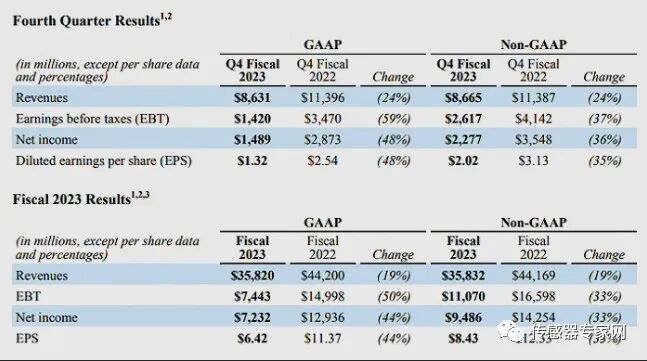
Despite a significant year-on-year decline, Qualcomm’s fourth-quarter performance exceeded expectations in terms of sales and earnings, with Qualcomm’s stock rising more than 3% in after-hours trading.
Qualcomm’s fate is closely tied to the smartphone industry, which has been in a slump for the past two years.
Qualcomm’s Chief Financial Officer Akash Palkhiwala stated during a conference call with analysts, “We are seeing early signs of stabilization in global demand for 3G, 4G, and 5G phones.” He said Qualcomm expects the total shipment volume of phones using its chips to decline “mid to high single-digit percentage” compared to last year, which is better than the company’s previous expectations.
In the fourth quarter, Qualcomm’s mobile chip sales fell 27% year-on-year to $5.46 billion, exceeding StreetAccount’s expectations of $5.34 billion. These sales are included in the QCT department, Qualcomm’s largest department responsible for selling processors, which saw a year-on-year sales decline of 26% to $7.37 billion.
The company’s automotive business is a bright spot in the QCT department, with a year-on-year increase of 15%, generating $535 million in sales, exceeding Wall Street’s expectations. This remains a small business, but as Qualcomm persuades more automakers and parts manufacturers to use its chips in vehicles, it will continue to grow.
The company’s “Internet of Things” business (which also includes chips for Meta’s Quest headset) saw a year-on-year decline of 31%, with revenue of $1.38 billion. The company’s profitable licensing business QTL reported sales of $1.26 billion, a year-on-year decline of 12%, in line with StreetAccount’s expectations.
Earlier this year, Qualcomm stated that it would continue to supply Apple with 5G modems for phones until 2026. Previously, analysts had expected Apple to use different modems this year.
【South Korea Announces Investment of 440.4 Billion Won in 6G Communication Technology R&D】
On November 2, South Korea was one of the first countries to begin R&D on 6G technology, with LG Electronics and Samsung Electronics starting their respective 6G-related technology research a few months before and after the launch of 5G commercial services.
The South Korean Ministry of Science and Information and Communication Technology announced on Wednesday that it will invest 440.7 billion won in R&D for 6G network services.
According to reports, the 440.7 billion won will be used for the development of technologies related to wireless communication, mobile core networks, 6G wireless networks, 6G systems, and 6G standardization.
South Korea hopes that 6G technology can provide diverse services, including the development of ultra-high-speed, large-capacity optical transmission systems to improve the latency of wired networks, as well as urban air traffic and virtual reality, which can fully utilize the benefits brought by 6G.
They stated that they will strive to standardize domestic 6G technology according to international standards, with the earliest formulation expected to begin in 2024. This plan also involves the development of mid-to-high frequency band technologies covering the frequency range of 7GHz to 24GHz, which can also help upgrade 5G networks.
The South Korean Ministry of Science and Information and Communication Technology also stated that they plan to showcase the results of 6G network R&D by 2026 and aim to play a role in the formulation of international standards for next-generation network services.
Starred content = content you care about, according to the recommendation principles of WeChat public accounts, if not marked as a star on the Sensor Expert Network public account homepage, you will not be able to receive the latest news in the sensor industry in a timely manner!
Disclaimer: The content of this article reflects the author’s personal views and does not represent the views or positions of the Sensor Expert Network. More opinions are welcome in the comments.
If you have submission, exposure, or interview needs, please email:[email protected].Recommended Reading:
- 2021 Global Best Sensor Awards Announced! Chinese Sensors Won Awards and Broke World Records
- Wuhan University 1052-page PPT Takes You Through Sensor Technology (The Most Comprehensive!)
-
Revealing the New Japanese Billionaire, Who Comes from Sensor King Keyence?!




ShareCollectLikeView