🔍 Problem Identification
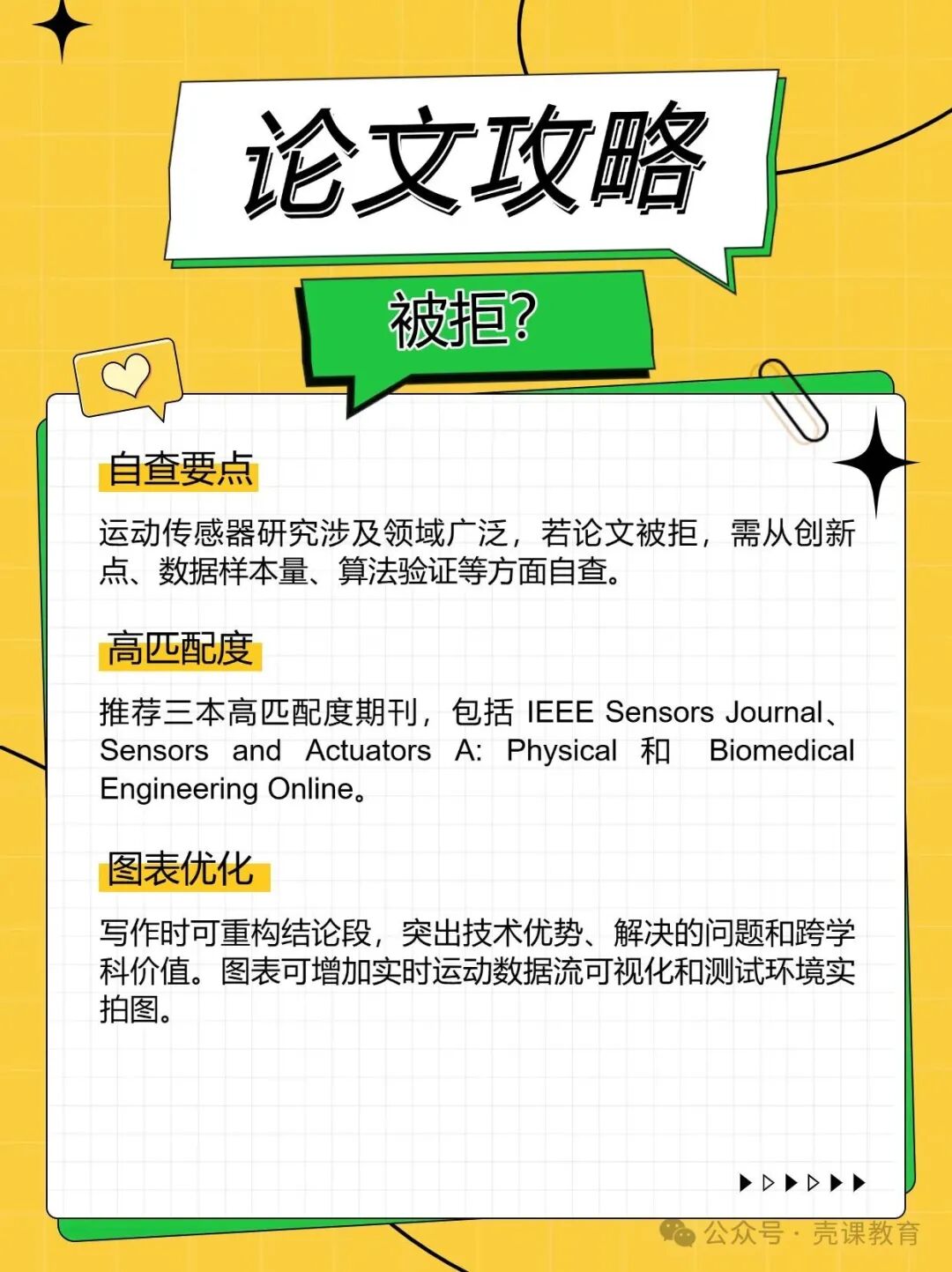
Research on motion sensors often involves biomechanics/wearable devices/medical monitoring fields
If you are frequently rejected, self-check:
① Are the innovations focused on practical application scenarios?
② Does the data sample size cover multi-dimensional motion characteristics?
③ Is the algorithm validation compared with classical models?
📚 Recommended Journals with High Match Rates
1. IEEE Sensors Journal (ISSN:1530-437X)
▫️ Impact Factor: 4.3 (2023 JCR)
▫️ Review Cycle: 8-12 weeks | Published 6 months after acceptance
▫️ Focus Areas: Intelligent sensing systems/motion signal processing
▫️ Publication Fee: $1950 (Open Access optional)
2. Sensors and Actuators A: Physical (ISSN:0924-4247)
▫️ Impact Factor: 3.9 | Review Cycle: 10 weeks
▫️ Preferred Research: Novel sensor materials/dynamic capture technologies
▫️ Acceptance Rate Tip: Experiments must include error analysis charts
3. Biomedical Engineering Online (ISSN:1475-925X)
▫️ Open Access SCIE | Impact Factor: 3.1
▫️ Fast Publication: Online 4 months after acceptance
▫️ Key Focus: Clinical validation of medical-grade sensors
✍️ Writing Strategy Upgrade
🚩 Conclusion Section Reconstruction Formula
Technical advantages + specific problems solved + interdisciplinary value (e.g., rehabilitation medicine/sports training)
🚩 Chart Optimization Focus
① Increase real-time motion data stream visualization (line charts > tables)
② Supplement with real photos of the testing environment for wearable devices
⏱️ Timing for Submission Control
▫️ Avoid peak periods of academic conferences (e.g., before the IEEE conference in October each year)
▫️ Choose special issue submission periods to increase acceptance rates by over 20%
💡 Tips from Experienced Scholars
When submitting manuscripts to editors, include discussions on controversial issues in the field (e.g., “The signal attenuation problem of existing piezoelectric sensors at high speeds”) to trigger a fast review mechanism.