Taking NXP’sTJA1028 as an example, this article explains the working principle of the LIN chip.
TJA1028 is a transceiver integrated with a low-dropout regulator, compliant with LIN 2.0/2.1/SAE J2602 and ISO17987-4:2016 (12V) standards. The maximum output current of the regulator is 70mA, providing both 3.3V and 5.0V versions. To support reliable designs, TJA1028 offers strong electrostatic discharge (ESD) performance and can withstand high voltages on the LIN bus. To minimize current consumption, TJA1028 supports a sleep mode, in which the LIN transceiver and regulator power are turned off, but it still has the capability to be awakened via the LIN bus.
TJA1028 supports four operating modes: Normal, Standby, Sleep, and Off. The transition relationships between these four modes are shown in the figure below. From the figure, it can be seen that the transitions between modes are mainly controlled by the voltage levels of EN, RSTN, TXD, and VBAT, which work together to control the operation.
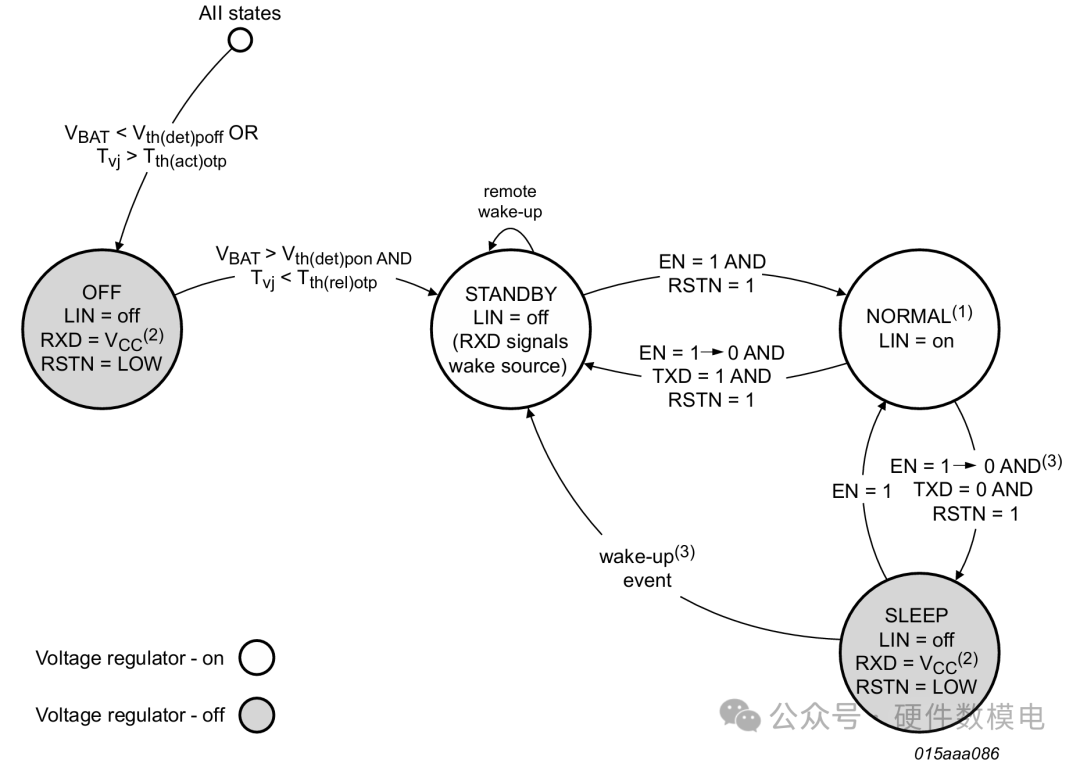
- Normal (正常): The transceiver and the on-chip LDO are both operational, allowing for full-duplex transmission; the bus current I (BAT) is approximately 0.85–1.8 mA in idle state and about 2.0–4.5 mA in active state. It supports disabling the transmitter to enter the “Receive Notification” state via EN/RSTN.
- Standby (待机): The LDO maintains power for the MCU, and the transceiver operates in low power mode; typical I (BAT) is about 45 μA. It supports LIN remote wake-up or wake-up via high EN, allowing for quick recovery of communication after waking up.
- Sleep (休眠): Both the transceiver and LDO are powered off, resulting in the lowest power consumption; typical I (BAT) is about 12 μA. It supports LIN remote wake-up or wake-up via high EN, but after waking up, it must wait for the LDO to power up and reset/reinitialize.
- Off (关断): Chip-level shutdown, with both the LDO and transceiver non-operational, consuming only a small amount of power for monitoring paths, with power consumption close to 0. It must be restored by the system EN/RSTN, commonly used in fault-safe or deep sleep scenarios.
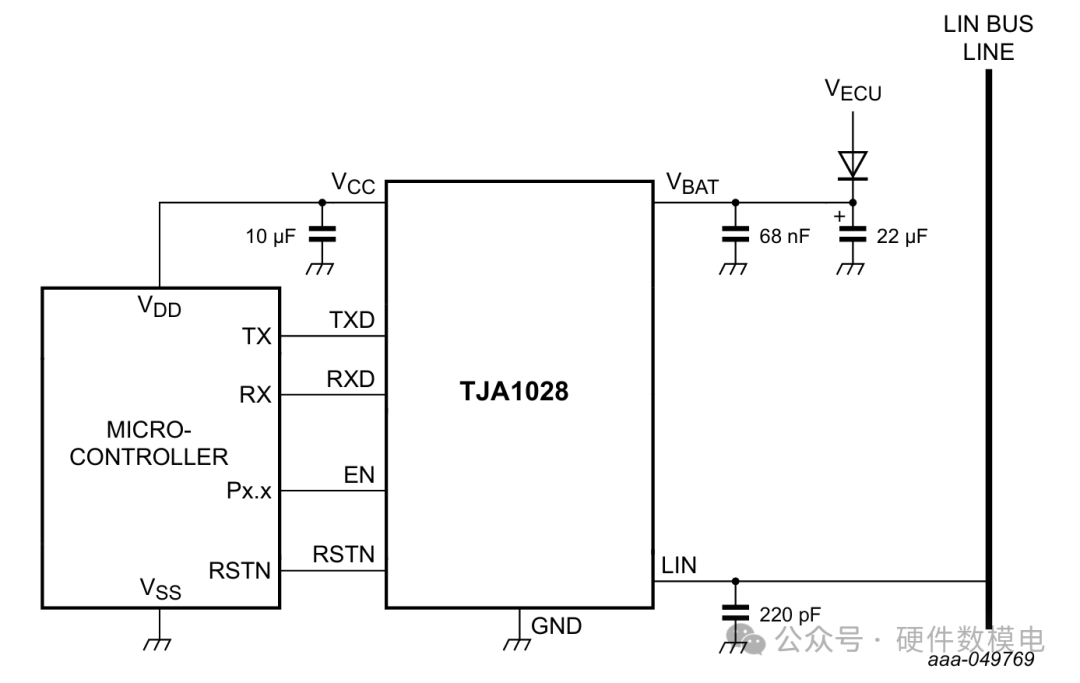
The typical application circuit of TJA1028 is shown below: