1. Experiment Task
As shown in the figure below, two common cathode seven-segment displays are connected to the P0 and P2 ports of the AT89S51 microcontroller, where the P0 port drives the tens place of the seconds display, and the P2 port drives the units place of the seconds display.
2. Circuit Diagram
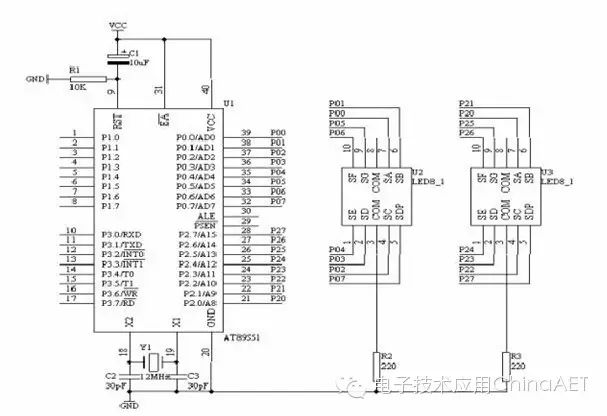
Figure 4.11.1
3. Hardware Connections on the System Board
(1. Connect the P0.0/AD0 to P0.7/AD7 ports in the “Microcontroller System” area to any of the a-h ports in the “Four-Way Static Digital Display Module” area using an 8-core ribbon cable; requirements: P0.0/AD0 corresponds to a, P0.1/AD1 corresponds to b, …, P0.7/AD7 corresponds to h.
(2. Connect the P2.0/A8 to P2.7/A15 ports in the “Microcontroller System” area to any of the a-h ports in the “Four-Way Static Digital Display Module” area using an 8-core ribbon cable; requirements: P2.0/A8 corresponds to a, P2.1/A9 corresponds to b, …, P2.7/A15 corresponds to h.
4. Program Design Content
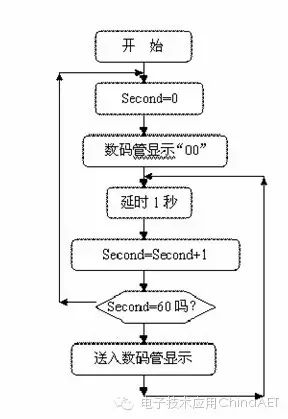
(1. In the design process, we use a memory unit as the second counting unit. When a second passes, the second counting unit increments by 1. When the second count reaches 60, it automatically returns to 0 and restarts the second count.
(2. The data in the second counting unit needs to be separated into tens and units, using division by 10 and modulo 10.
(3. The display on the seven-segment display is still achieved through a lookup table.
(4. The generation of one second is achieved here using a software precise delay method, with the precise calculation yielding that 1 second is equivalent to 1.002 seconds.
DELY1S: MOV R5,#100
D2: MOV R6,#20
D1: MOV R7,#248
DJNZ R7,$
DJNZ R6,D1
DJNZ R5,D2
RET
5. Program Flowchart
6. Assembly Source Code
Second EQU 30H
ORG 0
START: MOV Second,#00H
NEXT: MOV A,Second
MOV B,#10
DIV AB
MOV DPTR,#TABLE
MOVC A,@A+DPTR
MOV P0,A
MOV A,B
MOVC A,@A+DPTR
MOV P2,A
LCALL DELY1S
INC Second
MOV A,Second
CJNE A,#60,NEXT
LJMP START
DELY1S: MOV R5,#100
D2: MOV R6,#20
D1: MOV R7,#248
DJNZ R7,$
DJNZ R6,D1
DJNZ R5,D2
RET
TABLE: DB 3FH,06H,5BH,4FH,66H,6DH,7DH,07H,7FH,6FH
END
7. C Language Source Code
#include <AT89X51.H>
unsigned char code table[]={0x3f,0x06,0x5b,0x4f,0x66,
0x6d,0x7d,0x07,0x7f,0x6f};
unsigned char Second;
void delay1s(void)
{
unsigned char i,j,k;
for(k=100;k>0;k--)
for(i=20;i>0;i--)
for(j=248;j>0;j--);
}
void main(void)
{
Second=0;
P0=table[Second/10];
P2=table[Second%10];
while(1)
{
delay1s();
Second++;
if(Second==60)
{
Second=0;
}
P0=table[Second/10];
P2=table[Second%10];
}
}