In the modern industrial automation field, Soft PLCs act like a flexible “digital nerve,” closely connecting the “muscle” (hardware devices) of traditional machinery with the intelligent “brain” (software algorithms), endowing production lines with more agile execution capabilities and smarter decision-making abilities.
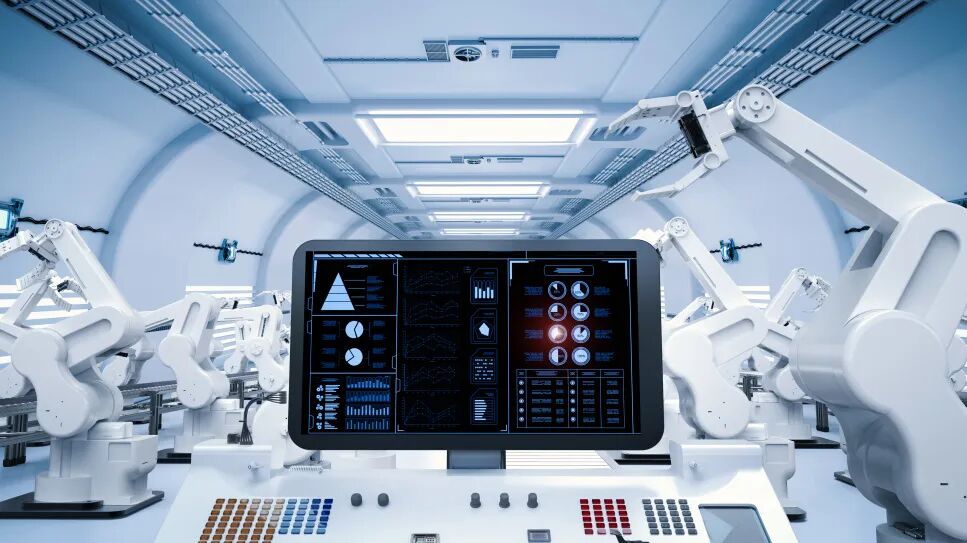
Traditional PLCs excel in achieving stable and efficient standardized processes, making them ideal for traditional mass production. However, when faced with the increasing demands for flexibility, personalization, and intelligent production, their fixed hardware logic shows certain adaptability limitations. In contrast, Soft PLCs are like “programmable chips,” capable of adjusting logic at any time and supporting flexible manufacturing with small batches and multiple varieties. Additionally, traditional PLCs (in the OT field) are relatively closed and independent, while Soft PLCs naturally adapt to IT systems (such as MES and ERP), allowing seamless data flow in factories and enabling the “cross-domain integration” of IT and OT.
An Overview of Yihui Soft PLC Technology Solutions
The Yihui Soft PLC solution can quickly realize the transformation from embedded boards to PLC products, thanks to Yihui’s accumulated standardized BSP (Board Support Package) platform and mature, highly extensible IGC SDK (Software Development Kit):
Hardware Abstraction and Standardization
Through the BSP layer, the differences in underlying hardware are masked, allowing the same set of PLC control logic to adapt to different embedded boards, achieving a Soft PLC architecture where “hardware is replaceable and software is reusable.”
Rapid Development and Flexible Expansion
The IGC SDK provides a programming environment compliant with IEC 61131-3 standards, supporting users in extending custom function blocks based on high-level languages to meet complex control requirements.
Real-time Performance and Reliability Assurance
By combining large real-time operating systems (such as SylixOS) and hardware acceleration, control cycles can reach the μs level, meeting the needs of high-precision motion control scenarios.
Open Ecosystem and Industrial Interconnectivity
At the core of Yihui’s self-developed VSOA distributed soft bus, an open and unified interconnection foundation is built. VSOA breaks through the limitations of traditional industrial protocols, achieving cross-protocol (supporting industrial protocols such as Modbus, PROFINET, EtherCAT), cross-regional, and cross-platform real-time data intercommunication and functional collaboration. Relying on Yihui’s self-developed technology stack, it realizes unified connections and open foundations from edge to cloud, from real-time control to intelligent analysis.
Yihui IGC1503: A Typical Example of Soft-Hardware Collaboration
The Yihui IGC series controllers are successful products of the Soft PLC solution, with IGC1503 as a representative. This is a Soft PLC runtime environment based on the SylixOS large real-time operating system, exemplifying deep collaborative optimization with self-designed industrial hardware platforms. It achieves full-stack technology integration from the operating system layer, runtime layer to hardware layer, providing users with a high-performance, high-determinism, and highly integrated control solution.
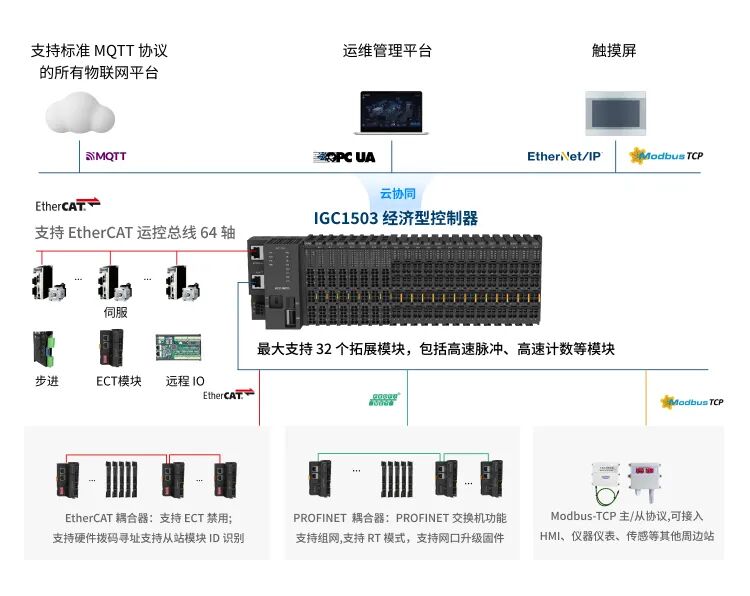
Yihui IGC1503 Electrical Topology Diagram
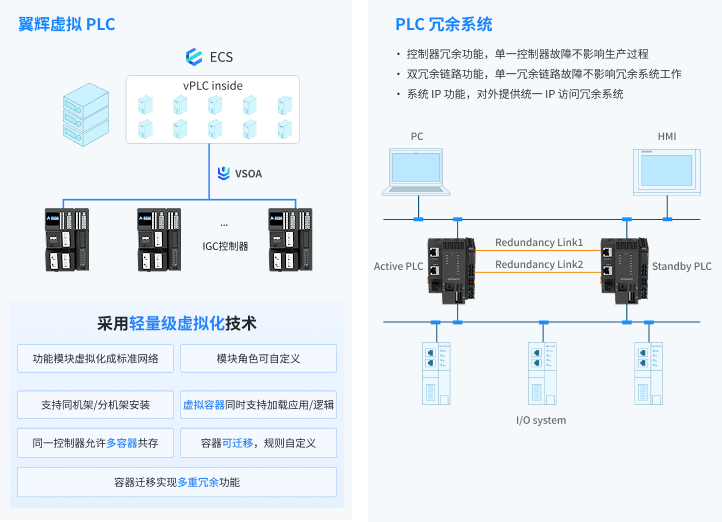
Yihui PLC Solutions
01

Soul: Deep Integration of Soft PLC Technology with Real-time Kernel
Determinism Guaranteed by Hard Real-time: SylixOS, as a domestically produced large hard real-time operating system, provides microsecond-level interrupt response and task switching precision. This ensures extremely strict time determinism for the scanning cycle of Soft PLCs and motion control loops, achieving outstanding performance with task jitter stabilized within ±10μs.
Kernel-level Bus Protocol Stack: Key industrial network protocols (such as EtherCAT) run directly in kernel mode as drivers or kernel modules within SylixOS. This architecture eliminates data copying and context switching overhead between user mode and kernel mode, resulting in lower processing latency and higher efficiency for the protocol stack, serving as the technical foundation for achieving high-precision synchronized motion control (such as 32-axis synchronization).
02

Body: Hardware Architecture Tailored for Soft PLCs
Hard Isolation of Processor Resources and Dedicated Cores: Equipped with a domestically produced quad-core 1.2GHz processor, this is not just simple parallel processing. In system design, this “dedicated core” design eliminates task interference at the hardware level, fundamentally ensuring ultra-high real-time performance.
Co-optimization of Hardware and Software: The FPGA or dedicated communication coprocessor on the hardware platform works deeply with the SylixOS kernel driver, responsible for the precise sending and receiving of EtherCAT frames, synchronization calibration of distributed clocks (DC), and other high-speed hardware operations, significantly reducing CPU load and further enhancing overall performance and determinism.
Deep Integration of Expansion Architecture: Its powerful local I/O expansion capability (supporting up to 32 modules) tightly integrates the backplane bus with SylixOS’s device management framework and the I/O mapping service of Soft PLCs, ensuring that the refresh cycle of all distributed I/O points can be included in a unified real-time task scheduling, completing synchronization with the controller memory within a determined cycle.
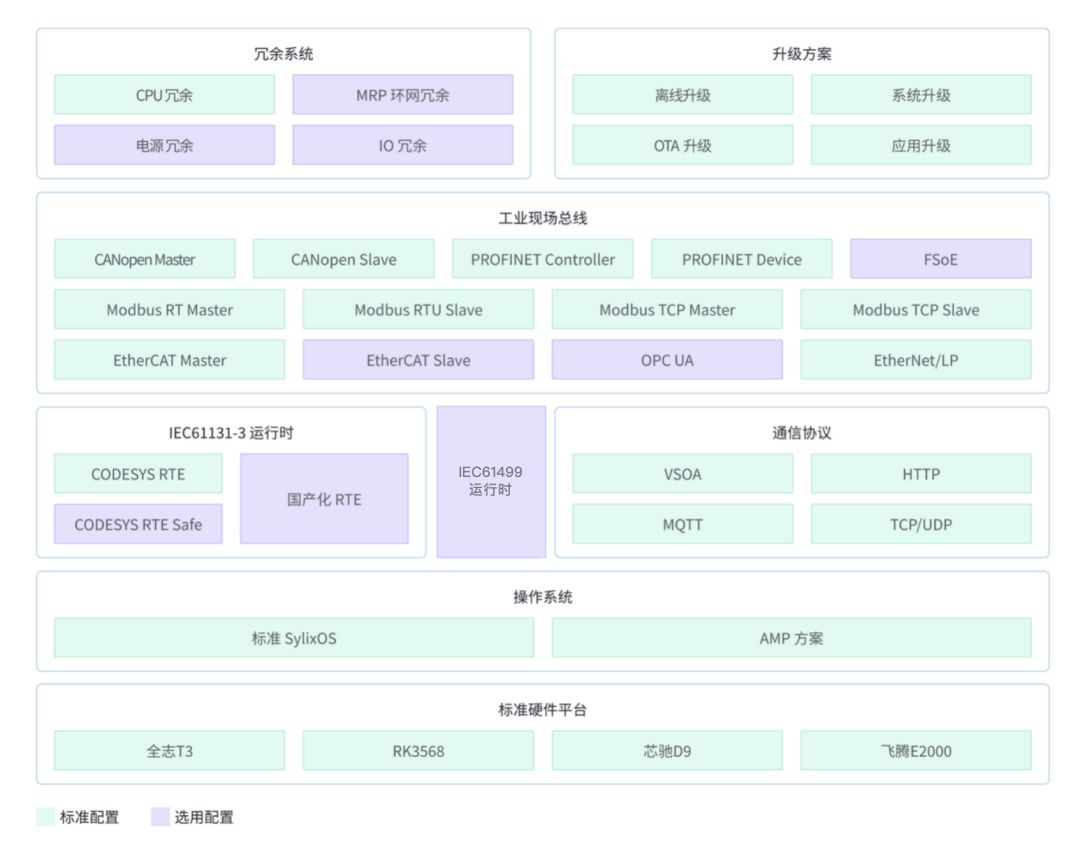
Yihui Information’s “Soft PLC” Technology Architecture
Yihui Information’s solution possesses openness and flexibility, allowing users to develop programs using a programming environment compliant with IEC 61131-3 standards (such as CODESYS) without relying on specific brand proprietary hardware. This provides the convenience of software iteration and a rich ecosystem. Through vertical integration of hardware and software, it achieves deterministic performance and industrial-grade reliability comparable to hard PLCs, overcoming the shortcomings of traditional Soft PLC solutions in stability and environmental adaptability.
Core Advantages of Yihui IGC SDK
Based on Yihui’s self-developed SylixOS real-time operating system, the IGC SDK has the following core advantages:
01
Adaptability to Diverse Hardware Architectures:
Covers mainstream and domestically produced chip architectures such as ARM32/64, x86/x64, MIPS32/64, LoongArch, RISC-V32/64, achieving true “one-time development, multi-platform deployment.”
02
Out-of-the-box BSP Ecosystem:
✓ Provides standardized BSP libraries, allowing customers to directly reuse existing driver support, significantly shortening the hardware adaptation cycle.
✓ Based on over ten years of BSP development experience, it provides deep optimization support for domestically produced chips (such as memory management/interruption response tuning).
✓ Supports automatic adaptation of toolchains, allowing the same code to be seamlessly ported to target architectures through different compilers.
03
Domestic Full-stack Technical Assurance:
✓ Self-controlled kernel: Achieves 100% domestication from the operating system to the BSP layer, avoiding supply chain risks.
✓ Real-time assurance: Ensures μs-level response in industrial scenarios through time-deterministic scheduling and core isolation technologies.
04
Yihui IGC SDK can help customers:
✓ Shorten the hardware adaptation cycle.
✓ Directly reuse existing BSP + toolchain, significantly reducing the cost of compatibility verification for domestically produced chips.
✓ Continuously provide BSP upgrades and security patches, ensuring full lifecycle maintenance support for customers.
✓ BSP has been verified based on multiple domestic platform architectures.
Optimization of Real-time Task Scheduling in SylixOS
SylixOS adopts a default Tick frequency of 1000Hz, ensuring system response determinism through a refined real-time task scheduling mechanism. When executing periodic tasks, the system intelligently distinguishes task characteristics:
For critical high-priority tasks with execution times shorter than 1ms, the system will keep them running exclusively on the CPU core, avoiding performance loss due to task switching; while for tasks with execution times exceeding 1ms, a strict priority preemptive scheduling strategy is adopted—the system always prioritizes high-priority tasks, only utilizing time gaps to execute low-priority tasks when high-priority tasks enter a waiting state.
This tiered scheduling mechanism ensures microsecond-level response capabilities for critical real-time tasks while achieving efficient utilization of system computing resources, perfectly balancing the demands of real-time performance and system throughput.
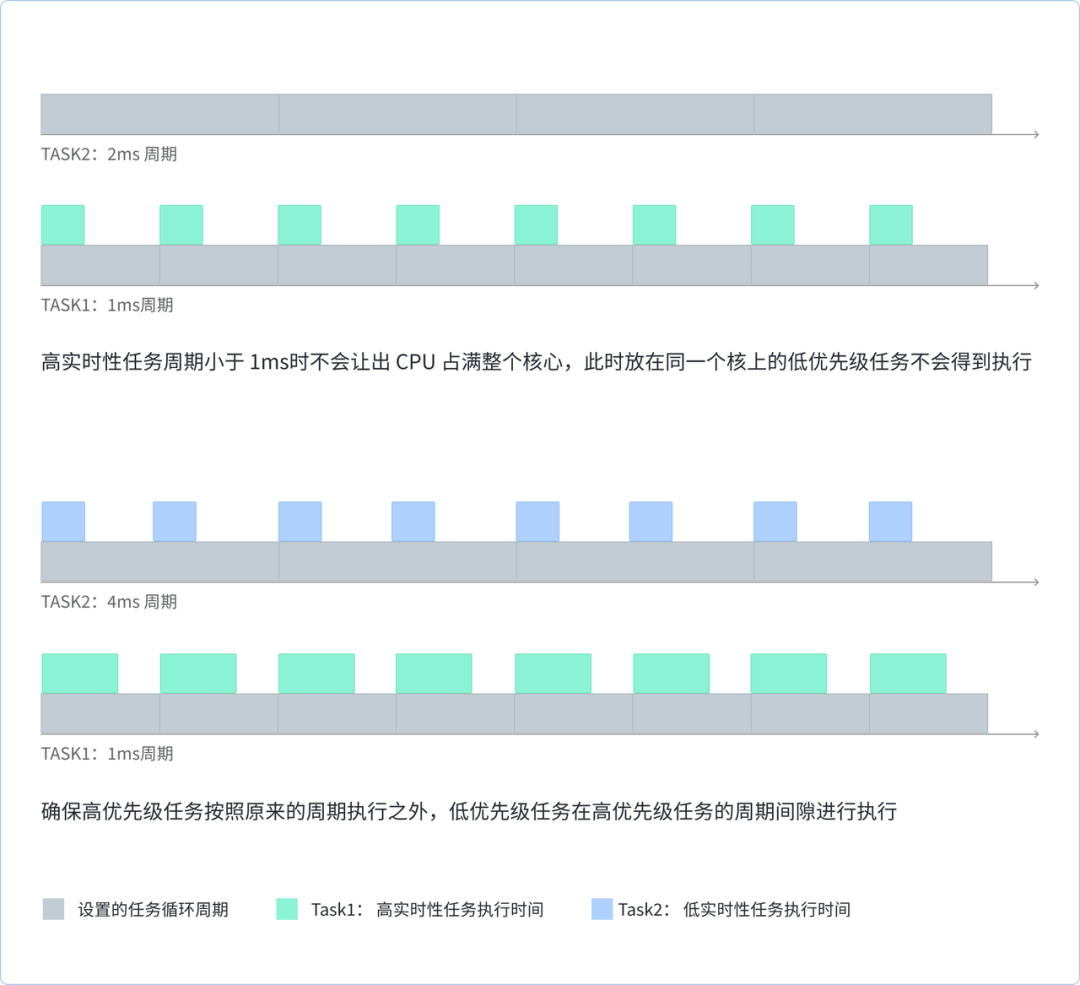
SylixOS Real-time Task Scheduling Optimization Diagram
ACOINFO
1. Cache Optimization: During normal task scheduling, task context switching triggers many cache flush operations, which can increase task jitter. SylixOS can significantly reduce cache-induced jitter issues by optimizing caches across different platforms and adapting to the cache partitioning features within CPU architectures (such as ARM DSU).
2. RMS (Rate Monotonic Scheduling) + FIFO (First-In-First-Out) Scheduling Strategy: PLC task scheduling has distinct periodic characteristics—most tasks operate regularly like clock gears, with relatively stable execution logic and duration. Based on this characteristic, we adopt RMS (Rate Monotonic Scheduling) as the priority allocation strategy, ensuring that tasks with shorter periods have higher priorities; simultaneously, we combine FIFO (First-In-First-Out) queue management, allowing high-priority tasks to “cut in line” like vehicles on an “emergency lane,” seizing execution rights from low-priority tasks. The advantages of this combined strategy include:
• Strong Real-time Assurance: High-priority tasks (such as high-speed I/O acquisition) can always “cut in line” for execution, ensuring the timeliness of critical operations;
• Overload Resistance Design: When system load surges, low-priority tasks (such as logging) can be directly “abandoned,” avoiding unnecessary context switching that drags down overall response, thus eliminating jitter in the execution of high-priority tasks;
• Deterministic Scheduling: Tasks are processed in strict priority order like workpieces on an assembly line, making system behavior highly predictable, meeting the stringent stability requirements of PLCs.
3. Task Core Binding and Core Affinity Configuration: In real-time systems, task scheduling is like precise traffic control—core binding (CPU pinning) ensures that critical tasks exclusively occupy their “lane,” while strict core affinity acts like a barrier, preventing unrelated tasks from interfering. By setting SCHED_FIFO + cpuset for forced isolation, the bound core serves only real-time tasks, while ordinary tasks and even kernel threads are not allowed to “borrow the lane”; this also avoids cold start jitter caused by other tasks flushing the cache.
4. Support for TSN Solutions: SylixOS’s support for the TSN (Time-Sensitive Networking) protocol family fundamentally enhances the real-time capabilities of the operating system, providing nanosecond-level jitter, microsecond-level synchronization, and seamless redundancy for the most critical real-time tasks. SylixOS deeply integrates the TSN protocol stack (especially 802.1AS and 802.1Qbv) into the kernel network stack, tightly coupling it with its high-precision clock interrupts and task scheduler. This allows the system to prioritize scheduling corresponding communication tasks before the time window for sending/receiving critical packets arrives, ensuring timely access to CPU resources for processing network data, thus eliminating jitter caused by operating system scheduling and achieving “end-to-end” determinism. (To learn more, click to view the full introduction to TSN: Time-Sensitive Networking TSN Helps Users Eliminate Two Major Problems—SylixOS Network Landscape Welcomes New Members)
5. Real-time Network Card Optimization:Standardization: The SylixOS network driver framework reserves polling send/receive interfaces for periodic calls as a real-time protocol stack.Real-time Performance: With professional and mature network driver development experience, there is also a standardized optimization process for real-time performance that can be applied to different network drivers.
Building a Strong Foundation for Customer Value with Professional Development Strength
With the advent of Industry 4.0, we believe that future industrial control will evolve from a “single robotic arm” to a “fully coordinated intelligent entity,” requiring both hard PLCs to provide a reliable “trunk” and Soft PLCs to weave a smart “nervous system,” jointly promoting industrial automation towards a more open and intelligent era.
To meet the diverse needs of different customers, the Yihui Information team will rely on a fully domesticated industrial control digital base and rich industry practical experience, adhering to a long-term deep cooperation concept, and will launch various flexible and adaptable business models:

License Model, Lowering the Entry Threshold: Small and medium-sized equipment manufacturers and customers needing to migrate from other platforms can quickly build their product series at a relatively low cost by purchasing operating system software licenses.
Standardized IGC SDK, Quick Start: Provides integrated hardware and software solutions and standardized IGC SDK. Industrial automation upstream and downstream channel vendors can directly deploy and verify controller systems and PLC programming platforms. Through actual operation testing, they can accurately assess the matching degree of technical solutions and business needs, avoiding blind investment in the project initiation phase.
Entrust Professional Development, Efficiently Achieve Goals: Domestic automation manufacturers facing high safety and reliability application fields such as domestic substitution should jointly carry out projects for new product definitions with integrators, and can choose to fully entrust Yihui Information with the customization services of controller systems and PLC programming software development platforms. The team, with its professional technical capabilities and rich project experience, can accurately grasp manufacturers’ needs and assist them in achieving customized development goals, minimizing detours.
Provide Ready-to-Use Industrial-grade Products: Pre-installed IGC product series with rigorously verified SylixOS real-time systems and CODESYS development environments can be put into production deployment by domestic automation equipment manufacturers and project integrators right out of the box. Yihui provides continuous support from hardware maintenance, software upgrades to security patches, ensuring that devices meet IEC 61131-3 industrial standards.
ACOINFO
Previous Issues Review