Click the blue text above “Industrial Control Beacon” to follow!
Soft PLC: A Re-examination of the Dilemma Facing Industrial Innovators.
In Brief
-
In industrial environments, software is increasingly replacing hardware.
-
Today, software-based controllers (Soft PLCs) are reliable, powerful, and flexible.
-
The adoption rate of Soft PLCs is expected to double between 2019 and 2025, presenting an “innovator’s dilemma” for existing industrial automation suppliers.
-
Actions taken by existing companies will prevent significant disruption in the short term, but the long-term threat of Soft PLCs will remain.
Why Is This Important?
-
The widespread adoption of Soft PLCs will fundamentally change how industrial automation works and how factories operate.
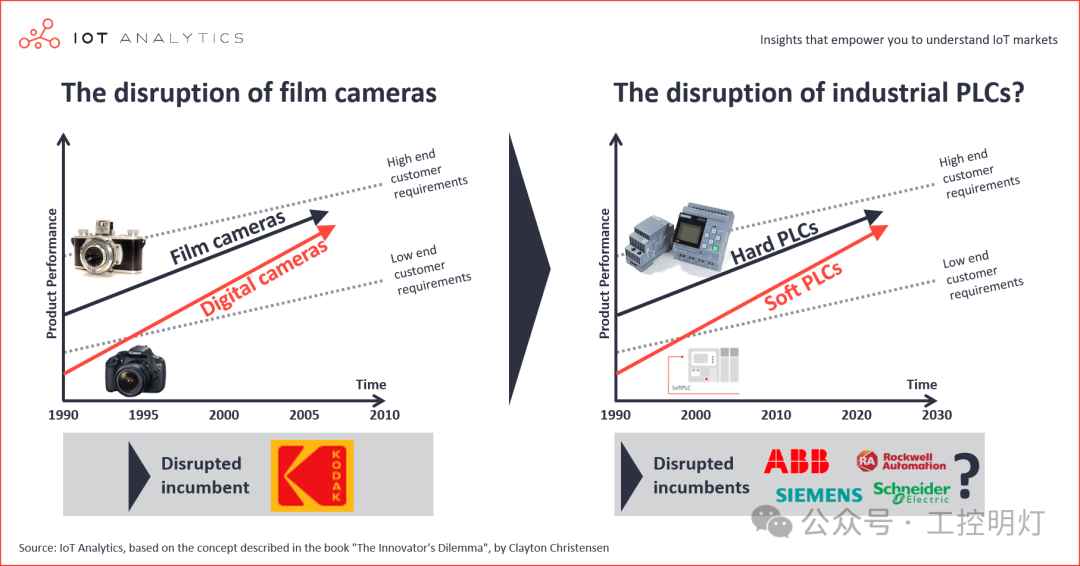
Kodak is a notorious example of a successful company that went from completely dominating its field to bankruptcy due to digital disruption. In 1976, the company held a 90% market share of global photographic film sales and pioneered the world’s first digital handheld camera in 1975, obtaining a patent. However, fearing the erosion of its existing high-margin film business, Kodak delayed the development and commercialization of digital handheld cameras. This delay opened the door for lower-cost Asian competitors and ultimately led to Kodak filing for bankruptcy in 2012.
This historical lesson is still relevant today. The struggle between protecting existing businesses by meeting current customer needs and adopting new technologies to meet future demands is known as the “innovator’s dilemma” (coined by Clayton Christensen). It has plagued businesses for decades and led to the complete collapse of several market leaders, such as Kodak.
The industrial world has not been spared from digital disruption and is currently on the brink of a technological revolution. Today, industrial control is primarily managed by PLCs (Programmable Logic Controllers), affectionately referred to as the industrial black box. It guides time-critical processes such as motor control and valve control through hard wiring and operates based on programs written and input by users. Almost every manufacturing process today utilizes this technology provided by industrial automation companies like Siemens, Rockwell Automation, ABB, and Schneider Electric.
Advancements in virtualization technology, real-time Linux operating systems, and inexpensive yet powerful edge computers have enabled companies to replace these “industrial black boxes” with software-based PLCs (Soft PLCs) running on standardized hardware like industrial PCs. The adoption of these Soft PLCs represents a significant shift in automation deployment.
A Brief History of Industrial Controllers and Soft PLCs
From the bulky, maintenance-intensive relay-based systems of the 1960s to today’s programmable logic controllers (PLCs) based on high-speed processors, industrial control has come a long way. Initially, it was a basic attempt to replace relay control, quickly evolving into the foundation of modern industrial control and automation.
The launch of Windows in 1985 sparked the first wave of Soft PLCs, manifesting in PC-based control systems. Engineers quickly recognized the benefits of combining PLC control and HMI in one box (PC). Various Windows-based control systems emerged in the 1990s (e.g., ASAP, Think and Do, Steeplechase Software, and Wonderware), but none gained sustained attention in the market. “Blue screen of death” raised questions about the reliability of these systems, while the lack of virtualization/containerization technology made it difficult to efficiently run multiple workloads (e.g., HMI and control) on a single machine. Fast forward to 2020, with the maturation of Linux operating systems, virtualization technology, and low-cost edge computing hardware, the value proposition of PC-based control is much stronger than in the 1990s, addressing many of the early problems that plagued the first wave of PC-based control systems. Today’s Soft PLCs are more reliable, powerful, and flexible than past PC-based systems, posing a real threat to the beloved “black box.”
The “Innovator’s Dilemma” Brought by Soft PLCs
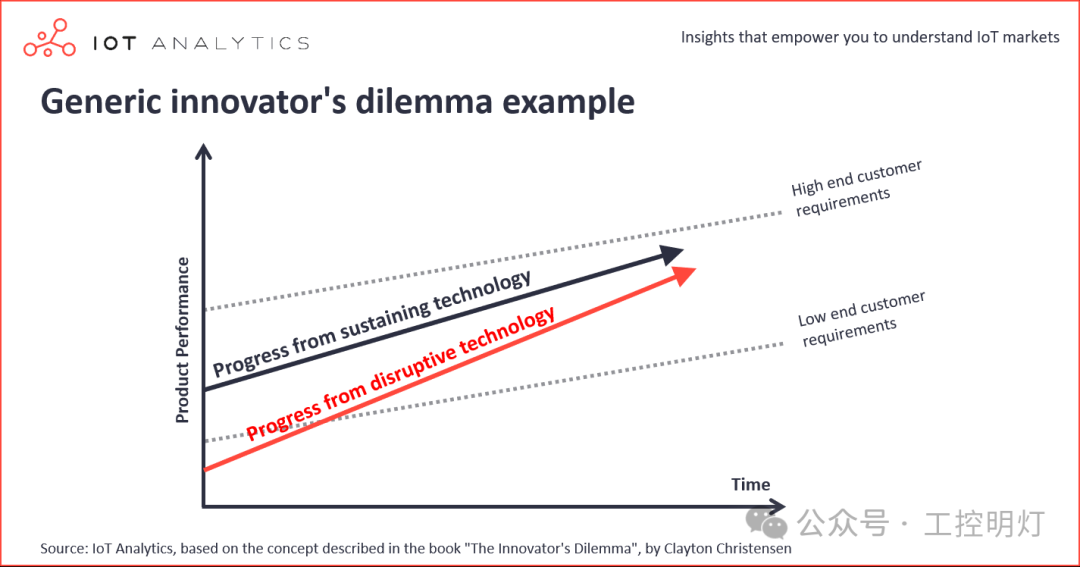
Soft PLCs represent a disruptive technology that brings the typical “innovator’s dilemma” to existing “hard PLC” suppliers. When existing businesses are disrupted by new technologies, the innovator’s dilemma arises. When disruptive technologies emerge, existing companies face an “innovator’s dilemma” of either continuing to serve existing/high-end customers through ongoing improvements to existing products or developing products built on disruptive technologies to serve new/low-end customers. A general description of this scenario is illustrated as follows:
If we apply the above general innovator’s dilemma diagram to the PLC market, we get the following diagram:
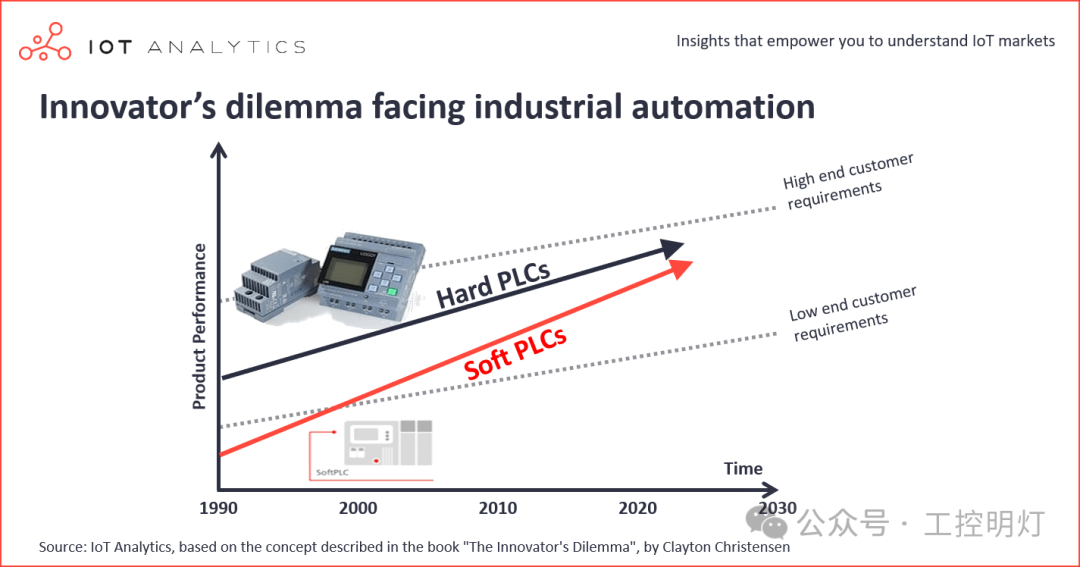
This diagram is overly simplified (e.g., different types of hard PLCs serve both high-end and low-end markets, with at least two types of Soft PLCs, etc.), but it captures the essence of market dynamics similar to the classic “innovator’s dilemma.” Hard PLCs (the market dominated by existing suppliers) have historically met most of the needs of the existing/high-end market, such as high reliability, fast cycle times, and perhaps most importantly, existing employee support and maintenance systems. On the other hand, Soft PLCs initially met the needs of new/low-end customers by providing more flexible, uncertain control solutions, often at a fraction of the cost of hard PLCs. Since entering the market in the 1990s, the performance of Soft PLCs has rapidly improved, thanks to advancements in virtualization technology, real-time Linux operating systems, and more powerful edge computing hardware, thus moving the y-axis (product performance) in the above diagram upwards.
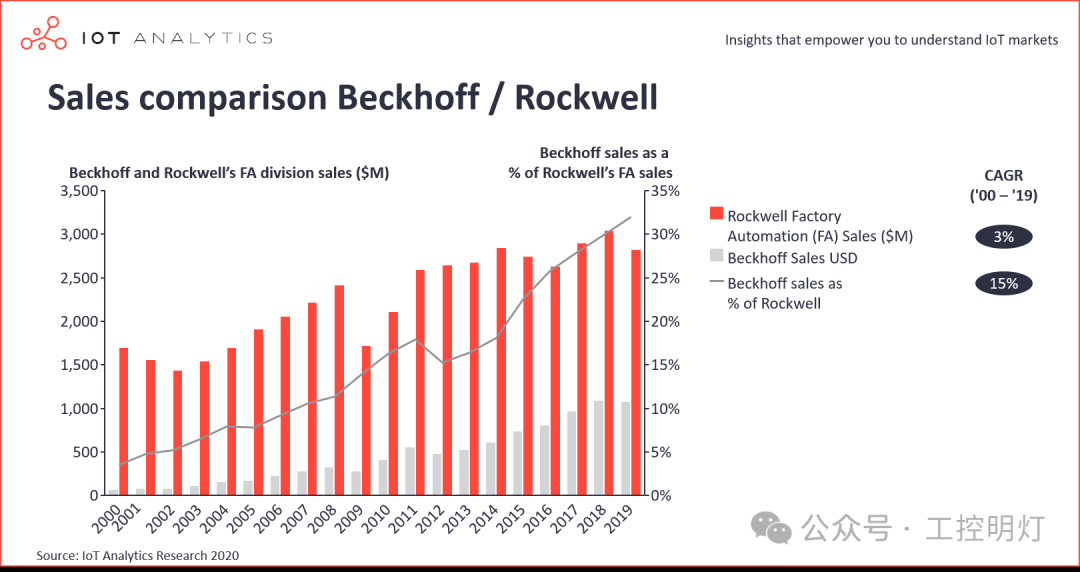
To further support the argument that Soft PLCs are indeed a disruptive force in the market, we can look at the success of Beckhoff (a supplier utilizing Soft PLC technology) relative to leading “hard PLC” supplier Rockwell Automation.
The following chart shows Beckhoff’s sales growth at approximately 15% compounded annually since 2000, while Rockwell Automation’s factory automation division has experienced a compounded annual growth rate of 3% during the same period. This growth disparity has resulted in Beckhoff accounting for over 30% of Rockwell’s factory automation division sales in 2019, up from less than 5% in 2000.
How Existing Suppliers Can Avoid Being Disrupted
Christensen states that existing suppliers often get disrupted when they focus on improving existing products rather than jumping ship and adopting new disruptive technologies. Competitors developing products based on new technologies ultimately disrupt existing businesses, as new products eventually improve enough to serve high-end customers—the story is as simple as that.
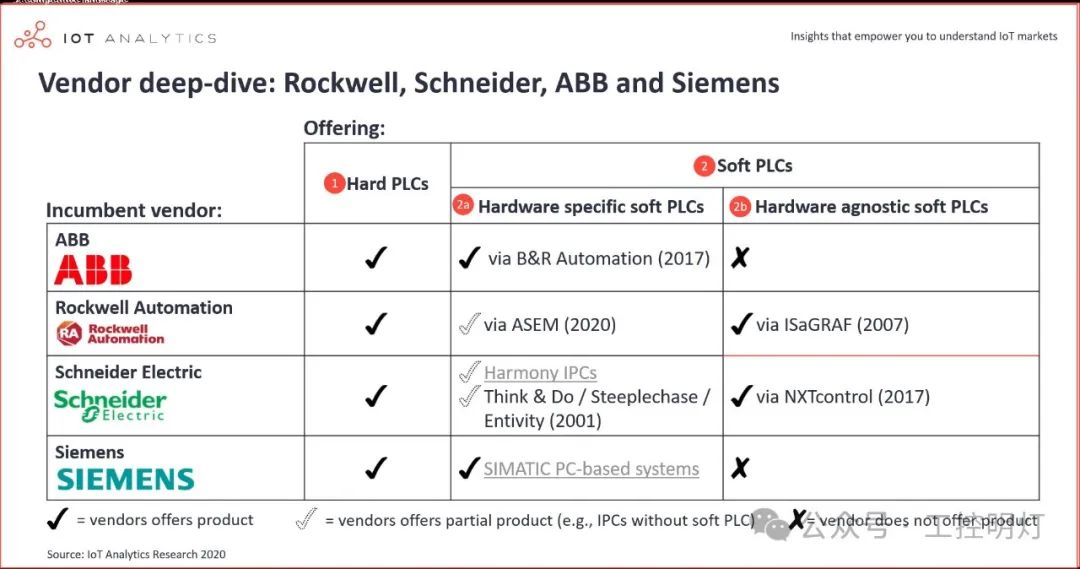
Our market analysis indicates that existing suppliers are not blind to the disruptive threat that Soft PLCs pose to their hard PLC businesses. As shown in the table below, major existing automation suppliers have Soft PLC products, many of which have come from acquisitions in the last five years:
Future Outlook
Opinions from IoT Analytics
Due to the slow adoption rate and the unfavorable nature of risks for industrial end-users, existing suppliers are unlikely to face an imminent threat of being severely disrupted by Soft PLCs. While Soft PLCs may reach or exceed certain performance characteristics of hard PLCs within the next five years, they still need to overcome significant barriers, namely decision-makers’ satisfaction with existing hard PLCs and resistance to change. Ultimately, if employees do not know how to use a technology, it does not matter how well the technology performs. As one employee of a major German industrial components manufacturer stated in an interview from our latest report:
“We standardized on Siemens [hard] PLCs because that is what our employees know—they were educated about Siemens in school, so in the end, we have to adopt what we know, even if it is more expensive.
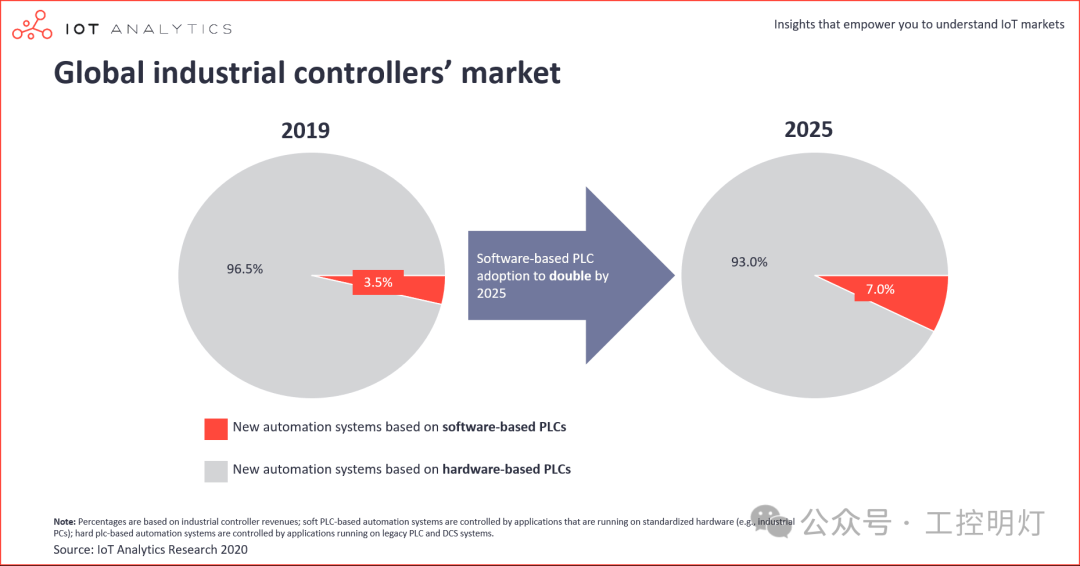
That said, the threat of Soft PLCs is not benign. Despite the labor inertia of hard PLCs (and existing enterprises), Soft PLCs are expected to continue gaining market share from hard PLCs in the future. According to our latest research, the proportion of automation systems based on Soft PLCs is expected to double from 3.5% of the entire industrial controller market to 7% from 2019 to 2025.
If existing enterprises continue to make incremental improvements to their existing products (at the expense of new innovations) to placate their existing customer base, they may find themselves becoming the next “Kodak.” Some might even say that this “gentle” disruption is already happening—the inertia held by CODESYS and the army of small to medium-sized suppliers is certainly a threat to the business of exiting suppliers, as evidenced by Rockwell’s lawsuits against CODESYS (3S)/Advantech and Wago over the past decade.
Recommended Articles
1
The police seized counterfeit industrial SCADA configuration software, come and see what software there is.
2
200 million PLC modules, refurbished counterfeit Mitsubishi, Omron, and Allen-Bradley modules, attracting the attention of the Ministry of Public Security!
3
Where do refurbished PLC modules come from? A gang that stole subway BAS system PLC modules was completely destroyed by the police.
4
Where do refurbished PLC modules come from? Episode 2, a gang that stole 3.5 million PLC modules over two years.
5
Over two years, more than 10 million PLC modules and DCS modules were stolen; where did the stolen modules go?
6
Hubei police broke up a renovation den for Siemens PLC modules worth 2 million.
7
Hangzhou public security agencies checked and seized counterfeit Siemens industrial control products PLC modules.
8
Nanchang City, Jiangxi Province, seized a case of counterfeit SIEMENS PLC industrial control products, with an involved value of nearly 2 million, live courtroom broadcast!
9
150 million DCS and PLC modules flowed into the hands of professional recyclers; Guangxi Guilin police broke a case of Emerson DCS card theft.
10
6 million Emerson Ovation DCS cards were stolen from the power plant.
11
A duo stole 3.8 million Siemens PLC and CPU modules over eight years; Chongqing Fuling police broke a major cross-province theft case.
12
Suzhou public security agencies checked and seized counterfeit Siemens PLC modules!
13
A former Siemens employee forged “Siemens” PLC modules, involving 30 million.
14
Why can others earn millions a year selling industrial control products, while you can only make tens of thousands?
15
After selling fake “Siemens” PLC module parts online, this counterfeiting den in Songjiang was destroyed by the police.
16
More than 2 million Siemens, “Holley”, “AB” and other brand control cabinet PLC modules were stolen in Jiangsu.
17
American AB agent CPU modules were stolen; the thieves and recyclers were sentenced.
18
American AB PLC (Allen-Bradley) SLC 500 series 1746/1747 modules, refurbishment revealed!
19
How to distinguish genuine Siemens products? Shanghai police successfully solved a case involving over 40 million counterfeit Siemens PLC module production and sales.
20
It was sentenced to three years in prison! Hubei police broke up a renovation den for Siemens PLC modules worth 2 million; follow-up!
21
The PLC programmable controller refurbishment company that alarmed the Ministry of Public Security was sued by Mitsubishi, with compensation of 2.6 million.
22
Exclusive reveal: Second-hand industrial automation products (industrial control) trading on “Xianyu”.
23
Reveal: How touch screens (HMI) are refurbished; the largest touch screen refurbishment player of AB earns over 1 million annually.
24
Industrial control recyclers, the Belt and Road, getting rich.
25
Has been procuring second-hand DCS modules on Xianyu, reselling for high profits, and was arrested!
26
Do you really only look at the price? Let’s get to know American A-B Allen-Bradley products.
27
Rockwell Automation (American A-B) first anti-counterfeiting in China.
28
In 2020, Suzhou theft of PLC modules involved American AB PLC traders.
29
Siemens Industrial Automation Group went to Xiamen to combat counterfeiting, encountered Schneider… live broadcast.
30
31. An industrial automation trading company in Shaanxi claims ZF’s visit; is it Xiamen help or Wuhan help?
32. Large purchases of refurbished AB PLC modules from Xiamen.
If you have business cooperation, please leave a message in the background.
We welcome all friends to share the stories you know.
1. Share insider information about the industrial control industry to guide us in finding direction.
2. Share industrial control products to improve smart manufacturing solutions.
Submission email: [email protected]

 Long press the QR code to follow Industrial Control Beacon Industrial Control BeaconBringing light to all who need it;