In various industries and applications, many FPGA designs can often be seen. A very common phenomenon is that designers often use complex finite state machines (FSM) to implement functions such as I²C, SPI, and GPIO timing control.
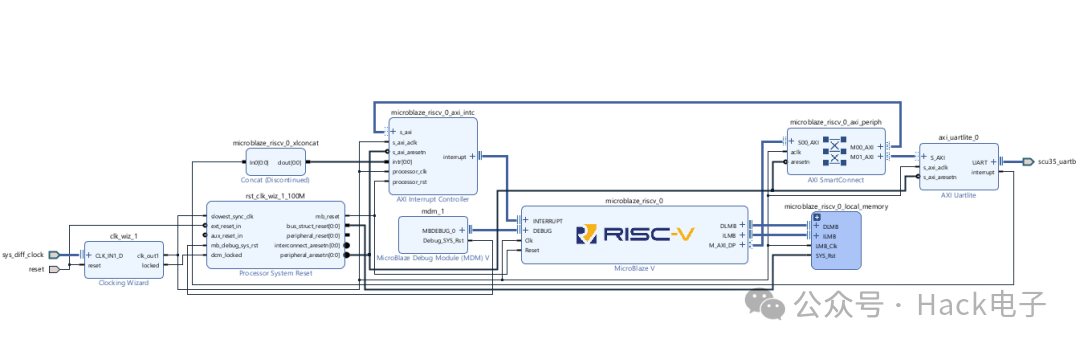
However, as functionalities continue to expand, these FSMs often become very large and difficult to maintain, significantly increasing the difficulty of debugging and verification on the system board. Moreover, these FSMs not only need to undergo simulation verification but also require re-validation after being implemented on the board—this is time-consuming, labor-intensive, and not flexible enough.
When I implement such interfaces in FPGA, my common approach is to directly use MicroBlaze V to replace complex FSMs. By adding a lightweight soft processor, I can complete control functions with simple C programs. This makes the entire logic more flexible, intuitive, and easier to modify, especially when the inevitable “last-minute changes” occur at the end of the project, significantly reducing risks.
Some may worry: will adding MicroBlaze V lead to a surge in resource usage?
In fact, MicroBlaze V is highly configurable and can be tailored to application requirements, significantly reducing resource consumption.
This article aims to explore in depth the configuration options of MicroBlaze V and their impact on resource usage.
MicroBlaze V Architecture Options: Different Pipeline Depths
MicroBlaze V is based on the RISC-V RV32 architecture, but it can not only configure peripherals and interfaces but also choose instruction set extensions and internal processor architecture, such as pipeline depth.
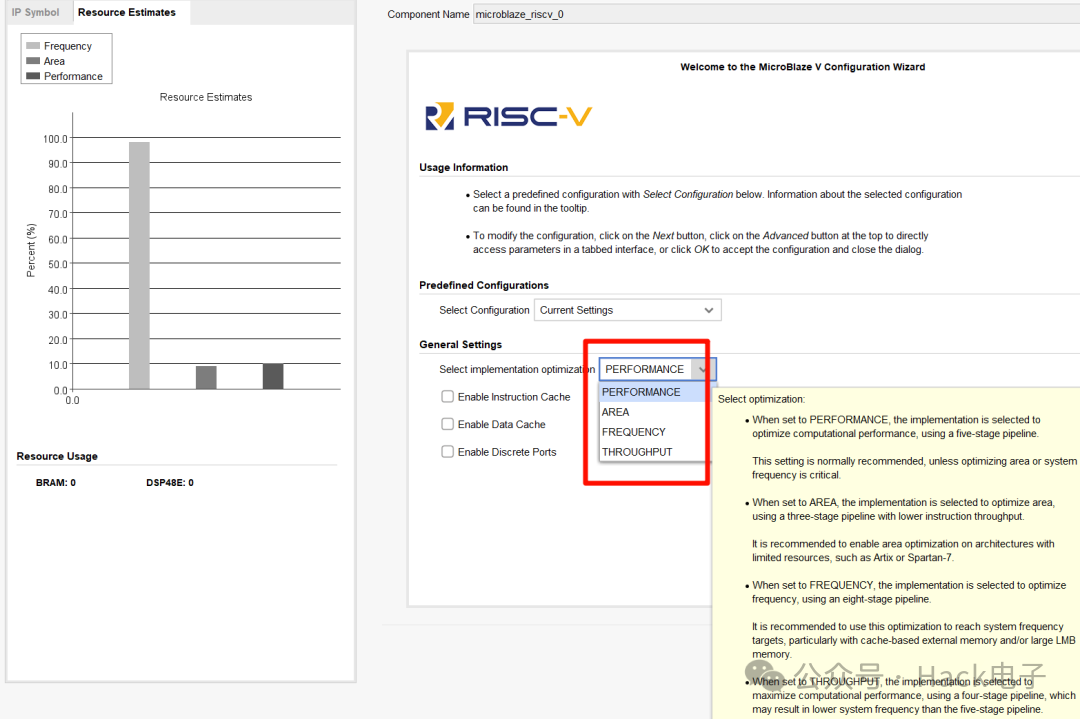
The architecture configuration of MicroBlaze V in Vivado is mainly reflected in the pipeline levels:
-
Area configuration: 3-stage pipeline — resource minimization
-
Throughput configuration: 4-stage pipeline — focusing on computational throughput
-
Performance configuration: 5-stage pipeline — aimed at high performance
-
Frequency configuration: 8-stage pipeline — optimizing the highest operating frequency
It is important to note that if the program runs on high-latency external storage (such as DDR), instruction fetching may exceed one cycle, thus memory hierarchy and tightly coupled memory/cache are crucial. I will discuss cache configuration in detail in the next article.
Optional ISA Extensions for MicroBlaze V
MicroBlaze V supports enabling various optional RISC-V extensions, each of which affects area, performance, and flexibility:
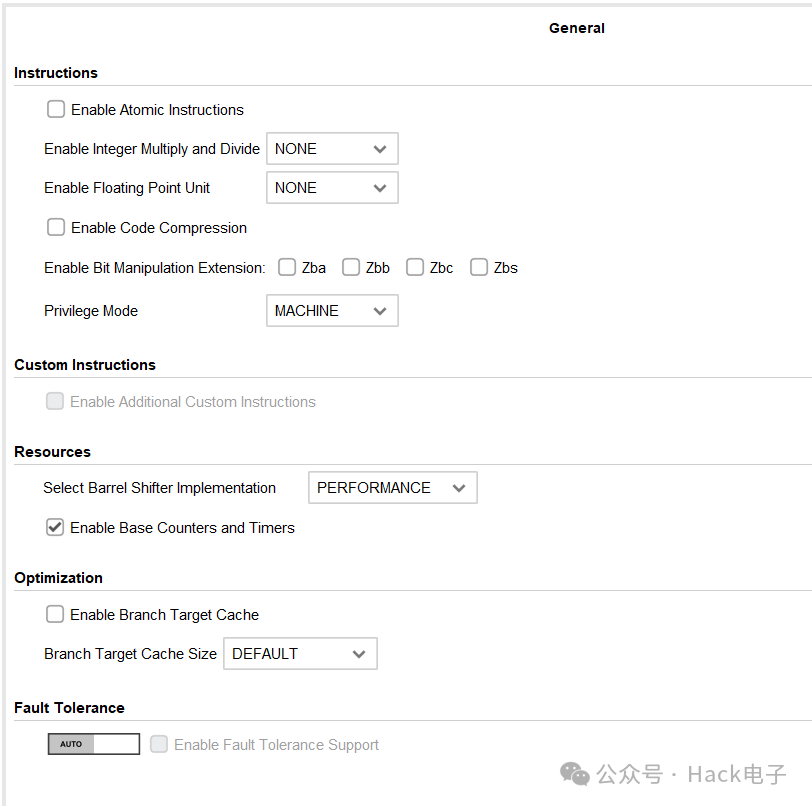
1. Code Compression (C) – Code Compression (C Extension)
32-bit instructions are replaced with 16-bit short instructions
Program size can be reduced by 25–35%
Almost no performance loss
Hardware requires very few resources, making it very cost-effective
2. Integer Multiplier (M) – Integer Multiplication/Division (M Extension)
Accelerates operations involving multiplication and division
Will use a certain number of FPGA DSP resources
3. Floating Point (F) – Single Precision Floating Point (F Extension)
Provides hardware floating-point operations
Significant performance improvement
Resource consumption increases significantly (LUT/FF)
4. Atomic Operations (A) – Atomic Operations (A Extension)
Implements atomic read-modify-write instructions
Suitable for RTOS, multithreading, and locking mechanisms
Logic overhead is small
5. Bit Manipulation (Zba/Zbb/Zbc/Zbs) – Bit Manipulation Extensions (Zba/Zbb/Zbc/Zbs)
Accelerates operations such as shifting, rotating, bit counting, and extraction
Very valuable for encryption and DSP applications
Enabling more extensions means more resource usage, so I conducted a comprehensive analysis and implementation of different configurations, comparing resource consumption.
MicroBlaze V Synthesis Results (Partial)
The following shows the LUT, FF, BRAM, and DSP usage for the main ISA combinations under four pipeline configurations. Some trends can be observed from the results:
Area
| Configuration | LUT | FF | BRAM | DSP |
|---|---|---|---|---|
| RV32I | 823 | 449 | 8 | 0 |
| RV32IC | 1033 | 488 | 8 | 0 |
| RV32IM | 1130 | 581 | 8 | 4 |
| RV32IMF | 3855 | 1698 | 8 | 6 |
| RV32ICMF | 4095 | 1737 | 8 | 6 |
Throughput
| Configuration | LUT | FF | BRAM | DSP |
|---|---|---|---|---|
| RV32I | 1200 | 547 | 8 | 0 |
| RV32IC | 1247 | 587 | 8 | 0 |
| RV32IM | 1577 | 684 | 8 | 4 |
| RV32IMF | 4044 | 1814 | 8 | 6 |
| RV32ICMF | 4243 | 1854 | 8 | 6 |
Performance
| Configuration | LUT | FF | BRAM | DSP |
|---|---|---|---|---|
| RV32I | 1235 | 631 | 8 | 0 |
| RV32IC | 1208 | 671 | 8 | 0 |
| RV32IM | 1304 | 768 | 8 | 4 |
| RV32IMF | 4012 | 1906 | 8 | 6 |
| RV32ICMF | 4229 | 1946 | 8 | 6 |
Frequency
| Configuration | LUT | FF | BRAM | DSP |
|---|---|---|---|---|
| RV32I | 1762 | 1252 | 8 | 0 |
| RV32IC | 1713 | 1315 | 8 | 0 |
| RV32IM | 1956 | 1448 | 8 | 4 |
| RV32IMF | 4685 | 2780 | 8 | 6 |
| RV32ICMF | 4949 | 2846 | 8 | 6 |
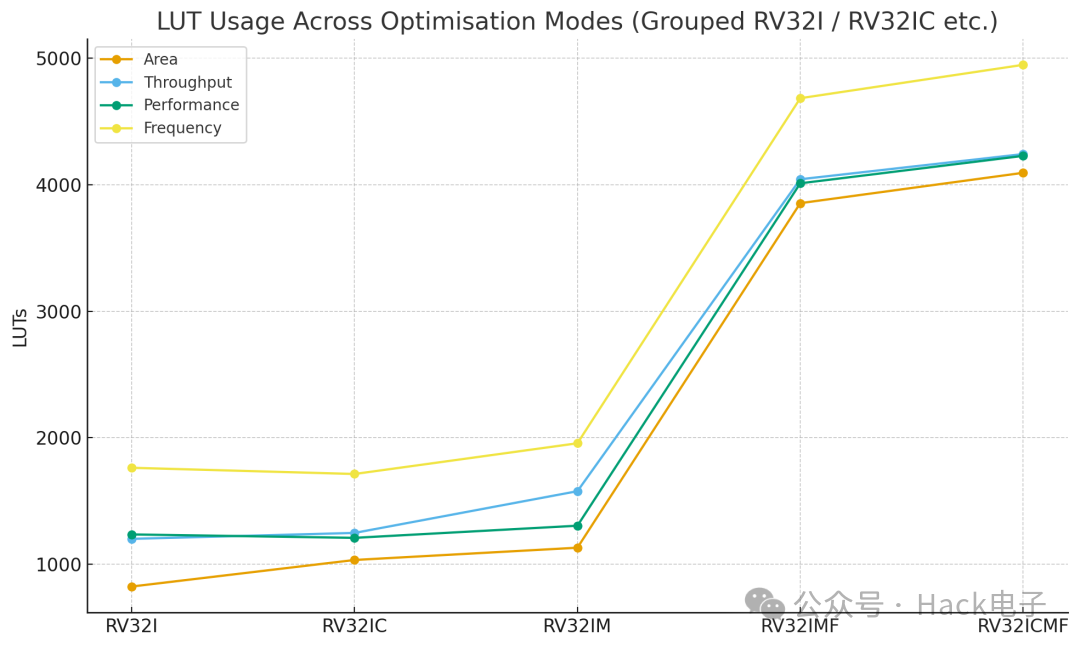
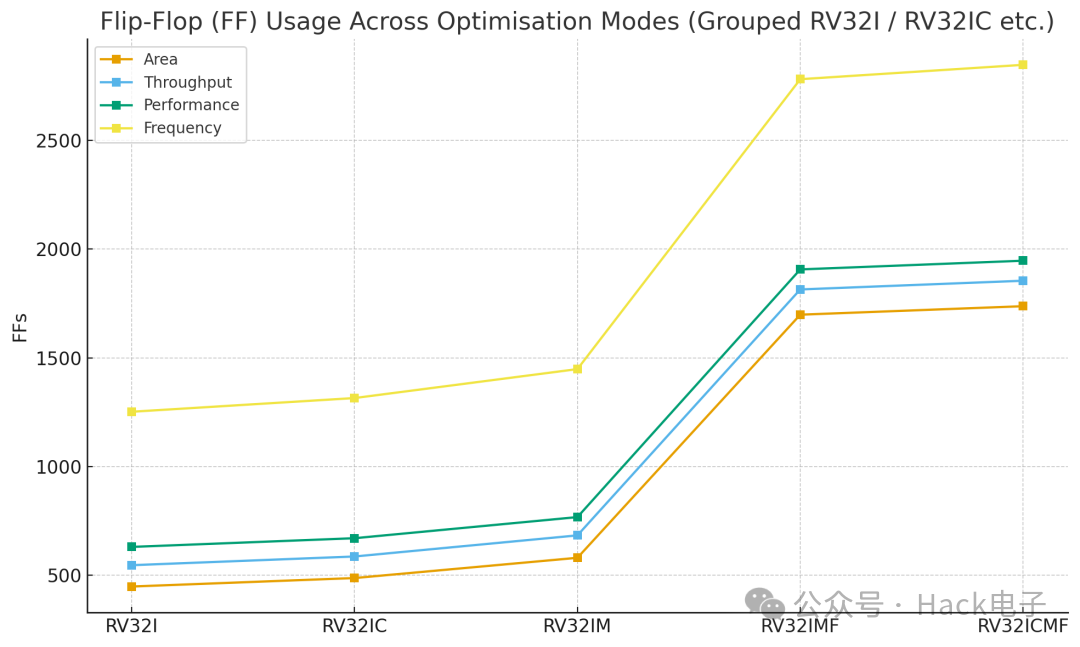
From the tables and charts, we can see:
- The smallest RV32I has the least resource usage
It does not include compression, multiplication, floating-point, and other extensions
It is very suitable for replacing medium and small FSMs
- The M extension leads to a moderate increase in resources
LUT/FF has a certain increase
DSP consumption increases (multipliers)
- The F extension leads to a significant increase in resources
Because the FPU (floating-point unit) requires a large amount of logic
- The C extension is almost “free”
The hardware increase is minimal
But it significantly reduces code size and BRAM usage
Strongly recommended to enable
- ICMF (fully functional) has the most resources
But compared to other CPUs, achieving the same functionality is still quite cost-effective
Resource Growth Trends (Relative to RV32I)
| Variant | ΔLUT | ΔFF |
|---|---|---|
| RV32IM | +37% | +29% |
| RV32IMF | +368% | +278% |
| RV32IC | +26% | +9% |
| RV32ICMF | +398% | +287% |
It can be seen that:
The C extension is the most cost-effective, and it is recommended to enable it in almost all projects
The F extension is the main source of resource explosion
The M extension is very worthwhile to enable, requiring only a small amount of DSP
Best Configuration Recommendations for Different Applications
Based on resources, performance, and empirical data, the following recommended options for common designs can be provided:
● RV32IM (Throughput)
Excellent balance — about 1.5K LUTs, 4 DSPs
Suitable for tasks that require a small amount of arithmetic and reliable throughput
● RV32IMF (Performance)
Compute-intensive — 4012 lookup tables, 6 digital signal processors
High performance and high computational power requirements
Example: floating-point operations, control algorithms
● RV32IC
If the workload only involves integer operations and memory bandwidth is limited, it is the most cost-effective choice.
Designs sensitive to BRAM should prioritize this option
● RV32ICMF (Area)
Suitable for complex system control
Instruction compression improves program density
Conclusion: MicroBlaze V is a More Modern and Flexible Alternative to FSM
In FPGA design, using MicroBlaze V instead of complex FSM can:
-
Significantly reduce RTL complexity
-
Improve maintainability
-
Accelerate debugging efficiency
-
Achieve extremely high flexibility and scalability while keeping resource usage under control
In the minimal configuration, MicroBlaze V has very low resource usage but can easily implement many complex functions that are difficult to maintain with FSM.
For control tasks that require rapid adaptation to changes, high software scalability, and complex logic, MicroBlaze V is undoubtedly a more advanced and efficient choice.