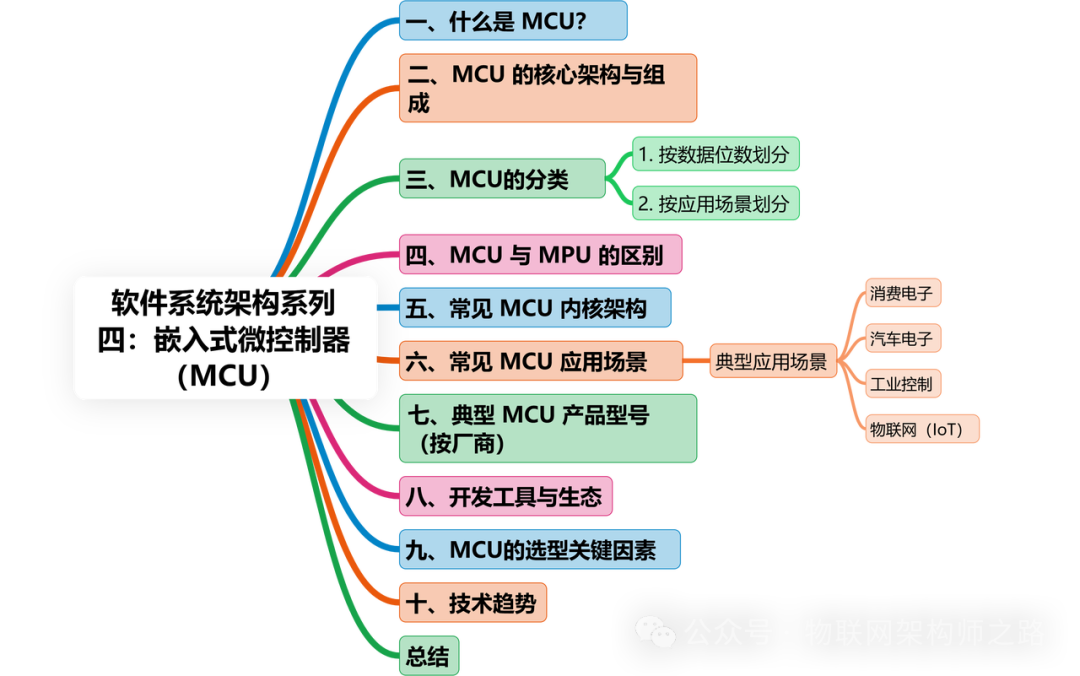
1. What is an MCU?
Embedded Microcontroller (MCU, Microcontroller Unit) is a highly integrated chip-level computer designed for embedded systems. It integrates functions such as a Central Processing Unit (CPU), memory (RAM/ROM/Flash), input/output interfaces (I/O), timers/counters, and communication modules (such as UART, SPI, I2C) onto a single chip, characterized by high integration, low power consumption, low cost, and real-time control capabilities. MCUs are widely used in industrial control, consumer electronics, automotive electronics, and the Internet of Things (IoT).
Core Features of MCUs
- High Integration: A single chip integrates CPU, memory, peripheral interfaces, and real-time operating system (RTOS) functions, allowing it to operate independently without additional expansion.
- Low Power and Low Cost: Supports various low-power modes (such as sleep and standby), suitable for battery-powered devices; mass production makes it cost-effective.
- Real-time Control Capability: Supports fast interrupt response (such as the NVIC interrupt controller in ARM Cortex-M series), suitable for real-time tasks like motor control and sensor data processing.
- Ease of Programming: Supports development in high-level languages like C/C++, shortening the development cycle, and is compatible with a rich development toolchain (such as Keil, IAR, open-source platforms like Arduino).
2. Core Architecture and Components of MCUs
graph TD
CPU[Processor Core (CPU)]
RAM[Data Memory (SRAM)]
ROM[Program Memory (Flash/ROM)]
IO[Input/Output Interface]
TIM[Timer/Counter]
ADC[Analog-to-Digital Converter (ADC)]
COM[Communication Interface (UART/SPI/I2C)]
WDG[Watchdog]
BUS[On-chip Bus]

CPU --> BUS
RAM --> BUS
ROM --> BUS
IO --> BUS
TIM --> BUS
ADC --> BUS
COM --> BUS
WDG --> BUS
Note: These modules are interconnected via the on-chip bus, forming a complete minimal computing system that can operate independently.
The internal structure of an MCU typically consists of the following modules:
- Processor Core:
- RISC Architecture: Such as ARM Cortex-M series (M0/M0+/M3/M4/M7), RISC-V (open-source architecture), AVR (Atmel), emphasizing energy efficiency and optimized instruction sets.
- CISC Architecture: Such as 8051, PIC (Microchip), rich in instructions but with higher complexity, suitable for simple control scenarios.
- Memory System:
- Flash/ROM: Stores program code and configuration parameters (e.g., GD32 series provides 256 KB eFlash).
- RAM: Runtime data cache (e.g., STM32 series supports SRAM expansion).
- Cache Mechanism: High-end MCUs (e.g., i.MX RT series) integrate L1 cache to enhance performance.
- Peripheral Interfaces:
- General Purpose Input/Output (GPIO): Controls basic peripherals like LEDs and buttons.
- Analog Interfaces: 12-bit ADC/DAC (e.g., 2 Msps sampling rate), comparators, temperature sensors, etc.
- Communication Interfaces: UART, SPI, I2C, CAN, USB, Ethernet, Bluetooth/Wi-Fi (e.g., ESP32 integrates Wi-Fi/Bluetooth).
- Timers/Counters: 32-bit timers, PWM output (e.g., 144 MHz PWM for motor control), watchdog timers (WDT).
- System Bus: High-speed data pathways connecting various modules (e.g., ARM’s AMBA bus protocol).
3. Classification of MCUs
1. By Data Width:
| Type | Characteristics and Application Areas |
|---|---|
| 4/8-bit | Simple control tasks (e.g., home appliances, toys, sensor nodes), extremely low cost (e.g., 8051, PIC16). |
| 16-bit | Mid-range applications (e.g., industrial instruments, motor control), balancing performance and cost (e.g., TI MSP430). |
| 32-bit | Mainstream choice, combining high performance and low power consumption (e.g., ARM Cortex-M series, RISC-V), covering IoT and automotive electronics. |
| 64-bit | High-end embedded systems (e.g., edge computing, AI acceleration), supporting complex algorithms (e.g., NXP i.MX 8 series). |
2. By Application Scenario:
- General-purpose MCUs: Flexibly configured, suitable for various scenarios (e.g., STM32 series).
- Special-purpose MCUs: Optimized for specific needs (e.g., automotive MCUs must meet AEC-Q100 reliability standards, industrial MCUs require anti-interference designs).
4. Differences Between MCU and MPU
| Item | MCU (Microcontroller) | MPU (Microprocessor) |
|---|---|---|
| Integration Level | High, SoC integrates ROM/RAM/I/O | Low, relies on external peripheral chips (e.g., DDR) |
| Performance | Medium-low, suitable for control and real-time response tasks | High, suitable for operating systems, multitasking, image/AI processing |
| Need for Operating System | Can run bare-metal or use lightweight RTOS | Requires running embedded Linux, Android, etc. |
| Communication Interfaces | UART, SPI, I2C, GPIO, PWM | USB, PCIe, HDMI, Ethernet, CAN, etc. |
| Power Consumption | Extremely low (μA level) | Relatively high |
| Common Systems | FreeRTOS, RT-Thread, bare-metal | Linux, Yocto, Android |
| Application Scenarios | Home appliances, sensors, low-speed devices, remote controls, instruments, etc. | Industrial control, human-machine interaction, AI gateways, camera main control, etc. |
5. Common MCU Core Architectures
| Core Architecture | Manufacturer or Standard | Characteristics |
|---|---|---|
| ARM Cortex-M | ST, NXP, Nordic, etc. | Mainstream general-purpose core, supports RTOS, ultra-low power |
| AVR | Atmel (now Microchip) | Classic 8-bit architecture, suitable for low-cost scenarios |
| MSP430 | TI | Ultra-low power, suitable for metering instruments, sensors |
| PIC Series | Microchip | 8/16-bit MCUs, widely used, mature tools |
| RISC-V | GD32, Sifive, Xinlai, etc. | Open-source instruction set, good support for domestic production, gradually improving ecosystem |
6. Common MCU Application Scenarios
| Scenario | Function Examples |
|---|---|
| Smart Appliances | Button input, motor control, display driving |
| IoT Terminals | Collecting sensor data, low-power wireless communication |
| Industrial Instruments | Measurement control, analog-to-digital acquisition, process automation |
| Health Wearables | Heart rate monitoring, step counting, Bluetooth broadcasting |
| Wireless Control | Remote controls, smart switches, infrared communication |
| Security Devices | Door magnets, smoke detectors, MCU driving ZigBee/Wi-Fi chips |
Typical Application Scenarios
Consumer Electronics:
- Smart Home: Smart locks (GD32 series), thermostats, smart speakers (ESP32).
- Wearable Devices: Bracelets (Nordic nRF52 series), electronic tags (ultra-low power MCUs).
Automotive Electronics:
- Body Control: Window and seat adjustments (Renesas RH850 series).
- Power Systems: Engine control (ECU), battery management systems (BMS, such as TI’s C2000 series).
- Digital Keys: NXP KW47 supports Bluetooth channel detection technology, achieving centimeter-level positioning accuracy.
Industrial Control:
- Automation Equipment: PLC controllers (e.g., Siemens S7 series based on ARM Cortex-M).
- Robotics: Servo motor control (STM32 high-end timers generate PWM signals).
Internet of Things (IoT):
- Edge Nodes: LoRa communication (Semtech SX127x + STM32), environmental monitoring (integrated ADC for temperature and humidity collection).
- AIoT Devices: Lightweight AI inference (e.g., TensorFlow Lite for Microcontrollers running on Cortex-M55).
7. Typical MCU Product Models (by Manufacturer)
| Brand | Series / Model | Characteristics and Applications |
|---|---|---|
| ST | STM32F1 / F4 / L4 / G0 | Main products in the Cortex-M series, well-established ecosystem |
| NXP | LPC55xx / i.MX RT | High real-time performance with security features |
| Nordic | nRF52840 / nRF5340 | BLE/Thread/Zigbee support, suitable for low-power wireless |
| TI | MSP430 / TM4C / CC3200 | Ultra-low power, analog processing, connectivity MCUs |
| Microchip | PIC16 / PIC32 / AVR ATmega328 | Widely used entry-level products, such as Arduino |
| Renesas | RX series, RH850 | Strong automotive MCUs (compliant with ISO 26262 standards). |
| GigaDevice | GD32 series | High cost-performance ratio, compatible with STM32 |
| Sifive | RISC-V MCU series | Open-source core, suitable for domestic controllable scenarios |
| Espressif | ESP32 (Wi-Fi/Bluetooth dual-mode) | Preferred for IoT development, integrates wireless communication. |
8. Development Tools and Ecosystem
- IDE Tools: Keil MDK, IAR EWARM, STM32CubeIDE, PlatformIO, Arduino IDE
- Debugging Tools: J-Link, ST-Link, DAPLink
- Simulators and Emulators: Proteus, QEMU (supports some cores)
- RTOS Support: FreeRTOS, RT-Thread, Zephyr, Amazon FreeRTOS
9. Key Factors in MCU Selection
1. Performance Requirements:
- Data width (8-bit vs. 32-bit), clock frequency (e.g., 144 MHz vs. 400 MHz).
- Need for floating-point operations (e.g., Cortex-M4F supports single-precision FPU).
2. Power Consumption and Cost:
- Battery-powered scenarios require ultra-low power (e.g., STM32L4’s Stop mode <5 μA).
- Cost-sensitive scenarios should choose 8-bit or entry-level 32-bit MCUs (e.g., GD32E230).
3. Peripheral Requirements:
- Need for specific interfaces (e.g., CAN bus for automotive, Ethernet for industrial).
- ADC/DAC resolution and speed (e.g., 2 Msps sampling rate).
4. Safety and Reliability:
- Automotive-grade MCUs must meet AEC-Q100 standards (e.g., NXP S32K).
- Safety features (e.g., ARM TrustZone, hardware encryption engines).
5. Development Support:
- Open-source ecosystem (e.g., Arduino, Zephyr OS).
- Debugging tools (e.g., JTAG/SWD interfaces, IDE support).
10. Technical Trends
1. Low Power and High Energy Efficiency:
- New processes (e.g., 28nm FD-SOI) and asynchronous clock designs further reduce power consumption.
- Dynamic Voltage Frequency Scaling (DVFS) becomes standard (e.g., Ambiq Apollo series).
2. Integrated AI Acceleration:
- Built-in NPU/DSP units (e.g., Arm Ethos-U55, CEVA-X1) support lightweight AI models (e.g., TensorFlow Lite).
3. Localization of Automotive-grade MCUs:
- Chinese manufacturers (e.g., Xinchih, Horizon) accelerate the replacement of foreign brands, meeting automotive functional safety (ISO 26262) and reliability requirements.
4. Rise of RISC-V Open-source Architecture:
- Alibaba’s Xuantie series and Xinlai Technology promote RISC-V applications in industrial and IoT fields, reducing licensing costs.
5. Wireless Connectivity Integration:
- Multi-protocol MCUs (e.g., ESP32 supporting Wi-Fi + Bluetooth), Sub-1 GHz (e.g., TI CC13x2) meet IoT communication needs.
Conclusion
❝
MCUs are the core of embedded systems, and their selection must comprehensively consider performance, power consumption, cost, safety, and ecosystem support. With the development of IoT, automotive electronics, and edge computing, MCUs are evolving towards low power consumption, high integration, AI empowerment, and open-source directions. For example, the ARM Cortex-M series occupies the mainstream market due to its mature ecosystem, while the RISC-V architecture drives innovation through flexibility and low cost. In the future, MCUs will further integrate AI acceleration and wireless communication capabilities, becoming the “nervous center” of smart devices.