In the perception systems of smart vehicles, no module is as understated yet critical as the “electronic rearview mirror (CMS)“ which is vital for safety and user experience, and also significantly impacts the first impression of OEMs in the era of intelligence. At the core of the CMS link, FPGA is quietly becoming the new technological leader: from camera input to MIPI/SerDes links, and then to ISP and display control—almost every step, FPGA can bring critical value.
Why now? Why FPGA?
Because CMS has entered a more challenging era:
- Higher resolution: 1080p → 4K
- Higher frame rate:60fps → 120fps
- Lower latency:< 50ms → < 20ms
- Higher safety:ASIL-B、ASIL-D
- Higher bandwidth:MIPI D-PHY from 1Gbps → 6Gbps/12Gbps
- Stronger domestic substitution demand
These demands are pushing parts that MCUs and ISP chips cannot handle back to FPGA.
Part.01
Why will FPGA become the new core of electronic rearview mirrors?
1. Millisecond-level latency is a lifeline
The latency of CMS cannot be “almost”; it must have extremely low latency across the entire link. Especially during lane changes, reversing, and high-speed merging, a delay of several milliseconds can lead to accidents.
FPGA has:
-
Parallelizable hardware ISP
-
Customizable MIPI–SerDes pipeline
-
Fully hardware pipeline
This means: 1 ms of image preprocessing + 20ms of overall latency is achievable.
Traditional SoCs cannot achieve this.
2. Explosive growth of camera interfaces, FPGA is the most flexible bridge
When OEMs deploy multiple cameras on the sides, rear, and even the A-pillar of vehicles, the system must handle:
-
Inconsistent versions of MIPI D-PHY
-
Inconsistent timing from different manufacturers’ sensors
-
Inconsistent display interfaces (LVDS/DSI/HDMI)
FPGA has a natural bridging capability and can adapt to all custom interfaces from car manufacturers.
3. The strategic window for domestic substitution has opened
Car manufacturers are increasingly concerned about supply chain risks. As “safety devices,” if the supply is unstable, the entire vehicle production halts.FPGA is one of the important devices that can be quickly domesticated.
Therefore, we see:
-
Domestic FPGA manufacturers like Gowin are entering OEM video link solutions
-
Video specifications and automotive certification capabilities are accelerating improvement
This is a once-in-a-lifetime opportunity seized by domestic manufacturers.
Part.02
The Global FPGA Manufacturers’ Battlefield Map in Electronic Rearview Mirrors
Next, we will analyze each company, rating them from three perspectives: technical capability, application compatibility, and innovation (out of five stars).
1. AMD / Xilinx: Flagship solution, unmatched strength (⭐⭐⭐⭐⭐)
Representative product: Zynq UltraScale+ MPSoC XA series
Why is it strong?
-
Perfect combination of ARM + FPGA
-
Mature automotive versions (AEC-Q100)
-
A wealth of mature ISP and ADAS video acceleration IP
-
Supports 4K ultra-high-definition video and multi-channel parallel processing
-
Strong enough DSP → can support AI modules
Applicable scenarios:
-
High-end CMS (luxury brands)
-
Multi-camera stitching
-
High frame rate, high definition
-
AI-enhanced electronic rearview mirrors
Innovation: ⭐⭐⭐⭐⭐
Reason: Has formed a “software ecological barrier” that later FPGA solutions find hard to completely replace.
Shortcomings:
-
High cost
-
Limited domestic production capabilities
-
Long supply cycles
2. Altera: Bandwidth monster but limited automotive options (⭐⭐⭐⭐)
Representative products: Agilex / Arria / Cyclone series
Advantages:
-
Extremely high on-chip bandwidth
-
High-speed SerDes (10–58Gbps)
-
Supports 4K video processing
-
Mature PCIe/network interfaces
Very suitable for:
-
High-bandwidth CMS
-
4K
-
Video transmission
-
Low-latency algorithm links
Innovation: ⭐⭐⭐⭐
Strong high-end interface capabilities, friendly to multiple high-speed cameras.
Shortcomings:
-
Limited automotive version options
-
Low adaptability for domestic production
-
Cost slightly high
3. Lattice: King of low-power bridging (⭐⭐⭐⭐)
Representative products: CrossLink / CrossLink-NX
Core positioning: Camera interface expert
Lattice has a very high presence in electronic rearview mirrors because it is almost:
-
MIPI → LVDS
-
MIPI → DSI
-
MIPI → HDMI
It is the first choice for low-power bridging chips.
Advantages:
-
Low power consumption
-
Small package
-
Excellent video interface performance (supports 4K)
-
Extensive market validation (applied by multiple car manufacturers)
Innovation: ⭐⭐⭐⭐
Almost no competitors in small FPGAs.
Shortcomings:
-
Too few DSP/logic resources
-
Not suitable for complex ISP tasks
-
Not suitable for “full-link CMS”
Suitable for OEMs and Tier 1s that only do interface conversion.
4. Microchip: Safe and stable “endurance-type” player (⭐⭐⭐)
Representative products: PolarFire / PolarFire SoC
Advantages:
-
Extremely low power consumption (30–50% lower than UltraScale+)
-
Stable and reliable (suitable for 24h always-on cameras)
-
Strong security mechanisms
Suitable for:
-
Mid-range CMS
-
Scenes with strict automotive requirements but moderate computing power
Innovation: ⭐⭐⭐
Strong stability, but product direction is not primarily video-focused, leaning more towards safety and low power consumption.
5. Gowin: Domestic “dark horse” is approaching the main battlefield (⭐⭐⭐⭐)
Representative products: Arora V / GW5AT series
The GW5AT-138 has become a frequently appearing model in domestic video bridging and ISP projects.
Why is it worth paying attention to?
① Video-friendly architecture
-
MIPI D-PHY RX/TX (hard core)
-
270Mbps → 12.5Gbps SerDes
-
A large number of DSP/BRAM (suitable for lightweight ISP)
-
Achieves 1ms level image processing latency
This is a significant breakthrough for domestic FPGAs.
② Advantages of domestic supply chain
As major manufacturers and Tier 1 suppliers seek alternatives, Gowin has seized the window period:
-
Domestic supply is controllable
-
Has advanced ISO26262, AEC-Q100
-
EDA process has passed functional safety certification
③ Significant cost advantage
Very suitable for:
-
Domestic CMS
-
Mid-range to high-end low-latency video links
-
Tier 1 modules requiring independent ISP + interface bridging
Innovation: ⭐⭐⭐⭐
Strongest innovation among domestic FPGAs, especially in:
-
Video links
-
MIPI
-
Hard cores
-
Automotive certification
-
Latency optimization breakthroughs, and fast project implementation speed.
Shortcomings:
-
High-end algorithm IP ecosystem is weaker than AMD
-
Long-term automotive certification experience is still being accumulated
-
Top-level 4K/AI functions still have gaps
Part.03
Three Major Trends of FPGA in CMS: The Industry Direction is Very Clear
Trend 1: Complete hardwareization of video links (hardware ISP + fully hardware MIPI pipeline)
In the future, CMS will not allow the uncertainty of “software ISP”. Car manufacturers are increasingly inclined to:
✔ Fully hardware ISP✔ Fully hardware pipeline✔ Fixed latency, not relying on CPU
This is precisely FPGA’s strength, and it is the most competitive area among Gowin, Lattice, and Xilinx.
Trend 2: CMS is no longer just a “mirror” but part of “sensor fusion”
CMS is shifting from “pure display” to:
-
Overlaying ADAS information
-
Integrating blind spot detection
-
Coordinating with body stability systems
-
AI recognition of pedestrian/vehicle hazards
Therefore, FPGA needs:
-
Expandable DSP
-
AI pipeline insertion
-
More MIPI/LVDS channels
-
Greater bandwidth
This means that AMD/Xilinx’s high-end solutions will continue to dominate the high-end market for a long time.
Trend 3: Domestic FPGAs will experience an explosion in mid-to-high-end CMS
OEMs have already listed “rearview camera” as a must-be domesticated item. Gowin’s video link product line just hits the nail on the head:
-
MIPI/ISP dedicated hard cores
-
Mature automotive promotion
-
Lower costs
-
Toolchain has obtained ISO certification
This is the first real opportunity for domestic FPGAs to establish a large-scale market in CMS.
Part.04
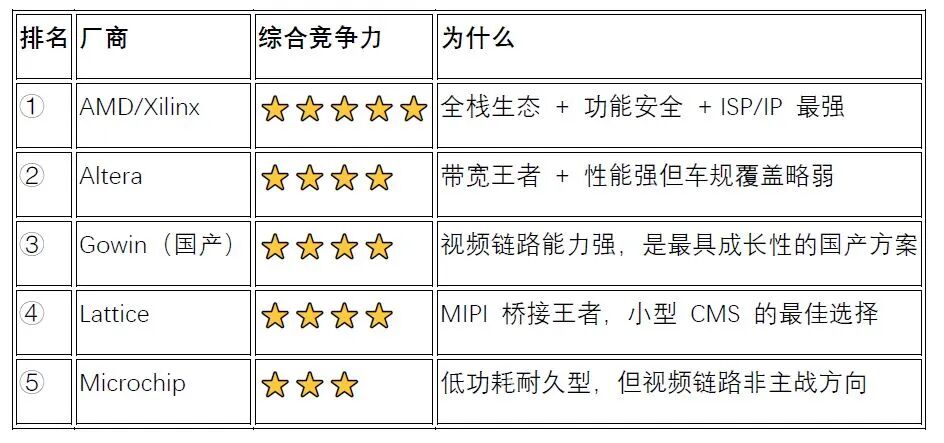
Comprehensive Competitiveness Ranking of FPGA Manufacturers in CMS
Part.05
Conclusion: Electronic Rearview Mirrors are Entering the Era of “Millisecond-Level Competition”, FPGA is in Full Swing
CMS is no longer just about “displaying camera images on a screen”; it is becoming:
-
A need for real-time performance
-
Video bandwidth
-
Hardware determinism
-
Domestic supply chain
-
Functional safety
-
AI collaboration
A “smart safety device” interwoven with multiple factors.
And FPGA is precisely the only type of device that can find a golden balance between cost, flexibility, customizability, and response speed.
What is the key to victory?
-
Who can achieve ≥4K, ≤20ms faster
-
Who can better support domestic production and automotive certification
-
Who can delve deeper into hardwareization of video links
-
Who has a richer ISP/video processing IP
-
Who can support future AI electronic rearview mirrors
This race has just begun.