Title: What Types of Bus Communication Protocols Are There? How to Choose?
First Paragraph: In the field of embedded systems, encountering various types of buses, scattered standards, and high on-site wiring costs is common. RS-485, CAN, and Ethernet each have their advantages and disadvantages, but when deploying quickly in a complex environment, factors such as topology flexibility, power supply methods, distance, and anti-interference capability must also be considered. XM2BUS focuses on the dual-bus technology, providing a unified solution of “non-polar power supply + communication,” making on-site wiring simpler and renovation costs lower. Centered around the XM620 host, paired with chips like XF2485/WM2485/HS2485 and the XM332 slave chip, it can meet requirements for slave communication, active reporting, as well as long-distance and high-speed transmission. For engineers in fields such as fire protection, building automation, industrial control, mining, and smart homes, this approach may just solve your current pain points. 😊💡

Main Content: Pain Point Scenario 1: Complex on-site construction with high costs, how to quickly switch to dual-bus? Solution: Traditional RS-485 systems have high requirements for polarity, power supply, and topology on-site, which can easily lead to wiring errors and subsequent maintenance issues. The XM2BUS dual-bus solution achieves non-polar power supply + communication, allowing for arbitrary topology wiring, significantly reducing construction difficulty and costs. Centered around the XM620 host, with 24V/48V power supply, a maximum current of 20A, and a communication distance of 2 kilometers, it can be quickly deployed on-site; the XM332 slave chip has active reporting capabilities, completing polling of 180 nodes in one second, providing more timely responses; the XF2485A has high integration, with a built-in switch control, greatly simplifying peripheral circuits. This combination makes on-site deployment in fire protection, smart buildings, and industrial control scenarios more robust and worry-free. 🌍🚧
Pain Point Scenario 2: Reliability requirements in long-distance or high-noise environments, how to choose equipment? Solution: For long-distance transmission in outdoor, mining, or large factory environments, traditional solutions are easily interfered with, and power supply is difficult to maintain. XM2BUS provides robust solutions for slave-to-slave and cross-segment communication. The WM2485 can achieve communication distances of over 10 kilometers, offering better cost-effectiveness and anti-interference compared to some wireless solutions; the HS2485 provides rates up to 230400bps, meeting certain high-speed control needs; the XF2485A, as an RS-485 transceiver with a built-in power chip, can work with zero peripheral circuits, greatly simplifying wiring and design in high-voltage environments. Combined with the compact integration of the XM620 module and the dual-bus “slave-to-slave communication” capability of XM620+XMS200, you can achieve stable and reliable communication links in environments such as mines, outdoors, and workshops while keeping construction costs low. 💪⚡
Question: What types of bus communication protocols are there? Answer: Common types include traditional RS-485/RS-422, CAN, and dual-bus solutions centered around two-wire non-polar designs. RS-485/RS-422 is suitable for point-to-point or simple multipoint connections, CAN has advantages in autonomy and fault tolerance, while the non-polar dual-bus solution combines power supply and communication, offering more flexible topology and significantly reducing on-site wiring and maintenance costs. The combination of XM2BUS products like XF2485, XM620, and XM332 can clarify the selection of these solutions, providing more direct deployment options for different scenarios. 😊🔗
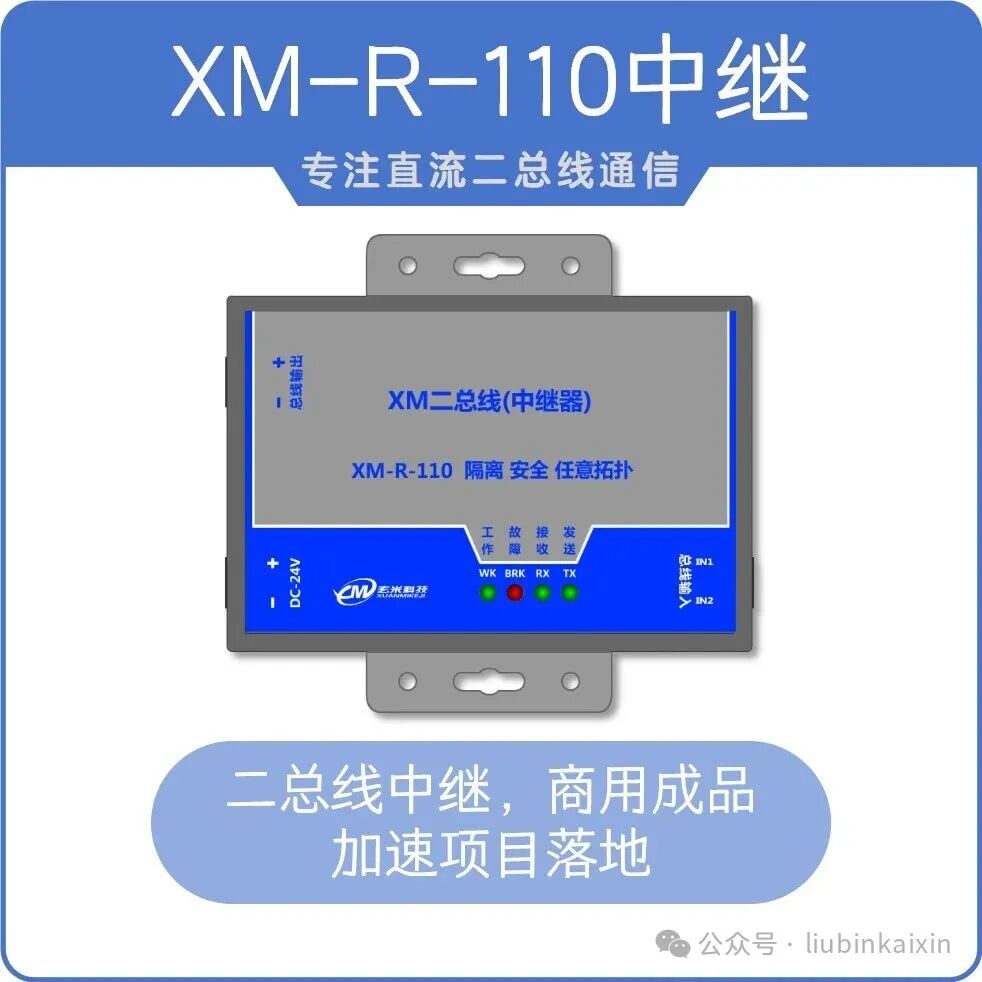
Question: When upgrading existing systems, how should one choose? Answer: First, consider the on-site distance and the number of nodes, then look at power supply requirements and operating voltage ranges. If you just want to quickly replace RS-485 and achieve non-polar wiring, you can prioritize the XF2485A/XF2485 architecture paired with the XM620 module to complete the “zero modification upgrade of the existing system” to dual-bus. If you need multiple hosts, cross-topology, or higher reporting efficiency, it is recommended to use the XM620+XMS200 solution, supplemented by the active reporting capability of the XM332 to improve polling efficiency and real-time performance. For long distances and extreme environments, you can choose combinations of development boards/modules like WM2485, HS2485, along with the low peripheral requirements of XF2485A to ensure on-site reliability and cost balance. Ultimately, the entire product line of XM2BUS (XM620 master station, XM2BUS dual-bus solution, XF2485/XF2485A, XM332, XMS200/XM-M-110, etc.) provides a complete selection path from single chips to entire systems, facilitating rapid deployment. 🧩🏭
Conclusion: What is your industry and on-site environment? What specific challenges do you face with bus communication? Describe your scenario to me, and let’s work together to outline the most suitable XM2BUS combination for you. Feel free to leave comments sharing your needs for extreme distances, quick power-up, or multi-node polling in projects, and we can provide more tailored solutions and implementation points based on XM620, XF2485A, WM2485, etc. Follow XM2BUS to get free engineering source files, test boards, and examples to help you quickly deploy and validate. 🚀🔧
(Q&A Supplement: If you want to further understand the in-depth comparison of “What types of bus communication protocols are there?” or need a selection list tailored to your specific scenario, I can also provide more detailed parameter comparisons and implementation points to facilitate direct deployment during the solution review phase.)
Dual-bus selection summary: For less than 2km with multiple nodes, choose the modulated XM620+XM332/XMS200; for direct slave-to-slave communication without a host chip, select the carrier-type XF2485; for distances of 2~10km, choose the WM2485 for long-distance communication, and for high-speed communication, select the HS2485.