
With the development of AI, we frequently interact with various AI large models and often encounter new terminology. Among them, one term that appears particularly frequently is AI Agent. Do you know what it is?
Let’s take a look at what an AI Agent is.
An AI Agent (Artificial Intelligence Agent) is an intelligent system with autonomous perception, decision-making, and execution capabilities. It can understand user goals through large language models (LLM), autonomously plan task paths, and call external tools to complete complex operations. Its core value lies in upgrading from “passively responding to instructions” to “actively solving problems,” widely applied in industrial, commercial, and daily life scenarios. Below, we will explain it from four dimensions: technical principles, core capabilities, application scenarios, and development trends.
1. Technical Principles: A Complete Loop from “Brain” to “Limbs”
The architecture of an AI Agent consists of four core components:
- Large Language Model (LLM): As the “brain,” it is responsible for understanding natural language instructions and reasoning task logic. For example, when a user inputs “analyze the production line failure of a factory and generate a report,” the LLM will parse key steps such as “retrieve SCADA data,” “identify abnormal logs,” and “generate Markdown charts.”
- Planning Module: Breaks down complex tasks into executable sub-task sequences. For instance, when handling a “cross-border e-commerce procurement” requirement, the Agent will automatically plan the process of “exchange rate inquiry → supplier comparison → logistics plan selection → contract generation” and dynamically adjust the dependencies between steps.
- Memory System: Stores task context and historical data, supporting long-term learning. For example, in industrial scenarios, the Agent will record historical failure patterns of equipment to optimize subsequent diagnostic strategies; a personal assistant Agent will remember user preferences (e.g., “prefer to choose SF Express for delivery”).
- Tool Invocation Interface: Connects to external resources (APIs, databases, hardware devices, etc.). For example, an e-commerce Agent can call the Taobao API to check product inventory, while an industrial Agent can directly control production line parameters through a PLC interface.
The essential difference from traditional LLMs (like ChatGPT) is that LLMs can only generate text responses, while AI Agents can convert text into actual actions. For example, when a user requests “book a restaurant for Friday,” ChatGPT will return a list of restaurant recommendations, while an AI Agent can directly call the OpenTable API to complete the reservation and sync the calendar.
2. Core Capabilities: From “Single Point Intelligence” to “System Collaboration”
The “intelligence” of an AI Agent is reflected in four core characteristics:
- Autonomy: It can independently complete multi-stage tasks without human step-by-step guidance. For example, AutoGPT can autonomously search for information, write reports, and optimize content without any human intervention.
- Environmental Adaptability: It can perceive external changes in real-time through sensors or APIs and dynamically adjust strategies. For instance, a logistics Agent can automatically switch delivery routes and notify customers when encountering traffic congestion.
- Tool Integration Capability: It supports the invocation of dozens of tools to work collaboratively. For example, a financial risk control Agent can simultaneously access transaction databases, public opinion analysis tools, and blockchain explorers to comprehensively assess abnormal transactions.
- Multi-Agent Collaboration: Multiple Agents can form a “digital team” to collaborate. For example, Stanford University’s SmallVille simulates human society, solving complex problems through collaboration among lawyer Agents, doctor Agents, etc.; in manufacturing, a quality inspection Agent can automatically trigger a work order Agent to dispatch a repair team after detecting product defects and notify the supply chain Agent to adjust raw material procurement.
3. Application Scenarios: From “Efficiency Tools” to “Strategic Partners”
AI Agents have penetrated the core links of multiple industries:
-
Industry and Intelligent Manufacturing
- Equipment Maintenance: Real-time monitoring of sensor data, predicting failures, and automatically generating maintenance work orders. A certain automotive factory covers processes such as power battery trial production and architecture fault diagnosis through 12 business Agents, saving 30,000 hours of labor annually.
- Production Optimization: Analyzing historical production data to dynamically adjust production line parameters. For example, Dingjie Smart’s Indepth AI platform optimizes production scheduling through Agents, increasing a factory’s capacity by 15%.
Business and Services
- E-commerce Operations: Amazon Bedrock Agents can automatically decompose cross-border e-commerce development tasks, automating the entire process from product listing to advertising.
- Customer Service: Agents integrated with Microsoft Dynamics 365 can automatically handle customer inquiries, generate sales quotes, and update the CRM system.
Daily Life and Personal Productivity
- Smart Assistants: OpenAI Operator can complete tasks such as “booking travel, purchasing daily necessities, coding,” with users only needing to input their goals.
- Health Management: Medical Agents monitor heart rate and blood sugar through wearable device data, automatically sending alerts and scheduling doctor appointments when abnormalities occur.
Cutting-edge Fields
- Research Collaboration: AI Agents can assist scientists in designing experimental plans, analyzing data, and writing papers. For example, a certain bioinformatics Agent has shortened the drug target discovery cycle by 60% by integrating gene databases and literature.
- Multi-Agent Social Simulation: For example, SmallVille simulates human social behavior to study complex issues such as urban planning and resource allocation.
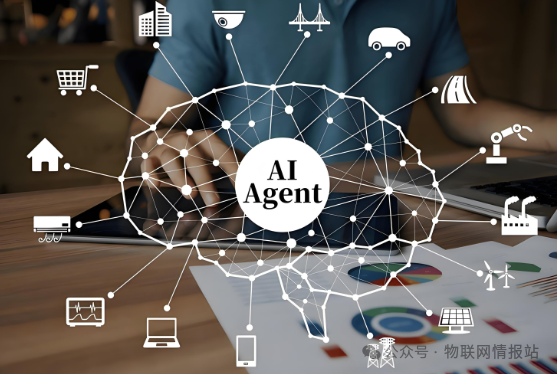
4. Development Trends: From “Technical Validation” to “Industrial Implementation”
-
Accelerated Technological Iteration
- Multimodal Fusion: Combining visual, voice, and other unstructured data processing capabilities. For example, Google DeepMind’s Robotic Agent can recognize objects through cameras and control robotic arms to complete sorting tasks.
- Low-Code / No-Code Platforms: Tools like FlowiseAI and Dify.ai allow enterprises to quickly build custom Agents through drag-and-drop modules, lowering technical barriers.
Deep Penetration into Industries
- Manufacturing: AI Agents are extending from “equipment monitoring” to “process optimization.” For example, an Agent in a certain electronics factory reduced the product defect rate from 3% to 0.8% by analyzing welding parameters.
- Finance: Risk control Agents combine federated learning technology to achieve cross-institutional risk prevention while protecting data privacy.
Improvement of Ethical and Security Systems
- Security Framework: Technologies like ByteDance’s Jeddak AgentArmor prevent Agents from being maliciously invoked through behavior auditing and permission grading.
- Enhanced Interpretability: Frameworks like DSPy optimize prompt engineering through programming, making the decision-making process of Agents traceable.
Widespread Adoption of Hardware
- Devices like Huawei Mate 70 and Apple plan to launch edge AI features, enabling local Agent operation to enhance response speed and protect privacy.
5. Typical Cases: Real Scenarios of Technology Implementation
-
Industrial Internet of Things (IIoT)
- A Certain Automotive Factory: Deployed 12 business Agents covering intelligent interviews, power battery trial production, architecture fault diagnosis, saving 30,000 hours of labor annually.
- A Certain Chemical Company: The Agent monitors the temperature and pressure of the reaction kettle in real-time through SCADA data, automatically adjusting parameters and triggering emergency plans, reducing accident response time from 30 minutes to 1 minute.
E-commerce and Cross-Border Trade
- Amazon Bedrock Agents: Automatically decompose cross-border e-commerce development tasks, including product listing, multilingual translation, advertising, reducing development cycles by 50%.
- A Certain Cross-Border Logistics Provider: The Agent integrates customs databases, exchange rate APIs, and logistics tracking systems to automatically generate optimal customs clearance plans, reducing clearance time by 40%.
Healthcare and Health
- A Certain Tertiary Hospital: Triage Agents analyze patient symptom descriptions, automatically recommend departments, and schedule doctors, improving registration efficiency by 60%.
- Smart Pillbox Agent: Reminds users to take medication on time, synchronizes medication data, and generates health reports, improving user compliance by 70%.
Conclusion
The essence of an AI Agent is a “super employee in the digital world.” Its value lies not only in replacing repetitive labor but also in reconstructing the human-machine collaboration model—humans focus on creative decision-making while Agents handle tedious, procedural tasks. As technology matures, AI Agents are evolving from “single-point tools” to “system-level solutions,” driving various industries from “digitalization” to “intelligence.” In the future, multi-agent collaboration, hardware integration, and ethical security systems will become key development focuses, and AI Agents are expected to become the core link connecting the physical and digital worlds.