With the ongoing popularity of AI globally, aside from Large Language Models (LLM), another focal point should be AI Agent. Since March and April of this year, AI Agents have continuously attracted close attention in the field of artificial intelligence and even in society as a whole, and many believe they are key to the impact of AIGC on people’s daily lives.
01Concept of AI AgentAI Agent (AI Agent) is an intelligent entity capable of perceiving the environment, making decisions and executing actions. Unlike traditional artificial intelligence, AI Agents possess the ability to independently think and utilize tools to gradually achieve given goals.AI Agents mimic human task execution through four main components: memory, planning ability, large language models, and tool usage. Each of these components plays a significant role in simulating human behavior.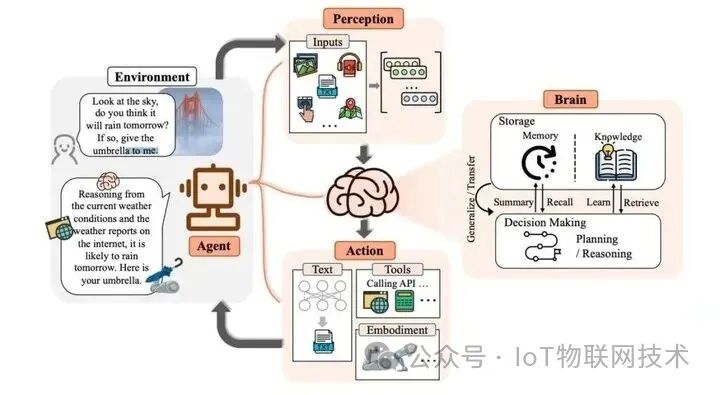 02
02
Technical Components of AI Agent
Memory
Memory is the ability of an AI Agent to store and retrieve information, which is crucial for mimicking human learning and experience accumulation. In AI systems, memory can be long-term stored data (such as information in a database) or short-term memory, like temporary data for current tasks. Memory enables AI to leverage past experiences to guide current decisions and actions.
Planning Ability
Planning ability refers to the capacity of AI to generate and execute multi-step strategies to achieve specific goals.This includes identifying the objectives of tasks, evaluating feasible action plans, and deciding the order of execution.Planning is particularly important for handling complex tasks and adapting to dynamic environments.
Large Language Model
Large language models, such as GPT-4 and ChatGLM, are crucial components in AI systems for understanding and generating natural language.These models learn the structure and usage of language by processing vast amounts of text data, enabling AI to perform efficient language understanding, generation, and translation.They are essential for human-computer interaction and information processing.
Tool Use
This refers to the ability of AI to utilize external tools or devices to complete tasks.In human behavior, tool use is a significant manifestation of intelligence and creativity.In AI, tool use can involve software tools, such as database queries and data analysis software, as well as hardware tools, like robots using mechanical arms for physical operations.
03
How to Build an AI Agent?
The design and training of an AI Agent require the integration of machine learning and artificial intelligence technologies, such as reinforcement learning and deep learning. Through interaction and feedback with the environment, AI Agents can gradually improve their performance and capabilities for better task execution.
Building an AI Agent involves the following main steps:
1. Define Tasks and Goals: First, determine the specific tasks and goals that the AI Agent needs to solve. This can be problems in any field, such as autonomous driving, gaming, speech recognition, etc.
2. Determine Inputs and Outputs: Identify the input information and output behaviors of the AI Agent. Input information can include sensor data, text, images, etc., while output behaviors can be decisions, actions, or generated text or images.
3. Data Collection and Preparation: Collect and prepare datasets for training and evaluating the AI Agent. The dataset should contain input relevant to the task and corresponding correct outputs or reward signals. This data can be generated through real-world observations or simulated environments.
4. Choose Appropriate Algorithms and Models: Select suitable algorithms and models to train the AI Agent based on task requirements. This may involve techniques such as reinforcement learning, supervised learning, and unsupervised learning, including deep neural networks, decision trees, Gaussian processes, etc.
5. Train the AI Agent: Train the AI Agent using the prepared dataset and selected algorithms. This may require multiple iterations and optimizations by adjusting model parameters and algorithms to improve the AI Agent’s performance.
6. Evaluate and Tune: Evaluate the trained AI Agent and tune it based on its performance. Evaluation can be done using test datasets or through simulated tests in real environments. Based on the evaluation results, algorithms, models, or training processes can be adjusted to enhance the AI Agent’s performance.
7. Deployment and Application: Once the AI Agent has been trained and evaluated, it can be deployed in real applications. This may involve integrating the Agent into hardware devices, software systems, or network services to achieve practical task solutions.
It is important to note that setting up an AI Agent is a complex process that requires comprehensive consideration of task requirements, data preparation, algorithm selection, training, and evaluation. Additionally, setting up an AI Agent typically requires specialized knowledge and skills, so team collaboration or professional involvement may be necessary.
Recommended Articles ☞ IDC China IoT Platform Evaluation Report☞ A Decade in Review: The History of IoT Platform Disappearance☞ IoT Platform Trends: Privatization☞ 5 Lessons from IoT Startup Failures Worth Sharing☞ Comparison of 4 Major IoT Platforms in China
☞ Are Cloud Vendors’ “IoT Platforms” No Longer Attractive?