The true distance from electrician to engineer is not about how many instructions you master, but whether you understand the ‘rhythm of life’ of an automation system.
When you first encounter a PLC, have you ever been confused: these ladder diagrams look very much like relay circuits, but why is there always a subtle difference in the action logic? Today, let us penetrate the surface and reach the ‘life source’ of the PLC.
Chapter 1 Breaking the Cognitive Barrier: The Leap from ‘Circuit Thinking’ to ‘System Thinking’
The Thinking World of Electricians:
- Current flow → Real-time response
- Physical contacts → Direct control
- Parallel processing → All circuits work simultaneously
The Thinking Dimension of Engineers:
- Signal sampling → Discrete processing
- Logical operations → Program control
- Cycle scanning → Sequential execution
This fundamental difference in thinking determines whether you are ‘wiring’ or ‘designing systems’.
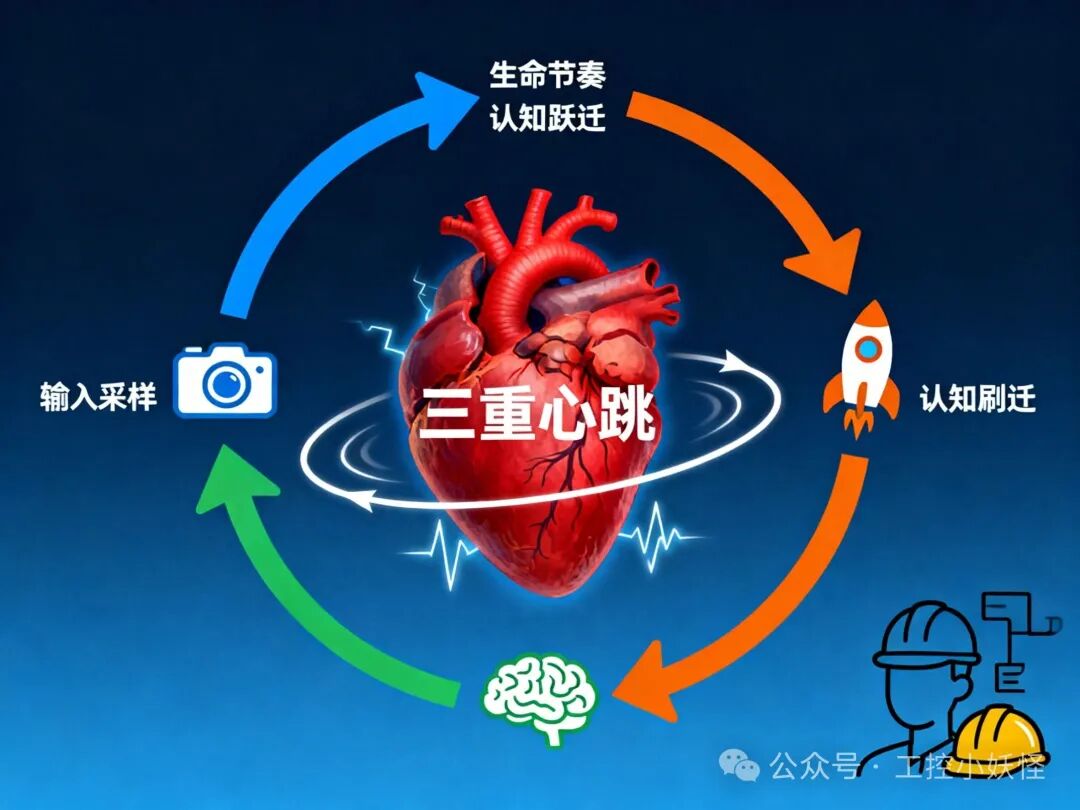
Chapter 2 Life Rhythm: Analyzing the ‘Triple Heartbeat’ of PLC
If we compare a PLC to a living organism, its ‘heartbeat’ is the scanning cycle. This is not a simple loop, but a precise trio.
First Layer: Input Sampling – The Moment of Perceiving the World
// This is not just a simple "read input"
// But pressing the shutter for the entire world at a specific moment
Sampling moment: 'Freezing' all input states into the input image area
Sampling philosophy: Discrete processing, responding to changes with stillness
Deeper Meaning: Establishing time slices to provide a stable ‘factual basis’ for logical operations.
Second Layer: Program Execution – The Journey of Thought Calculation
// This is not just a simple "execute program"
// But performing deterministic deduction in a closed environment
Execution characteristics:
- Using the "input snapshot" as the sole basis
- Strictly executing from start to finish in order
- Completely isolating external interference
Core Value: Ensuring the determinism of logic, avoiding interference from random factors.
Third Layer: Output Refresh – The Release of Decision Results
// This is not just a simple "change output"
// But synchronously updating all execution instructions
Refresh moment: Unifying the computation results to the physical world
Refresh meaning: Ensuring the coordination of all actions
Engineering Wisdom: Trading “synchronization” for “certainty”, trading “delay” for “stability”.
Chapter 3 Spacetime Reconstruction: Building Continuous Control in a Discrete World
The Spacetime View of Scanning Cycles:
Real World: Continuous flow of time
PLC World: Discrete time slices
    ↓
Within each slice, constructing deterministic logical relationships
Case Deep Analysis: Spacetime Reconstruction of Motor Start, Hold, and Stop
// Traditional Electrician View: Continuous current path
Power → Button → Contactor → Motor


// Engineer View: Discrete logical relationships
Network 1: Input sampling (I0.0, I0.1, I0.2)
Network 2: Logical operations (Start, Hold, Stop logic)
Network 3: Output refresh (Q0.0)
Sign of Cognitive Leap: When what you see is no longer the current path, but signal flow, logical relationships, and timing coordination, you have completed the cognitive barrier.
Chapter 4 Architectural Thinking: System Design Based on Scanning Cycles
Levels of Design for Experts:
Level One: Signal Flow Architecture
// Planning the flow path of signals
Input signal → Preprocessing → Business logic → Output control
    ↓
Considering the timing characteristics of each link
Level Two: Task Timing Design
// Planning task sequences based on scanning cycles
Network 1-5: Safety logic (highest priority)
Network 6-15: Main control logic
Network 16-20: Status monitoring
Network 21-25: Communication processing
Level Three: System State Management
// Replacing linear logic with state machine thinking
Standby state → Startup process → Running state → Stopping process
    ↑                               ↓
    └─────── Fault handling ←───────┘
Insights from Real Projects: A certain smart production line optimized the system response time from 50ms to 20ms by reconstructing the scanning task sequence, increasing productivity by 15%.
Chapter 5 Debugging Philosophy: Locating Problems in the Time Dimension
Novice Debugging: Phenomenon → Guess → Trial and Error
Engineer Debugging: Phenomenon → Timing Analysis → Locating Scanning Links → Precise Fix
Deep Debugging Case: Tracing the Source of Random Failures
// Phenomenon: Counter occasionally misses counts
// Traditional Investigation: Check sensors, wiring, program logic → All normal


// Analysis based on scanning cycles:
1. Monitor the trajectory of input signal changes
2. Analyze the relationship between signal pulse width and scanning cycle
3. Discover: Signal pulse width < scanning cycle → Sampling loss
4. Solution: Enable pulse capture function
Evolution of Debugging Thinking: From “What is broken” to “When and under what conditions did it break”.
Chapter 6 Cognitive Elevation: From Programmer to Architect
When you truly grasp the scanning cycle, you will gain:
1. Predictive Design Capability The ability to foresee timing issues before coding, avoiding them in advance
2. System Optimization Capability Enhancing overall performance through task rearrangement and logical optimization
3. Architectural Design Capability Designing maintainable and scalable control system architectures
4. Technical Innovation Capability Developing new control strategies based on underlying principles
Conclusion: Mastering the Heartbeat to Give Life to the System
Today, you have gained not just technical knowledge, but a set of meta-cognition for automation system design. From now on, facing any control demand, you can start from the essence and design stable, efficient, and elegant solutions.
Remember:The true engineers are those who understand the rhythm of life of the system and can make the devices dance accordingly.
Your Cognitive Leap: At what moment did you suddenly realize you had transitioned from ‘electrician thinking’ to ‘engineer thinking’? Was it the first time you considered timing issues, or the first time you engaged in system architecture design? Share your ‘moment of enlightenment’ in the comments, and let us witness each other’s growth!