First, consider the special requirements of optical chips, such as light transmittance, stress, and temperature resistance. A deeper requirement is to find a reliable adhesive that does not affect optical performance while avoiding common pitfalls, such as curing shrinkage or long-term aging issues.
Next, differentiate between different types of adhesives: epoxy resins, acrylates, and silicones, each with their own advantages and disadvantages, and choose based on the actual application scenario. For example, if high strength and high temperature resistance are needed, epoxy may be chosen; if stress is a concern, silicone should be used.
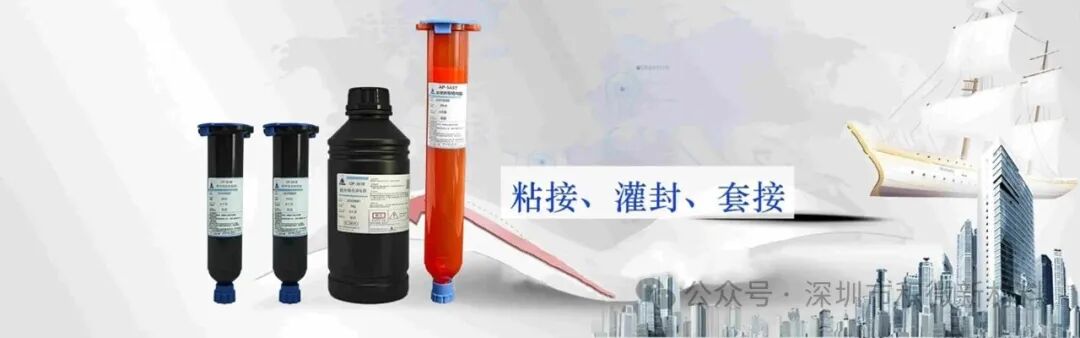
Also, pay attention to the curing method, especially UV curing, which may be convenient but requires light transmission conditions.
1. Main Types of Adhesives
1. Epoxy Resin Adhesive
This is the most commonly used type of chip adhesive, with a wide variety.
- Advantages: High bonding strength, high hardness, good chemical resistance, a wide variety, and relatively low cost. Disadvantages: Relatively high curing shrinkage rate, significant internal stress; may yellow under prolonged high temperatures, affecting light transmittance.
- Applicable Scenarios:
- For devices that are not very sensitive to stress. Structural parts that require high-strength fixation. Thermal conductivity can be adjusted by adding fillers (such as silica microspheres) to reduce stress.
2. Acrylate Adhesive/UV Curing Adhesive
- Advantages: Extremely fast curing speed (seconds), can be initially fixed by UV irradiation, convenient for production line operations; usually has high transparency. Disadvantages: Pure UV curing requires light to reach the adhesive layer, which is a challenge for opaque chips or bonding under substrates; toughness may not be as good as epoxy, and some varieties have slightly lower temperature resistance.
- Applicable Scenarios:
- For rapid alignment and fixation of lenses, glass covers, and optical fibers with chips. Often used as a temporary fix or the first curing process, commonly combined with thermal curing (UV + thermal dual curing).
3. Silicone
- Advantages: Excellent elasticity, can effectively absorb stress and vibration; outstanding high and low-temperature resistance (-50°C to 200+°C); high transparency, not easily yellowed. Disadvantages: Lower bonding strength, soft texture; higher permeability; may emit small molecular siloxanes, contaminating surrounding optical surfaces (“silicone pollution”).
- Applicable Scenarios:
- Preferred for optical chips that are extremely sensitive to stress (such as large GaAs chips). Environments that need to withstand significant temperature changes. Commonly used in LED chip packaging and suitable for some optoelectronic devices.
4. UV/Thermal Dual Curing Adhesive
- Advantages: Combines the advantages of UV and thermal curing. Quickly positions with UV light (in seconds), then undergoes thermal curing to achieve final strength and high reliability. Solves the problem of curing in shadow areas. Disadvantages: Typically higher cost.
- Applicable Scenarios:
- Bonding of complex structures, such as areas with obstructions where light cannot fully reach. Applications requiring high precision alignment while ensuring final strength.