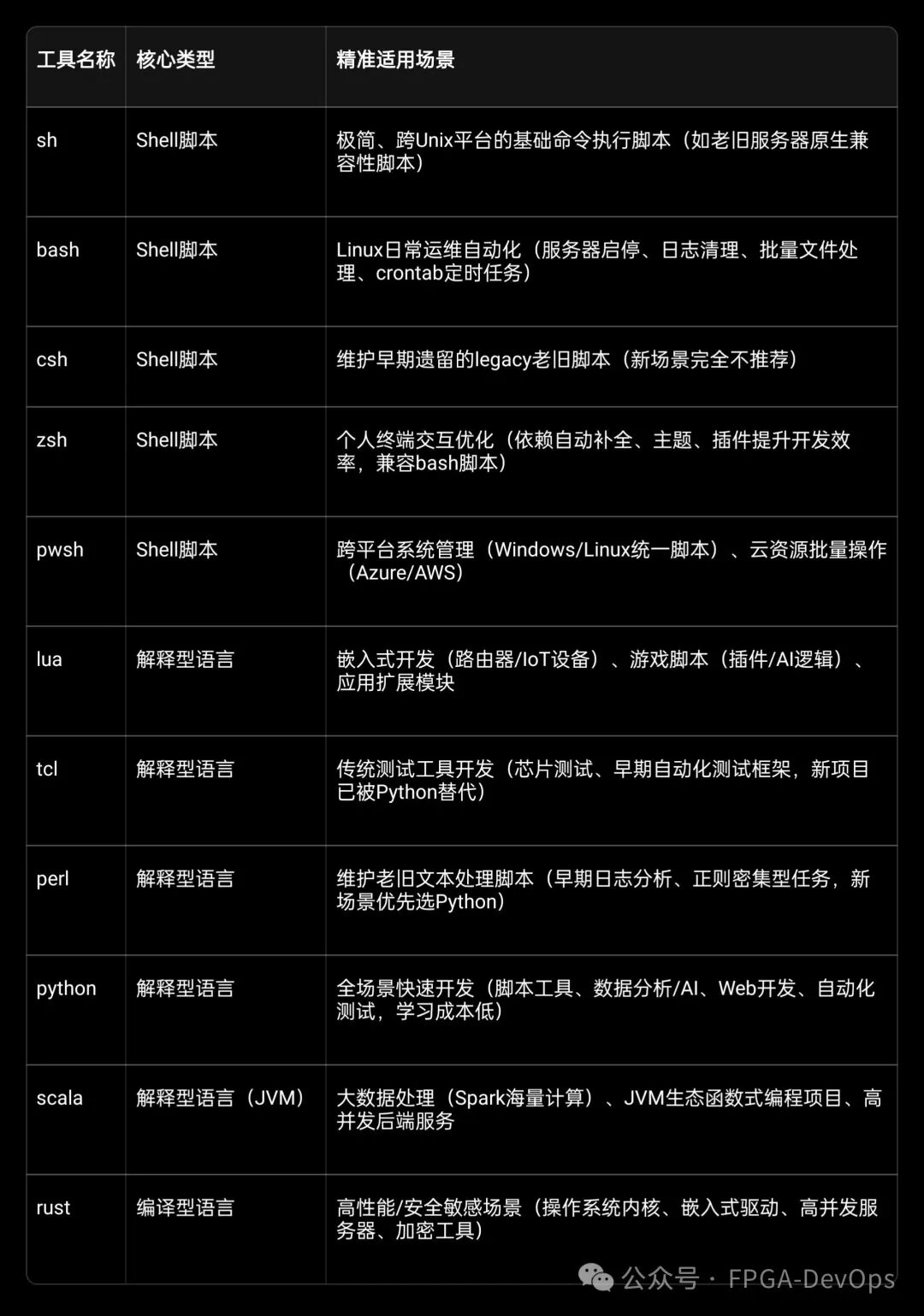
1. Shell Script Types (Primarily for System Automation) – sh (Bourne Shell): The native basic shell of Unix systems, it is the “ancestor” of most shells, with extremely simple syntax and strong compatibility. However, it only supports basic commands and simple logic, lacking complex features (such as functions and advanced variables), making it suitable for writing minimal scripts with compatibility as a priority. – bash (Bourne-Again Shell): The default shell in Linux, fully compatible with sh, adds features such as conditional statements (if-else), loops (for/while), functions, and arrays. It supports complex combinations of pipes and redirection, making it the preferred tool for daily system management and server automation. – csh (C Shell): The syntax mimics C language (such as variable assignment and loop structures), supports command history and command aliases, but has poor script compatibility (syntax errors are common across different systems) and does not support complex functions and arrays. It is currently only used in a few legacy systems. – zsh: The most feature-rich interactive shell, compatible with bash syntax. Its core advantages include powerful auto-completion (matching paths, commands, and parameters), theme customization (supporting personalized interfaces), and plugin extensions (such as the Oh My Zsh ecosystem, which can integrate syntax highlighting and command correction), making it suitable for developers seeking an efficient terminal experience. – pwsh (PowerShell Core): A cross-platform shell launched by Microsoft (supporting Windows/macOS/Linux), differing from traditional shells in its “text manipulation” approach, focusing on objects (such as files and processes being objects that can directly call properties/methods). It supports calling .NET libraries and excels in cloud service management (Azure/AWS) and cross-system batch operations.
2. Script/Programming Language Interpreters (Primarily for Development and Tool Building) – lua: A lightweight scripting language with a core library size of only a few hundred KB, fast execution speed, and concise syntax (no redundant keywords), requiring no complex environment configuration. It is mainly used for game scripts (such as plugins for Roblox and World of Warcraft) and embedded devices (routers, smart hardware), and can also serve as an extension script for applications (such as the Lua module for Nginx). – tcl (Tool Command Language): An early classic scripting language, its core advantage is the rapid construction of graphical interfaces (with the Tk library, a window can be generated in just a few lines of code) and the development of testing tools (such as early chip testing scripts). Its syntax is flexible but the ecosystem is somewhat outdated, currently only retained in some traditional testing scenarios. – perl (Practical Extraction and Reporting Language): An established scripting language, proficient in text processing (strong support for regular expressions, more efficient than early Python), data extraction, and report generation. It was widely used in CGI web development and system log analysis. Although it has been largely replaced by Python, it still holds an irreplaceable position in legacy operations scripts and bioinformatics (gene sequence processing). – python: A versatile scripting language with syntax close to natural language (e.g., “if condition:” instead of braces), boasting the richest library ecosystem globally (data analysis with Pandas, AI with TensorFlow, web development with Django). It supports everything from simple automation scripts to large enterprise-level projects, making it one of the languages with the lowest learning curve and the widest application range today. – scala: A language running on the JVM (Java Virtual Machine) that combines object-oriented (classes, inheritance) and functional programming (immutable variables, higher-order functions). It can directly call all Java libraries while having more concise code (e.g., using “val” to define constants and “map” to simplify loops), primarily applied in big data processing (the default development language for the Apache Spark framework). – rust: Note! It is a compiled language (not an interpreter), with core advantages in memory safety (avoiding null pointers and out-of-bounds access at compile time) and high performance (close to C/C++, with no garbage collection). It is suitable for developing scenarios with high stability requirements: operating system kernels (such as Redox OS), browser engines (Firefox’s Servo), and embedded devices (drones, industrial control). However, its syntax is complex, and the learning curve is relatively high.
3. Core Information Summary
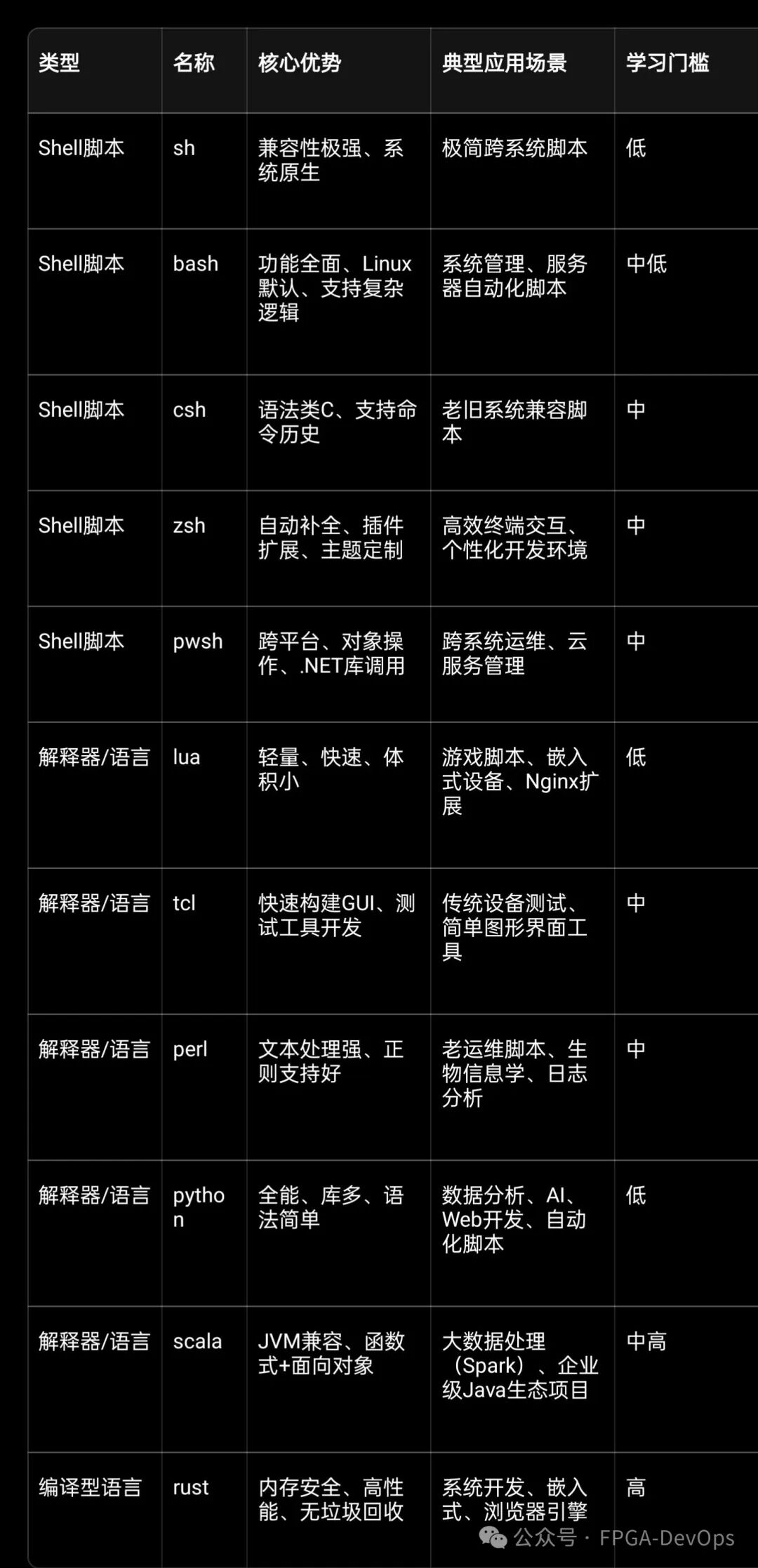
4. Comparison of Applicable Scenarios
The following table summarizes the core types of all tools and their precise applicable scenarios, with a clear structure that can be directly screenshot or copied for sharing, facilitating quick reference to match needs.