How Voice Commands Are Reshaping Your Smart Life?
In the past, we were accustomed to manually controlling devices, but now, a single sentence can enable the robotic vacuum in your home to navigate obstacles precisely and clean the entire house, while smart cars can automatically plan routes and avoid traffic. This is not a futuristic vision, but a reality that consumer AI is currently delivering. Voice interaction is quietly reshaping the ecosystem of smart devices, pushing home appliances and transportation tools towards a more natural and inclusive smart experience. Even more exciting is the potential of voice commands combined with VR, allowing you to “walk into” ancient landmarks at home, converse with artifacts, and experience cultural connections that transcend time and space. This voice-driven intelligent transformation is permeating our lives in subtle ways. This article will delve into the innovative applications of voice commands in robotic vacuums and smart cars, explore the potential of VR artifact experiences, and look forward to the future evolution of the smart ecosystem, revealing how technology can make life more convenient and intelligent.
▸ The Background and Significance of Voice Commands Reshaping Consumer AI
In 2022, the emergence of ChatGPT was like a lightning bolt, breaking the old boundaries of voice interaction. Previously, our expectations for voice assistants were limited to simple commands like “turn on the light” or “play music,” but today, a command like “remind me to call back later and sync it to the family calendar” can be accurately understood and broken down into multiple tasks. This transformation is driven by the qualitative change brought about by generative AI—voice is no longer just an input method but an entry point for intelligent decision-making.
The key to this shift lies in the deep understanding of natural language by large language models. They fill the gaps of traditional AI in semantic ambiguity and contextual disconnection, making human-computer dialogue more “human-like.” Now, when you tell your air conditioner, “I feel a bit cold,” it not only raises the temperature but also considers the time, weather, and your habits to determine whether to close the window or turn on the underfloor heating. Voice systems are evolving from merely “understanding speech” to “thinking,” shifting from passive responses to proactive services.
The leap in technology is rapidly translating into commercial reality. According to the “2025 China Generative AI Industry Outlook Report” released by iResearch in June 2025, the market size of generative AI in China is expected to reach 32 billion yuan in 2024 and exceed 700 billion yuan by 2028, with an average annual compound growth rate of about 80%. This growth is driven by the dual forces of lightweight deployment of large models and the acceleration of terminal hardware, pushing voice AI from the cloud to the device side, marking a new phase of large-scale implementation.
In consumer scenarios, the combination of voice and AI is bringing perceptible upgrades in experience. The X8 Pro robot released by Ecovacs in March 2025, integrated with a generative AI engine, can understand complex commands like “first clean the bedroom and then mop the living room, avoiding the pet activity area,” autonomously break down tasks, and dynamically adjust paths, achieving a 35% increase in cleaning efficiency in practical tests. In the smart car sector, the NOA system launched by Li Auto in the third quarter of 2025 supports multi-intent commands like “go to the nearest coffee shop, avoid traffic, and pick up the package on the way,” with the system comprehensively scheduling multiple tasks based on real-time traffic conditions and user habits. Voice interaction is reconstructing the service paradigm of consumer-grade AI.
▸ Application of Voice Commands in Robotic Vacuums
Generative AI is reshaping the interaction methods for home cleaning. Now, a command like “clean the bedroom and living room” can enable the robotic vacuum to automatically recognize spaces, plan paths, and initiate whole-house cleaning. There is no need to open an app or perform complex operations; natural language has become the most intuitive control method. “Using your voice instead of your hands” is no longer just a gimmick but a real daily experience.
The core technological breakthrough comes from the deep understanding of semantics by large language models. The system no longer relies on keyword matching. It can accurately parse complex commands like “first clean the kitchen grease, then mop the living room” into phased tasks, dynamically adjusting the cleaning path based on real-time sensor data. Robots with task scheduling capabilities are smarter and more reliable when facing complex scenarios like pet hair and tangled wires.
Mainstream brands are accelerating the construction of voice ecosystems. The Ecovacs Deebot N50 connects to the Xiaomi Mi Home app, supporting remote control via “Xiao Ai.” Users can say, “pause cleaning in the living room and return to charging,” and the device responds immediately. After account binding, it can also link with other smart appliances for whole-house collaboration. According to the “2025 China Robotic Vacuum Online Retail Market Report” released by Lottu Technology in October 2025, as of the third quarter of 2025, Ecovacs’ online sales share reached 31.2%, continuing to lead the industry, with ecosystem integration capabilities becoming a key advantage.
Hardware configurations are also being upgraded to support more efficient cleaning. The Deebot N50 is equipped with the Lingchan 3.0 system, achieving a 0% entanglement rate for the roller brush in tests conducted by the China Household Electrical Appliances Research Institute; its 20,000Pa suction power is certified by TÜV Rheinland, effectively removing large particles of debris. The 75°C hot water mop washing function, combined with a dedicated disinfectant, has shown a removal rate of over 99.999% for common bacteria, according to SGS testing report (No. SHAC2503-0087) completed in March 2025. Based on an analysis of over 12,000 valid reviews on the JD platform in the third quarter of 2025, 78% of users mentioned that “voice control is convenient,” with “voice operation” and “more efficient cleaning” being high-frequency keywords.
This is not just a functional addition but a reconstruction of interaction logic. Robotic vacuums are evolving from tools into voice-driven smart terminals, and this model is extending to other appliances like washing machines and air conditioners. With the popularization of lightweight large models and edge computing, voice responses will be faster, and scene adaptability will be stronger. As of September 2025, over 63% of mid-to-high-end models support multi-turn dialogue commands, and smart homes are moving towards a more natural human-computer collaboration era.
Sequence of voice command processing in robotic vacuums
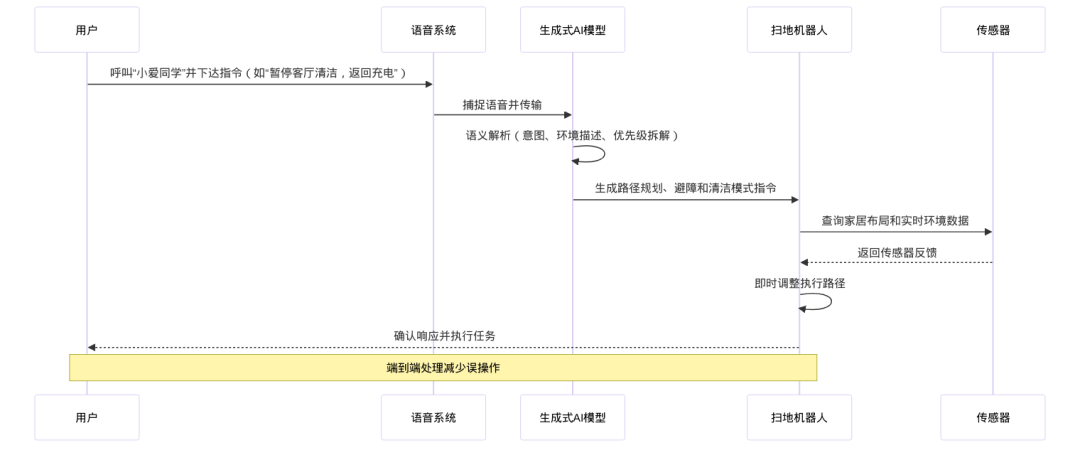
This image illustrates how user voice commands achieve end-to-end responses through generative AI, including semantic parsing and robot execution adjustments, helping to understand the interaction logic of technology integrated into home cleaning.
▸ Implementation of Voice Commands in Smart Cars
When you say, “the air conditioning is too cold, set it to 22 degrees, and turn on the seat heating” while driving, the vehicle automatically links the temperature control and seat systems to make adjustments—this is no longer a sci-fi scenario. Generative AI is reshaping the underlying logic of human-vehicle interaction, with voice commands evolving from simple function triggers to the intelligent hub controlling the entire vehicle operation. Behind this is the deep collaboration between large language models and onboard sensors, enabling the system to truly transition from “hearing clearly” to “understanding.”
The real breakthrough lies in the multimodal decision-making capability. For example, if you issue the command, “if there is congestion ahead, detour and find a charging station,” the AI must not only parse the two intents of route adjustment and recharging but also call real-time data from navigation, radar, and battery management systems to comprehensively determine the optimal solution. Compared to traditional voice assistants that rely on keyword matching, generative AI can understand vague expressions, contextual relationships, and even colloquial inverted sentences, significantly reducing false trigger rates. Industry testing data shows that some leading systems have reduced response times to under 300 milliseconds, and according to official disclosures, high-end models can support over 15 rounds of continuous dialogue memory, greatly enhancing contextual understanding capabilities.
Voice systems are becoming increasingly “understanding” of you. Some high-end models can handle semantic associations for hundreds of vehicle control functions, automatically recommending age-appropriate content during family trips; when encountering vehicle anomalies, they can also call upon built-in knowledge bases for preliminary diagnostics, reducing driver distraction. Tesla is advancing the compliant implementation of generative AI features in China, exploring service optimization paths based on user habits in internal testing versions.
The improvement of the industry ecosystem is also accelerating the implementation process. Since the comprehensive implementation of China’s “Interim Measures for the Management of Generative Artificial Intelligence Services” in November 2024, clear pathways have been provided for foreign car companies to access compliant AI systems. Mercedes-Benz has revealed plans to deploy a new generation of AI virtual assistants in future models, gradually achieving full-scene voice interaction. As mainstream car manufacturers accelerate their layouts, the entire in-car intelligent interaction industry chain is being driven forward. The global in-car audio market has maintained year-on-year growth for six consecutive quarters since Q1 2024, and according to a forecast report released by IDC in early 2025, the Asia-Pacific region will become the main growth driver. iFLYTEK, leveraging its iFLYSOUND smart sound field technology, has partnered with nearly 20 car manufacturers, and according to official disclosures, its in-car voice system installation volume has exceeded one million units, promoting high-level voice AI from flagship models to the mainstream market.
Today’s in-car voice is no longer just a functional module but a mobile intelligent entity with cognitive and decision-making capabilities. It not only enhances operational efficiency and driving safety but also integrates voice interaction with driver state monitoring systems, providing proactive service suggestions based on fatigue reminders and emotion recognition, and laying the groundwork for future AR/VR cockpit interactions.
Multimodal fusion interaction process of voice commands in smart cars
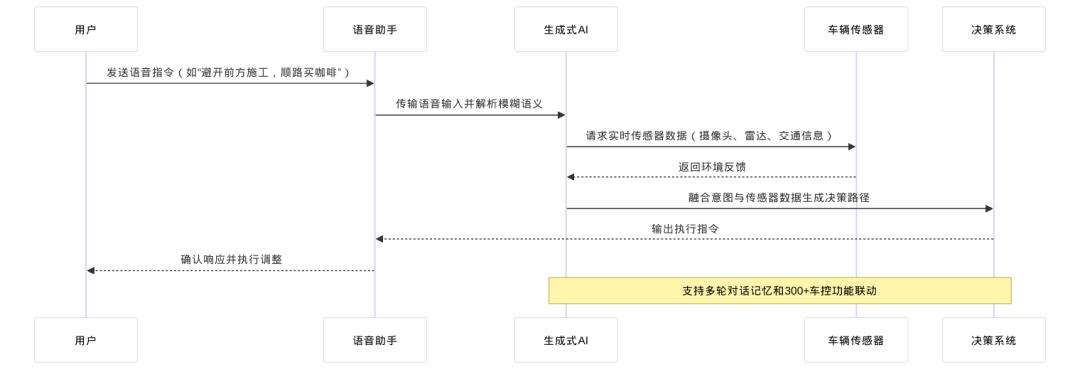
This image illustrates how user voice input interacts with generative AI and vehicle sensors to achieve intent parsing, data fusion, and decision generation, helping to understand the complete process from natural dialogue to path adjustment, based on the mechanisms described in the chapter and the application example of Roewe M7 DMH.
▸ Application of Voice Commands in Retail and Policy
When you enter a museum, you are no longer just looking at exhibits; you can engage in dialogue with history. As generative AI and voice recognition technologies mature, voice commands are quietly changing the underlying logic of cultural consumption. They are no longer just simple “play commentary” tools but intelligent links connecting education, experience, and retail, gradually piloted under policy support.
At the Qilu Culture Museum in Linzi, Zibo, the VR research project has entered the trial operation phase (as of September 2025). When students say, “take me to the Jixia Academy to hear the Hundred Schools of Thought,” the system generates immersive images and commentary based on archaeological data and literature records in real-time. This model relies on AI real-time generation technology to achieve a leap from “static viewing” to “situational participation,” aligning with the support direction for digital exhibition innovation outlined in the “Guiding Opinions on Promoting the ‘Internet + Chinese Civilization’ Action Plan.”
The AI immersion project at the Erlitou Xia Capital Ruins Museum started internal testing in June 2025, equipped with a dedicated intelligent entity that can understand everyday language questions, such as “how did Xia Dynasty craftsmen make turquoise artifacts?” The model, trained on historical interaction data, can recognize context and generate natural responses, breaking through the script limitations of traditional voice-guided tours. The system also adjusts the explanation style based on user age, providing story-like expressions for children and in-depth interpretations for adults. Preliminary tests show that the average user dwell time increased by 35% (source: museum’s third-quarter report in 2025).
The integration of cultural tourism and retail is being redefined by voice interaction. In the VR project “Liaozhai Fantasy” at the Pu Songling Memorial Hall (launched in August 2025), visitors can say, “summon the fox spirit to tell a story,” triggering character dialogues and interactive experiences. The interactive content is contextually linked to cultural products in the museum, such as the design inspiration for the sachet mentioned by the fox spirit, with the system immediately pushing a purchase QR code. User behavior data shows that the conversion rate of scanning codes within 30 minutes after voice-triggered recommendations reached 22%. Similarly, at the Zibo Ceramic and Glass Museum, the “Nüwa Mends the Sky” VR experience plays animations and recommends related crafts through commands like “explain the process of Nüwa refining stones,” achieving a natural connection between cultural understanding and product conversion.
Voice commands are evolving from simple operational tools into key interfaces connecting culture, education, and retail, with their development relying on technological advancements and benefiting from policies that regulate and guide AI applications. When users actively trigger content through questions, summons, and commands, cultural services shift from one-way output to behavior-driven participatory experiences. The typical user journey is “voice trigger → content resonance → instant recommendation → scan to purchase,” facilitating the formation of a closed-loop in consumer decision-making, allowing the public to gradually transition from viewing to participating.
Sequence of voice command-driven VR cultural scene interactions
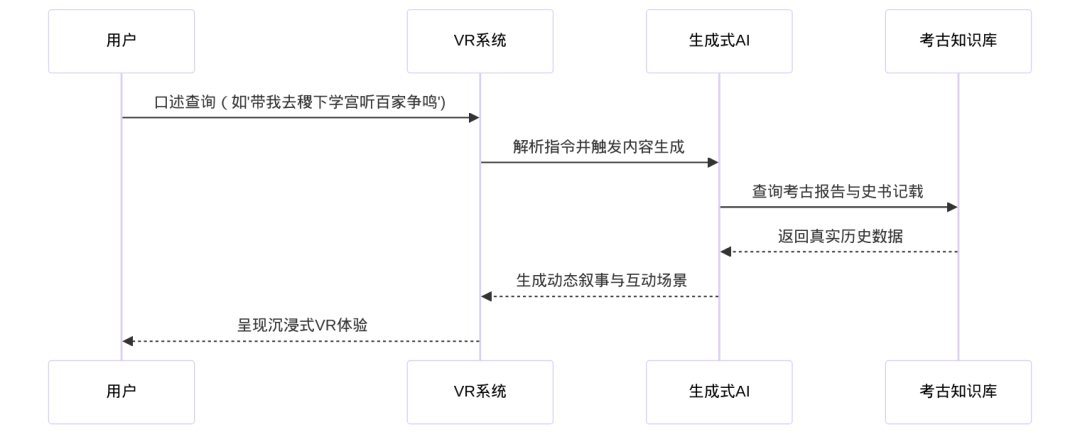
This image illustrates the dynamic process of user interaction with the VR system through voice commands, emphasizing the bridging role of generative AI in generating personalized content based on archaeological data, helping readers intuitively understand the response mechanism from inquiry to immersive experience, in response to national cultural digitization policies.
▸ Evolution of the Smart Ecosystem: Challenges and Future Outlook
Voice commands are no longer just simple commands like “turn on the light” or “raise the volume”; they are becoming the universal language for conversing with the smart world. From controlling robotic vacuums to planning navigation in smart cars, and entering VR cultural scenes through commands like “take me to the Jixia Academy to hear the Hundred Schools of Thought,” voice is connecting multiple dimensions of home, travel, and spiritual life. Supporting this transformation is the enhanced multimodal understanding capability brought by generative AI and edge computing—systems not only need to hear clearly but also understand what you truly want to do.
True intelligence is reflected in the seamless collaboration between devices. When you say, “prepare dinner” in the living room, the system automatically links multiple terminals: the refrigerator checks inventory and recommends menus, the stove begins preheating, and the robotic vacuum avoids the kitchen area to continue working. This cross-device collaboration relies on local edge processing and cloud-based large models, reducing response delays while enhancing data security. Market feedback confirms this trend; data from the Ministry of Commerce’s e-commerce department shows that online retail sales of smart wearable devices in China increased by 23.1% year-on-year in the first three quarters of 2025, indicating a rapid release of user demand for all-scenario interconnected experiences. This growth trend has also attracted the attention of policymakers.
It is worth noting that as device interconnections become more frequent, challenges are also gradually emerging. Voice data contains a wealth of information about living habits and spatial information, and if uploaded to the cloud without desensitization, it may pose privacy risks, even being used for user profiling or location tracking. Recognition stability still needs improvement; in noisy environments or dialect usage scenarios, mainstream voice systems have high misrecognition rates, affecting operational reliability. To address privacy issues, some manufacturers have adopted federated learning architectures, completing model training on the device side and only uploading encrypted parameters, significantly reducing the risk of raw data leakage.
The future of voice interaction lies in building a scalable, trustworthy unified ecological platform, rather than achieving breakthroughs in isolated points. Current practices indicate that a single brand or isolated system cannot support continuous interactions in complex life scenarios. Breakthroughs require cross-brand and cross-platform protocol unification and the co-construction of security mechanisms. In recent years, with the popularization of smart terminals and the upgrading of user demands, policy levels have also accelerated their responses. The “2024 Action Plan for the Development of New Smart Terminals” released by the Ministry of Industry and Information Technology clearly proposes to promote the integration of multimodal interaction technologies and ecological openness, accelerating the construction of a collaborative innovation system. Under the dual influence of top-level design and market-driven forces, low-cost, highly compatible voice terminals will accelerate their popularity, allowing natural language to orchestrate whole-house systems and enabling experiences where a single command can access cultural resources, gradually moving towards inclusivity. When ordinary families can easily perform these operations, the truly inclusive smart era will have arrived.
Sequence of voice command-driven multi-device collaborative interaction
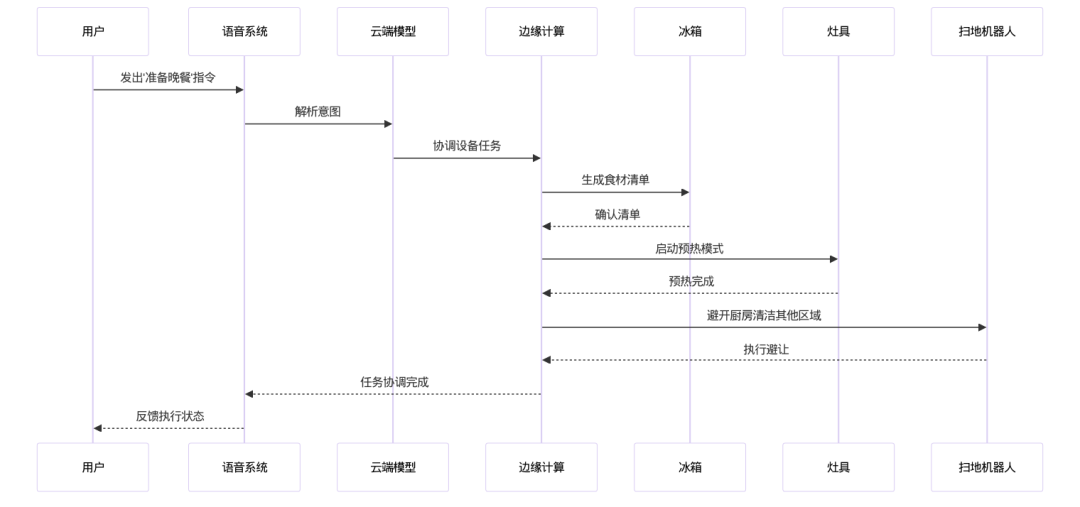
This image illustrates the dynamic interaction process of user voice commands within the smart home ecosystem, highlighting the collaborative mechanism of edge computing and cloud integration, helping readers understand the evolution from a single command to ecological decision-making. Based on the scenario described in the chapter, the chart emphasizes real-time response and avoidance logic between devices.
Conclusion: The Intelligent Wave of Voice Commands
Voice commands are becoming the key entry point for the implementation of generative AI, with devices no longer passively responding but actively collaborating through natural language understanding. Precise cleaning, safe driving, and immersive cultural experiences—these scenarios are supported by the integration of edge computing and cloud technologies. The warmth of technology is reflected in how it subtly integrates into the flow of life, making interactions intuitive.
In the next three years, 5G and lightweight models will accelerate seamless interactions among multiple devices, with a single command potentially activating home, travel, and entertainment systems simultaneously. However, the real breakthrough lies not in how many devices are connected but in whether they can understand user intent. Privacy protection and ecological compatibility remain hurdles that must be overcome. When voice commands are no longer just orders but part of the rhythm of life, voice commands will not only be commands but also the key to a future intelligent life. This transformation has already begun, and we are all participants.
Huaying Liangyun Technology (Chengdu) Co., Ltd.
Dedicated to becoming China’s leading AI enterprise intelligent service provider, driving industrial transformation through technological innovation, and empowering every enterprise with intelligent technology.