1. Industry Overview and Development Stages
3D printing, also known as additive manufacturing, is a manufacturing method that directly creates three-dimensional physical entities by layer-by-layer adding materials based on three-dimensional model data. It is completely different from traditional subtractive manufacturing technologies (such as CNC machining) and has unique advantages such as “freedom of manufacturing, no molds, reduced waste, and lower inventory,” making it an important complement to traditional processes.
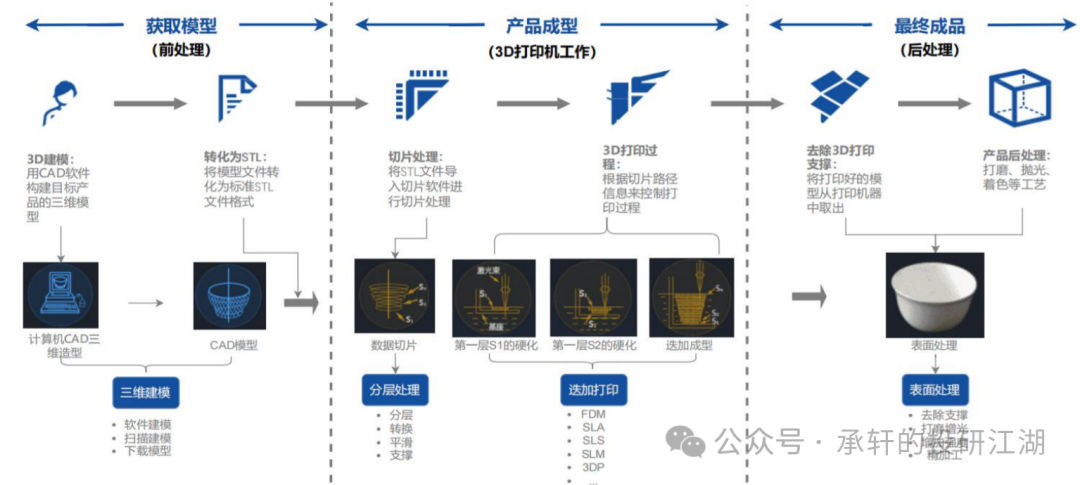
The development of 3D printing technology can be divided into three stages:
1980-1990: The patents, technologies, and prototypes of 3D printing were successively born.
1990-2010: Influential 3D printing companies gradually emerged in Europe and the United States, such as 3D Systems, Stratasys, and EOS. The technology transitioned from theoretical prototypes to practical production and application, with an expanding range of products and downstream scenarios.
2010 to present: Leading companies expanded their businesses through mergers and acquisitions, some technology patents expired, and the industry experienced rapid development. The domestic 3D printing industry started later than that of Europe and the United States, but in recent years, the gap has gradually narrowed, and the scale of commercialization has continuously expanded, completing the transition from technological accumulation to commercialization.
2. Analysis of the 3D Printing Industry Chain
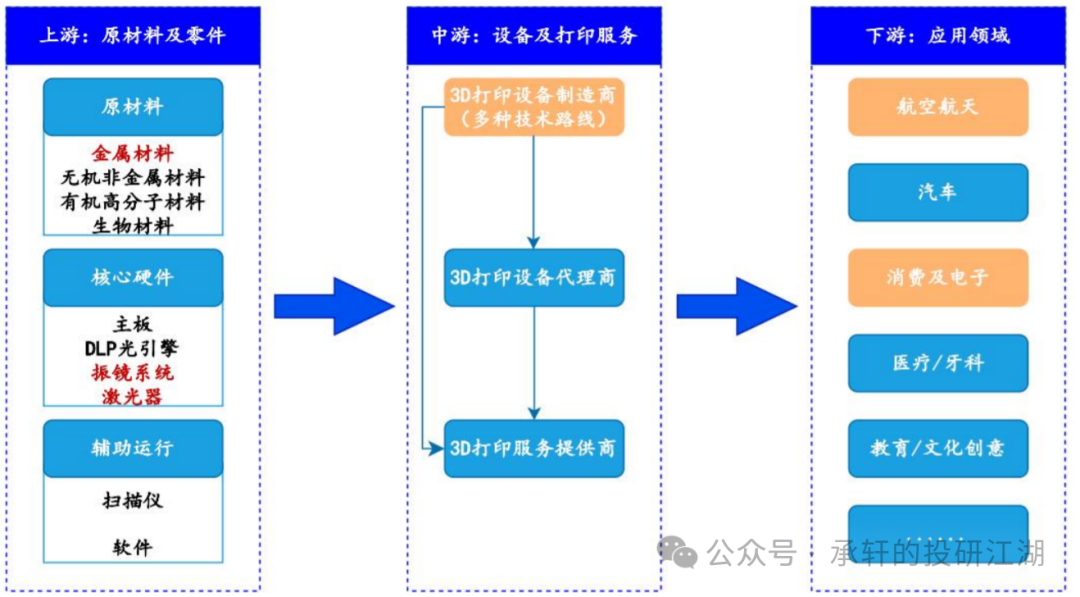
The 3D printing industry has formed a complete industry chain, covering upstream raw materials and parts, midstream equipment manufacturers and service providers, and multiple downstream application fields. According to data from the Huajing Industry Research Institute, in 2021, 3D printing equipment and services accounted for 80% of the global market and 76% of the Chinese market. Midstream equipment manufacturers dominate the industry chain, especially the promotion and application of industrial-grade 3D printing equipment, which has driven the rapid growth of the entire industry.
3. Classification and Application Scenarios of 3D Printing Materials
There are many types of 3D printing materials, which can be mainly divided into four categories: metal materials, inorganic non-metallic materials, organic polymer materials, and biomaterials. Each material has its unique characteristics and application scenarios, as detailed below:
3.1 Metal Materials
Metal materials are one of the most important materials in 3D printing, especially metal powders and liquid metal materials such as titanium alloys, high-temperature alloys, and aluminum alloys. Representative processes for metal materials include Selective Laser Melting (SLM), Electron Beam Melting (EBM/EBSM), and Laser Engineered Net Shaping (LENS). The application scenarios for metal 3D printing are very broad, especially in aerospace, shipbuilding, nuclear industry, automotive industry, and rail transportation, enabling the direct manufacturing of high-performance, difficult-to-process components. The advantages of metal 3D printing lie in its fine forming structure and superior mechanical properties, making it particularly suitable for the manufacturing of complex structural parts.
Titanium Alloys: Titanium alloys have high specific strength, corrosion resistance, and good biocompatibility, widely used in aerospace components (such as compressor parts of aircraft engines, rocket and missile structural components) and medical fields (such as artificial implants for bones and teeth). However, the preparation cost of titanium alloys is relatively high, quality control is challenging, and products are prone to porosity.
Aluminum Alloys: Aluminum alloys have low density, good corrosion resistance, and high fatigue resistance, suitable for printing larger items, especially widely used in aerospace and automotive manufacturing.
Cobalt-Chromium Alloys: Cobalt-chromium alloys have excellent corrosion and mechanical properties, mainly used in medical and aerospace fields.
Stainless Steel: Stainless steel has strong corrosion resistance, suitable for printing complex structural components, especially widely used in aerospace and automotive manufacturing.
3.2 Inorganic Non-Metallic Materials
Inorganic non-metallic materials mainly include high-performance ceramics, non-metallic minerals, gemstone materials, resin sand, sand-covered membranes, silica sand, and silicate materials. Representative processes include Selective Laser Sintering (SLS), 3D Printing (3DP), and Material Jetting (PJ). The application scenarios for inorganic non-metallic materials cover the development of casting molds for aerospace, automotive engines, and the manufacturing of functional components, as well as extensive applications in industrial product prototyping and innovative creative product production.
Ceramic Materials: Ceramic materials have high strength, high hardness, high-temperature resistance, low density, good chemical stability, and corrosion resistance, mainly applied in aerospace, automotive, and biomedical fields. Due to their high melting point, they are difficult to form directly using external energy fields, leading to high preparation costs and challenges in quality control.
3.3 Organic Polymer Materials
Organic polymer materials mainly include resin-based, filament-based, and powder-based materials. Resin materials such as photosensitive resins, filament materials such as PLA, ABS, PC, PPSF, PETG, and powder materials such as PA, PS, PC, PP, and PEEK. Representative processes include Stereolithography (SLA) and Fused Deposition Modeling (FDM). The application scenarios for organic polymer materials are very broad, covering mold manufacturing, prototype verification, scientific research and teaching, cultural relic protection, and biomedical fields.
PLA (Polylactic Acid): PLA is a biodegradable and environmentally friendly plastic, inexpensive, with good printing performance and excellent biocompatibility, mainly applied in education, medical, construction, and mold design fields.
ABS: ABS is one of the most commonly used materials in FDM processes, inexpensive, with high strength, good toughness, and impact resistance, widely used in automotive, home appliances, and consumer electronics.
PA (Nylon): PA is the main material used in SLS processes, with high density and strength, and certain flexibility, mainly applied in engine peripheral parts, door handles, brake pedals, etc.
PC (Polycarbonate): PC materials have high strength, high-temperature resistance, impact resistance, and bending resistance, widely used in the glass assembly industry, automotive industry, and electronics and electrical industries.
3.4 Biomaterials
Biomaterials for additive manufacturing mainly include biodegradable materials, biocompatible materials, and living cells. The representative process is Cell Bioprinting (CBP), with application scenarios mainly focused on controlled drug release, organ transplantation, and regeneration and reconstruction of tissue and cartilage structures. The development of bioprinting technology has brought revolutionary changes to the medical field, especially in personalized medicine and tissue engineering, with broad application prospects.
Biocompatible Materials: These materials have good biocompatibility, mainly applied in medical devices and tissue engineering. However, the output of bioprinting is relatively low, and the technical requirements for supporting 3D printing equipment are high.
4. Development Routes of 3D Printing Technology
After years of development, 3D printing technology has formed various mainstream process routes. Below is a detailed introduction to seven categories of 3D printing technologies:
4.1 Powder Bed Fusion (PBF)
Powder Bed Fusion technology is an additive manufacturing process that selectively melts/sinter the powder bed area using thermal energy. Among them, Selective Laser Melting (SLM) and Selective Laser Sintering (SLS) are the most important process types. Parts printed using SLM have mechanical properties that exceed those of castings and can even reach forged standards, making it the most widely used in the industrial field, especially in the manufacturing of complex metal precision parts in aerospace and medical fields. Representative companies include EOS, SLM Solutions, PLT, and Huazhu High-Tech.
SLM: Suitable for small batch and customized production characteristics in aerospace, with the potential for large-scale industrial production as technology develops and costs are controlled.
SLS: Mainly applied in aerospace for engineering plastic components, casting sand cores for automotive and home appliances, medical surgical guides, and orthopedic implants.
4.2 Directed Energy Deposition (DED)
Directed Energy Deposition technology is an additive manufacturing process that melts materials by focusing thermal energy, depositing as it melts. Major processes include Laser Engineered Net Shaping (LENS), Wire Arc Additive Manufacturing (WAAM), and Electron Beam Wire Deposition (EBDM). These technologies are mainly applied in the forming and repair of large complex metal components, especially in the aerospace field. Representative companies include Optomec Design, Xinjinghe, and PLT.
LENS: Suitable for the manufacturing and repair of large complex metal components, especially widely used in the aerospace field.
WAAM: Mainly applied in the manufacturing of large metal components in aerospace.
4.3 VAT Photopolymerization
VAT Photopolymerization technology is an additive manufacturing process that selectively cures liquid photosensitive polymers through photopolymerization. Major processes include Stereolithography (SLA), with representative companies such as 3D Systems, Formlabs, Hengtong, and Xianlin 3D. This technology is widely used in industrial product design development, innovative creative product production, and precision casting wax molds, mainly using non-metal materials.
SLA: Suitable for industrial product design development, innovative creative product production, etc., especially the high precision and surface quality of photosensitive resin materials make it widely used in automotive, home appliances, and consumer electronics.
4.4 Binder Jetting
Binder Jetting technology is an additive manufacturing process that selectively deposits liquid binders to bond powder materials. Major processes include 3D Printing (3DP), with representative companies such as Exone, VoxelJet, and Fenghua Zhuoli. This technology is widely used in industrial product design development, casting sand cores, medical implants, medical models, innovative creative products, and construction.
3DP: Mainly applied in industrial product design development, casting sand cores, medical implants, etc., especially with the extensive application of non-metal materials.
4.5 Material Extrusion
Material Extrusion technology is an additive manufacturing process that extrudes materials through nozzles or openings. Major processes include Fused Deposition Modeling (FDM), with representative companies such as Stratasys and Tai’er Times. This technology is widely used in industrial product design development and innovative creative product production, mainly using non-metal materials.
FDM: Suitable for industrial product design development and innovative creative product production, especially with the extensive application of materials such as PLA and ABS.
4.6 Material Jetting
Material Jetting technology is an additive manufacturing process that deposits materials in micro-droplets as needed. Representative processes include PolyJet, mainly applied in industrial product design development, medical implants, innovative creative product production, and casting wax molds.
PolyJet: The Israeli company Objet is a representative enterprise of this technology, mainly applied in industrial product design development and medical implants.
4.7 Sheet Lamination
Sheet Lamination technology is an additive manufacturing process that bonds thin layers of material to form a physical object. Representative processes include Laminated Object Manufacturing (LOM), mainly applied in industrial product design development.
LOM: Helisys and Shaanxi Zhituo Solid Phase are representative companies of this technology, mainly applied in industrial product design development.
5. Application Scenarios of 3D Printing Technology
The application scenarios of 3D printing technology have expanded from early rapid prototyping to the direct manufacturing of end parts, especially in aerospace, automotive, and medical fields. Below is a detailed analysis of application scenarios in various fields:
5.1 Aerospace Field
Aerospace is the field with the deepest application of 3D printing. The application of 3D printing technology in this field mainly focuses on lightweight and integrated manufacturing of complex structural parts. Aerospace products generally have small batch sizes, large dimensions, short processing cycles, and high quality performance requirements. Traditional processes do not have significant cost and cycle advantages in the aerospace field, while 3D printing technology has significant advantages in geometric design freedom, material utilization, and customized production, significantly shortening manufacturing cycles and reducing costs. For example, 40% of the mass of SpaceX’s Raptor engine is produced using 3D printing technology, and the fuel nozzle of the domestic C919 aircraft engine also uses 3D printing technology.
SpaceX: According to estimates, SpaceX’s annual demand for 3D printing equipment is 140-350 units, with a demand value of approximately $112-280 million.
C919 Aircraft Engine: The total demand for 3D printing equipment for the C919 engine is approximately 1,080 units, with a total demand value of about 3.5 billion yuan, with a delivery time from 2024 to 2031.
5.2 Automotive Field
The automotive industry is also an important application field for 3D printing technology, especially as companies like BMW, Volkswagen, and Ford gradually adopt 3D printing technology. For example, Volkswagen has been using HP’s metal 3D printing technology for large-scale customization and manufacturing of decorative parts since 2019, aiming to produce 50,000 to 100,000 parts the size of a soccer ball each year, including gear levers and rearview mirror brackets. BMW plans to produce at least 50,000 mass-produced parts and over 10,000 spare parts annually using 3D printing technology through the IDAM joint project.
Ford: Ford plans to adopt 3D printing technology in large-scale automotive manufacturing, with developed 3D printed parts to be used in the full production of Ford’s “very popular models.”
5.3 Medical Field
The application of 3D printing technology in the medical field mainly focuses on personalized medicine and tissue engineering. Metal 3D printing technology is particularly widely used in the medical field, especially processes such as Selective Laser Melting (SLM) and Electron Beam Melting (EBM). 3D printing enables the customized production of complex structures, especially in the manufacturing of artificial implants for bones and teeth, showing significant advantages. Additionally, bioprinting technology also shows great potential in drug controlled release and organ transplantation.
Cobalt-Chromium Alloys: Cobalt-chromium alloys are widely used in the medical field due to their excellent corrosion and mechanical properties, especially in the manufacturing of artificial implants.
5.4 Consumer Electronics Field
Consumer electronics is an emerging application market for 3D printing technology, especially in fields such as foldable smartphones and smartwatches. 3D printing technology can achieve weight reduction and thinning of products, with titanium alloy 3D printing technology being particularly widely used. Leading manufacturers such as Apple, Huawei, and Xiaomi have begun to apply 3D printing technology, such as titanium alloy hinge covers for foldable smartphones, phone frames, and smartwatches. As 3D printing technology matures further, its penetration rate in the consumer electronics field is expected to increase, with the global market size for 3D printing of foldable smartphone hinges and phone frames expected to reach 79.22-99.02 billion yuan by 2028, and the Chinese market size expected to reach 19.08-23.85 billion yuan.
Foldable Smartphone Hinges: The application of titanium alloy 3D printing technology in foldable smartphone hinges can significantly reduce product weight, with the global market size for 3D printing of foldable smartphone hinges expected to reach 3.66-4.57 billion yuan by 2028.
5.5 Other Fields
3D printing technology also has extensive applications in mold manufacturing, cultural creativity, and construction. For example, the application of non-metal 3D printing technology in mold manufacturing can significantly reduce manufacturing costs, especially in the development of casting molds for the automotive and home appliance industries. Additionally, 3D printing has a wide range of applications in the cultural creativity field, enabling the rapid production of complex artistic models and innovative products.
Mold Manufacturing: The application of non-metal 3D printing technology in mold manufacturing can significantly reduce manufacturing costs, especially in the development of casting molds for the automotive and home appliance industries.
6. Market Size and Growth Potential of the 3D Printing Industry
The 3D printing industry has shown rapid growth in recent years, especially driven by the aerospace and consumer electronics fields, with the industry scale continuously expanding. According to the Wohlers Report 2022, the global 3D printing market has a compound annual growth rate of over 20% from 2013 to 2023, with global sales in the additive manufacturing industry reaching $20.035 billion in 2023, a year-on-year increase of 11.1%. Among them, the metal additive manufacturing market grew by 24.4% year-on-year.
7. Development of 3D Printing Equipment and Industry Chain Integration
The development of 3D printing equipment has transitioned from single equipment manufacturers to comprehensive solution providers. Since most of the core patents of 3D printing are held by equipment manufacturers, these manufacturers have gradually strengthened their overall control over the industry chain by acquiring 3D printing software companies, material companies, and service providers. For example, domestic 3D printing companies such as PLT and Huazhu High-Tech have made significant progress in the field of metal 3D printing equipment, especially Huazhu High-Tech’s FS621M large-size metal additive manufacturing solution, which has been widely used in rocket engine manufacturing.
PLT: PLT’s metal 3D printing equipment has performed excellently in rocket engine manufacturing, significantly shortening manufacturing cycles and reducing costs.
Huazhu High-Tech: Huazhu High-Tech’s FS621M equipment has been widely used in the manufacturing of rocket engines for SpaceX and Star River Power, especially excelling in the manufacturing of large-size nozzles.
8. Risks and Challenges in the 3D Printing Industry
Risk of dependence on imported key core components: The core components of 3D printing equipment still rely on imports, which may affect the industry’s autonomy and controllability.
Risks of industrial application in emerging industries or fields: The industrial application of 3D printing technology in some emerging fields is not yet fully mature, posing certain market risks.
Risks of intensified market competition: As 3D printing technology becomes more widespread, market competition is gradually intensifying, and companies need to continuously improve product yield and reduce costs.
Risks of downstream demand growth not meeting expectations: If the downstream demand of the 3D printing industry does not grow as expected, it may negatively impact the overall development of the industry.