Hello everyone, this week I would like to share an article published in JACS titled Localized 2′-OH Acylation at Poly(A) Extends RNA Translation. The corresponding author is Professor Eric T. Kool from Stanford University, whose research group focuses on nucleic acid chemical modifications and RNA therapeutics.
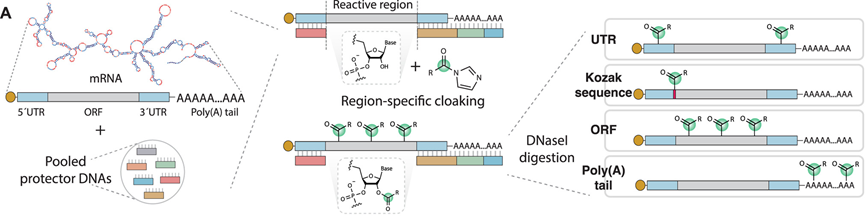
In the field of mRNA therapeutics, the integrity of the poly(A) tail is crucial for maintaining translational activity. However, traditional modification methods face two major limitations: the structural constraints of modified nucleotides imposed by RNA polymerases and the heterogeneity issues associated with enzymatic ligation of poly(A) tails. This study innovatively develops a DNA-guided local acylation strategy—by designing complementary DNA “protective strands” to cover non-target regions of the mRNA, allowing the 2′-hydroxyl of the poly(A) tail to be specifically exposed to acyl imidazole reagents.
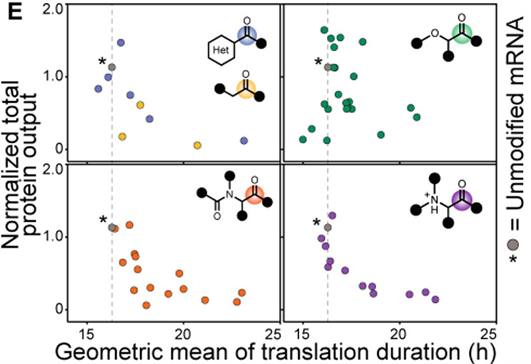
The authors first synthesized 28 structurally diverse acyl imidazole reagents, covering features such as α-carbon-containing oxygen/nitrogen groups, chiral centers, and aromatic substituents. When global acylation was performed on the entire d2eGFP mRNA (approximately 50% 2′-OH modification), most reagents significantly reduced protein yield, with only a few, such as α-methyl methoxy acyl derivatives 8, maintaining translational activity. However, the modification effects exhibited an orthogonal distribution: reagents that increased total yield shortened the duration, while those that extended the duration reduced the total yield.
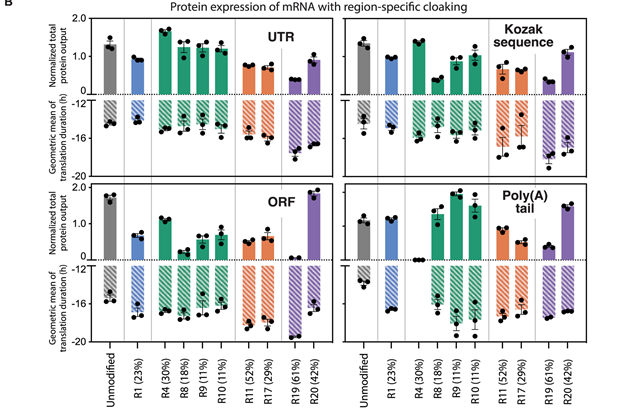
To overcome this bottleneck, the authors employed DNA tile positioning technology to systematically compare the local modification effects in different functional regions. The results showed that acylation in the UTR region (such as compounds 4, 8-10) could retain translational capability; acylation in the ORF region generally inhibited ribosomal progression; and modifications in the Kozak sequence hindered translation initiation. The most groundbreaking finding was the local acylation of the poly(A) tail—at approximately 13% modification, α-aromatic substituent reagents such as (R)-α-phenyl dimethylglycine imidazole 37 increased d2eGFP protein expression by 7 times, with median translation time extended by 4 hours. This “spatiotemporal decoupling” effect was validated in HEK293, HeLa, and HepG2 cell lines, with minimal chiral influence. Notably, the acylation level needs to be precisely controlled: below 13%, the dose-dependent enhancement of expression occurs, while above 25%, off-target modifications lead to expression suppression.
Mechanistic studies indicate that α-aromatic acylation disrupts the helical structure of the poly(A) tail through steric hindrance. Circular dichroism analysis shows that as the modification level of reagent 37 increases from 0% to 87%, the characteristic peaks (positive peak at 264 nm/negative peak at 249 nm) gradually disappear, indicating the dissociation of the A-type helical conformation. This structural disruption may hinder the recognition of the helical region by the deadenylase Pan2/Caf1, and qPCR confirmed that the half-life of the modified mRNA was significantly extended. In therapeutic application validation, the expression level of human β-globin mRNA with 15% local acylation was increased 5-fold in HEK293 cells, and cytotoxicity tests showed that the acylation reagents had good biocompatibility.
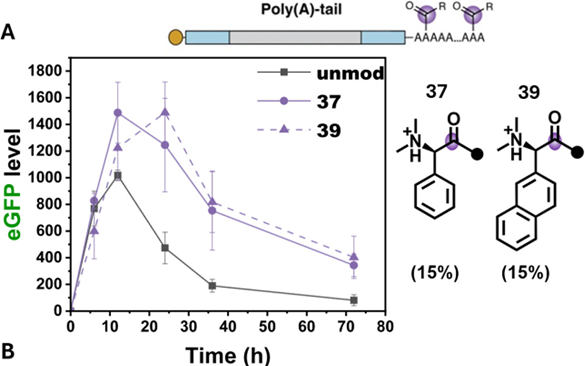
This strategy breaks through the limitations of traditional enzymatic modifications and achieves precise chemical engineering of the poly(A) tail for the first time. Compared to the nucleotide incorporation method, the DNA-guided acylation operation is simple (one-pot reaction), cost-effective (reagents are activated and synthesized in one step from carboxylic acids), and can introduce a richer chemical diversity. In the future, by optimizing positioning accuracy and developing new aromatic acyl groups, it is expected to provide new solutions for gene therapies such as β-thalassemia.
Author: TZS
Editor: WYQ
DOI: 10.1021/jacs.5c11900
Original link: https://doi.org/10.1021/jacs.5c11900