1. Join the humanoid robot technology exchange group by adding WeChat 18255163584, with the note ‘robot’2. Long press the QR code to follow the ‘Humanoid Robot Research Lab’ public account!
As the “nerve center” and “power drive core” for high-precision motion control of humanoid robot joints, the rotational motor controller is a core hardware unit that determines joint response speed, motion accuracy, load adaptability, and system reliability. Its design must deeply match the requirements of humanoid robots, including multi-joint coordination, dynamic load fluctuations, compact space installation, and low power operation. The core focuses on four main objectives: high-precision control, high power density, high reliability, and modular integration, achieving full-link closed-loop control through a layered architecture that implements instruction parsing, power drive, state feedback, and safety protection.
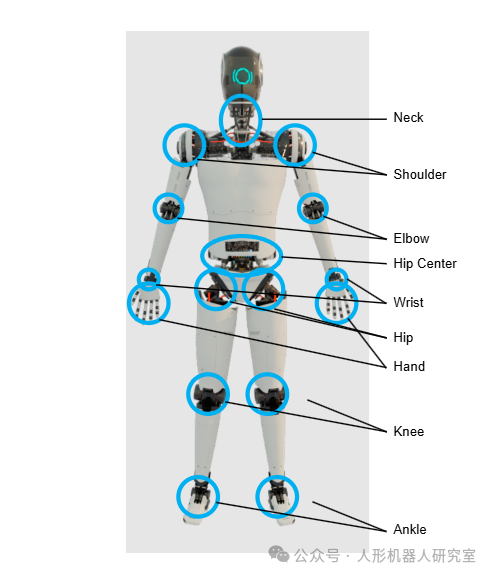
The system adopts a modular layered architecture design, divided into five core levels. Each layer collaborates through standardized hardware interfaces and high-speed signal links, ensuring the independence of individual functions while enhancing the overall system’s scalability and maintainability. The following is a core analysis of the layered structure:
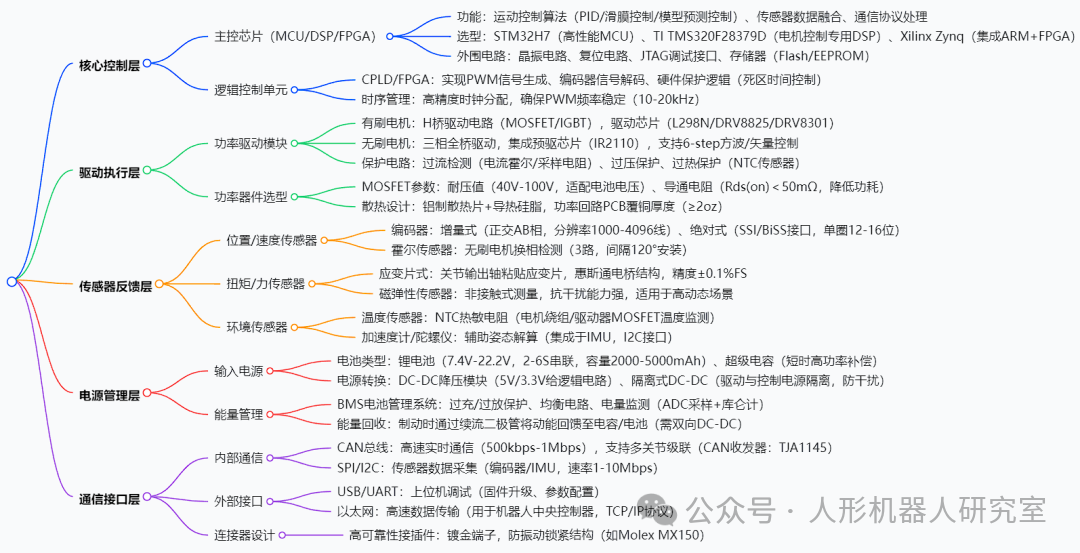
1. Core Control Layer (“Decision Brain”)
Core Hardware: Utilizes high-performance MCU (Microcontroller) or FPGA (Field Programmable Gate Array) as the main control chip, with some high-end solutions integrating DSP (Digital Signal Processor) for complex algorithm acceleration;
Core Function: Receives joint motion commands (such as position, speed, torque target values) issued by the robot’s main controller, parses the commands through built-in high-precision control algorithms (such as PID algorithm, Model Predictive Control (MPC), adaptive control algorithms), and generates precise drive control signals. It also processes feedback data from each layer in real-time, dynamically adjusting control strategies to ensure smooth and accurate joint movements;
Technical Highlights: Supports multi-modal command parsing, with millisecond-level command response speed. The algorithm can dynamically optimize parameters based on joint load changes, adapting to different motion scenarios such as walking and grasping.
2. Drive Execution Layer (“Power Amplifier”)
Core Hardware: Composed of high power density power devices (such as IGBT, SiC MOSFET), driver chips, and H-bridge topology circuits;
Core Function: Amplifies the weak electrical control signals output from the core control layer into strong electrical power signals that can drive the motor, precisely controlling the motor’s current, voltage, and frequency to achieve motor start-stop, speed regulation, and torque adjustment;
Technical Highlights: Adopts a wide voltage input design, supports large current instantaneous output, and SiC device solutions can reduce switching losses, improving energy conversion efficiency (up to over 95%), while also providing fast overcurrent and short-circuit protection to prevent device damage.
3. Sensor Feedback Layer (“Perception Nerve”)
Core Hardware: Integrates high-precision position sensors (such as magnetic encoders, photoelectric encoders, with a resolution of over 16 bits), torque sensors, temperature sensors, and current sensors;
Core Function: Real-time collection of key state data such as motor rotor position, actual joint torque, motor winding temperature, and drive circuit current, feeding this data back to the core control layer at high speed, providing precise basis for closed-loop control;
Technical Highlights: Position sensor sampling frequency can reach kHz level, torque detection accuracy error ≤1%, and temperature and current sensors have fast response capabilities to promptly capture abnormal states, ensuring system safety.
4. Power Management Layer (“Energy Distribution and Protection Center”)
Core Hardware: Includes wide voltage input modules, DC-DC conversion circuits, filtering circuits, and protection circuits (overvoltage, overcurrent, overheating, undervoltage protection);
Core Function: Receives power supply from the robot, converting it via DC-DC to the stable voltages required by each layer of circuits (such as 3.3V/5V for the core control layer, high voltage for the drive execution layer), while filtering power supply noise to ensure power supply stability. When an abnormal power supply state is detected, it quickly cuts off the power or triggers protection mechanisms to prevent damage to the controller and motor;
Technical Highlights: Supports a wide range of input voltages (such as 24V-60V), adapting to different power supply schemes for humanoid robots, with high conversion efficiency (≥90%) and protection response time ≤10μs.
5. Communication Interface Layer (“Data Interaction Bridge”)
Core Hardware: Integrates high-speed communication interface chips, supporting industrial communication protocols such as CANopen, EtherCAT, SPI, I2C;
Core Function: Achieves bidirectional data interaction between the controller and the robot’s main controller, other joint controllers, and the upper computer, including uploading joint status data (position, torque, temperature, etc.), receiving motion commands, and performing parameter configuration and firmware upgrades;
Technical Highlights: Communication speed can reach over 100Mbps, supports multi-node synchronous communication, with low latency (≤1ms), ensuring the synchronization of multi-joint coordinated movements, while also having a communication fault tolerance mechanism to enhance data transmission reliability.
In summary, this controller achieves full closed-loop control of “instruction – drive – feedback – adjustment” through deep collaboration of the five-layer architecture, meeting the core requirements of humanoid robot joints for high precision and high response speed, while the modular design reduces the difficulty of overall integration, making it a key core component for achieving flexible, stable, and efficient movement in humanoid robots.
—————-END——————
Disclaimer: We organize and reprint this article for the purpose of disseminating more information and do not represent the views of this account, nor does it constitute any investment opinion. Any investment decisions made based on this article are unrelated to the author! If there are copyright issues with the videos, images, or text used in this article, please contact the editor immediately, and we will delete them without any commercial use!Join the knowledge community to continuously receive the latest reports in the robot industry for free!