Many photography beginners encounter this situation when they buy a camera for the first time – they excitedly unwrap the package only to find that there is no memory card included!? Or they receive a complimentary memory card, but it seems to fill up quickly, and upon closer inspection, it has a capacity of only 8GB, or even 4GB!? Or you might think that this storage capacity is sufficient, but you will find that the speed of photo storage is incredibly slow, and the camera often displays a “Storing” message!? Today, I will explain everything related to memory cards and teach you how to choose the right one for yourself!
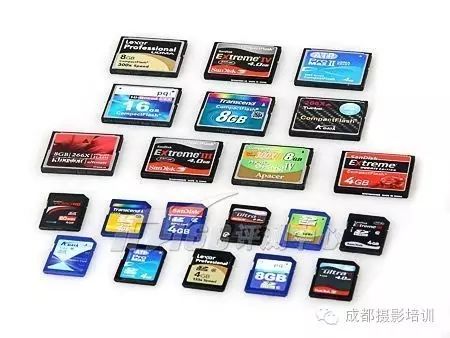
Generally speaking, memory cards are not included as standard accessories when purchasing a camera, so it is not surprising if the included memory card is of subpar quality or not included at all.
If you want to equip your beloved camera with a memory card or upgrade to a better one, the first thing we need to clarify is what type of card your camera uses. Memory cards differ not only in storage capacity but also in type, size, speed, and other factors that need to be considered.
Types of Memory Cards
The mainstream camera memory cards available on the market include several types:
First is the SD card, which is further divided into SDHC and SDXC cards. Both in size and thickness, they are similar to a one-yuan coin (of course, this thickness is not compared to a one-yuan coin standing up, haha).
Next is the CF card, which is larger than the SD card and is commonly used in higher-end models. Currently, a few high-end cameras use CFast cards or XQD cards, which look similar to CF cards.
Then there is the Micro SD card, also known as TF card, which is a mini version of the SD card. Although it is smaller, it is similarly categorized into Micro SDHC and Micro SDXC.
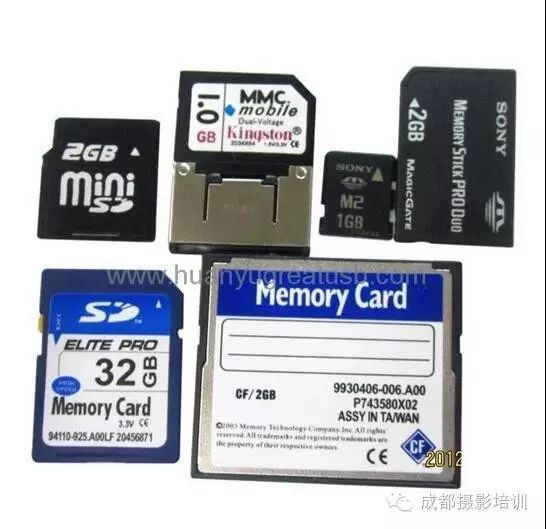
TF card in the first row, second from the right; SD card in the second row, first from the left; CF card in the second row, first from the right.
Once you clarify the size, you can determine which type of memory card to use by checking the memory card slot or the battery compartment of your camera. If you are still unable to determine, you can find more detailed and accurate memory card information in the camera packaging, product manual, or official specifications to avoid purchasing an unusable card and wasting money.
Top Memory Card Brands
Common memory card brands include Kingston, SanDisk, Samsung, Sony, Toshiba, ADATA, Kingmax, Lexar, Transcend, and PNY.
SDHC and SDXC
What is the difference between SDHC and SDXC mentioned earlier? Firstly, they have different capacity standards, with 32GB as the boundary. SDHC is a High Capacity SD card with a storage capacity range of 2GB-32GB; SDXC is an eXtended Capacity SD card with a storage capacity starting from 32GB and theoretically reaching up to 2TB.
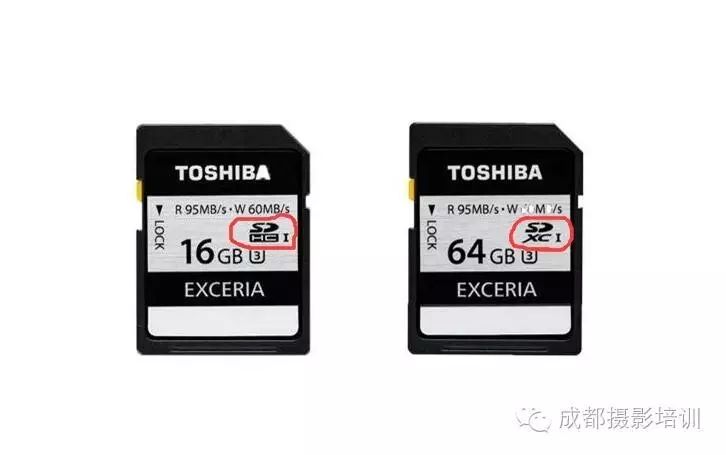
Another major difference between SDHC and SDXC is the transfer speed. If you closely observe the markings on the memory card, you will notice that some cards have a number surrounded by a circle with an opening on the right, while others have numbers partially surrounded by a U. These indicate the speed class.
The circle with an opening on the right represents the UHS Speed Class C, with transfer speeds defined as Class 2 (2MB/s), Class 4 (4MB/s), and Class 6 (6MB/s); U represents Ultra High Speed (UHS), such as UI indicating UHS-1 Class 1 with a minimum transfer speed of at least 10MB/s and a maximum of up to 30MB/s, and U3 with a minimum of at least 30MB/s and a maximum of 90MB/s. SDHC must meet at least Class 2 speed standards, while SDXC standards start from UHS-1 support.
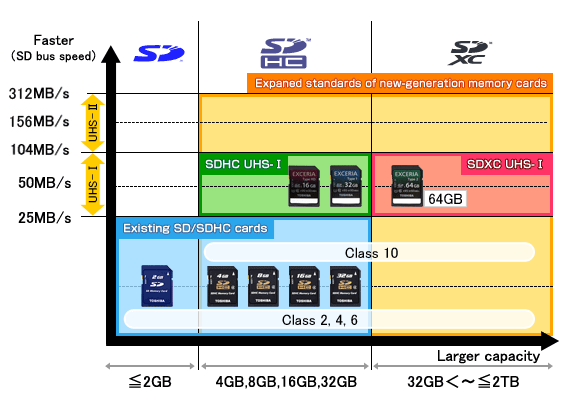
Whether in terms of capacity or transfer speed, we can see that SDXC was created to meet the needs that SDHC could not satisfy. As digital SLR cameras’ pixels increase, especially with the widespread addition of high-definition video capabilities, even a Class 10 specification 32GB high-speed SDHC may not meet the demands. As the saying goes, high-speed cards are more applicable.
How does the applicability of high-speed cards manifest? High-speed continuous shooting, 4K video recording, and RAW format all require faster memory cards. If you value these three aspects and have chosen a camera accordingly, do not hesitate to purchase an SDHX card for your beloved camera.
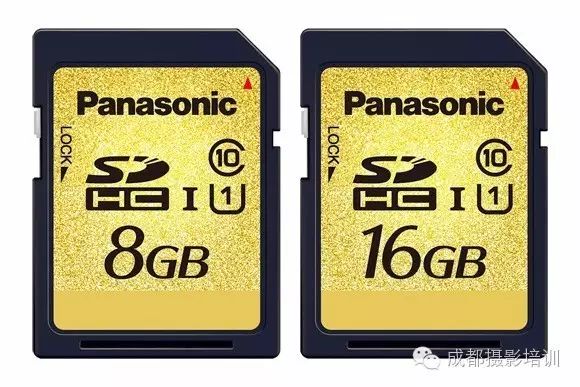
Perhaps beginners think that spending a few dozen yuan on a memory card is enough, but what is the value of a card priced over a hundred? Let me give you an example: if you bought a Sony camera for 4K, the new generation of Sony products has specific requirements for the capacity and speed of memory cards when recording video: a 64GB or larger capacity SDXC card can enable XAVC S recording format; a 64GB or larger capacity card that meets UHS-I Class 3 (U3) speed standard can enable XAVCS 4K 100Mbps recording format. The same standard memory card sold on the Sony official website is priced at 567 yuan.
CF Card
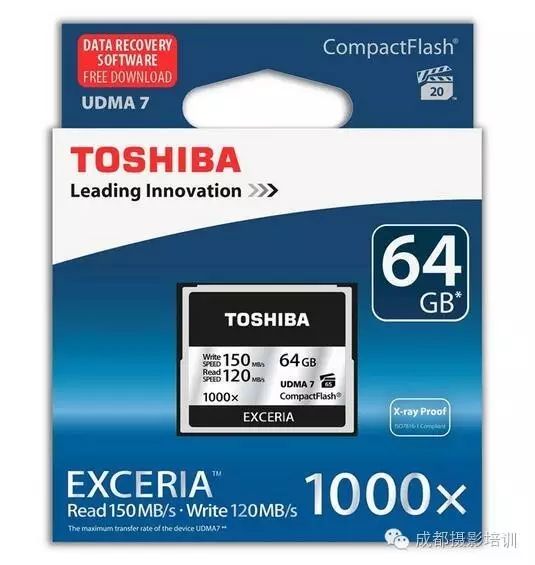
The CF card (Compact Flash) was originally a data storage device for portable electronic devices, revolutionizing the use of flash memory. Compared to the more versatile SD cards, CF cards are commonly found in high-end professional models, whether in products with high pixel CMOS like the Canon 5DS series or high continuous shooting speed products like Canon 1DX series and Nikon D5.
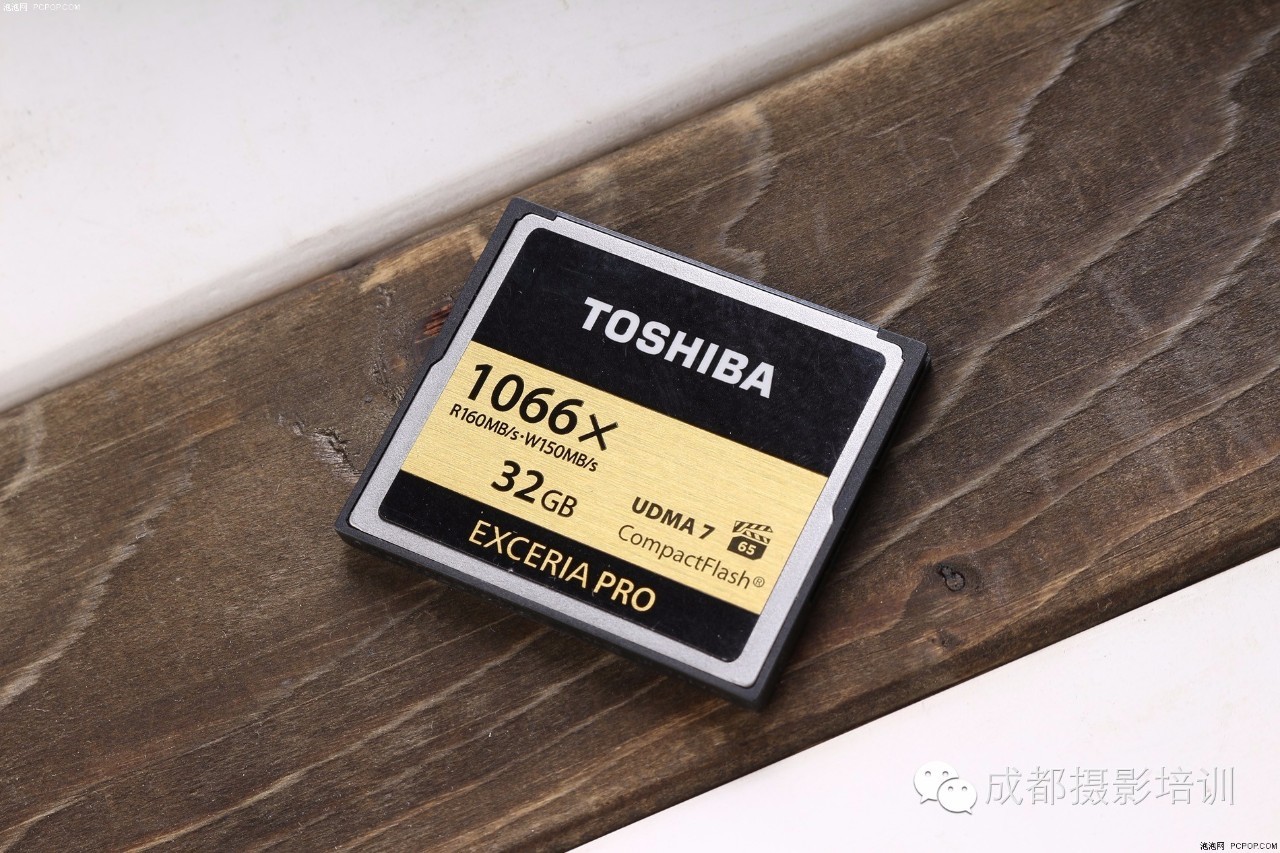 For friends who have chosen the above high-end camera models, they should not hesitate to purchase CF cards, which are also priced higher.
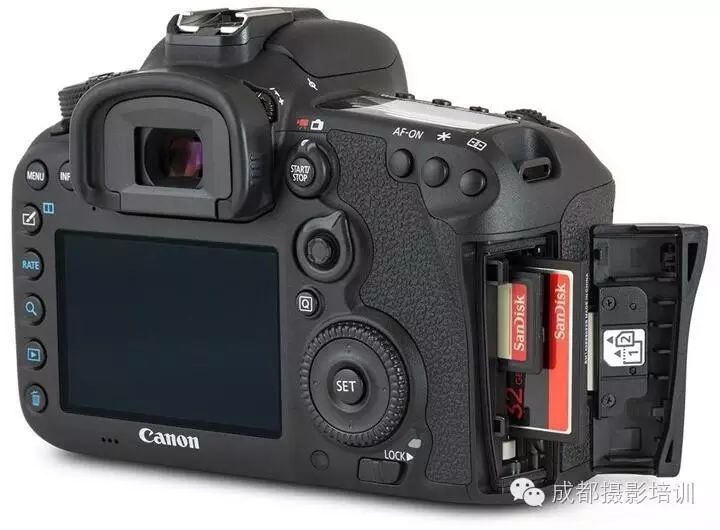
It is worth mentioning that some cameras have dual card slots. Models with both SD and CF dual card slots include Canon 5DIII/5DS/5DS R, 7D II, Nikon D8x0 series, etc. Canon EOS-1DX has dual CF card slots, Canon EOS-1DX II has CF + CFast dual card slots, Nikon D5 has dual CF or dual XQD card slots, and Nikon D4 and D4S have CF + XQD dual card slots. You can prepare several memory cards for dual card slot models to ensure safe backups and handle special situations.
 TF Card
The TF card, also known as microSD, is an extremely small flash storage card, about the size of a fingernail, primarily used in mobile phones. However, due to its small size advantage and increasing capacity, it is also used in some cameras. Most action cameras and some portable models, such as Nikon J5/V3 and Samsung NX mini, use Micro SD cards.
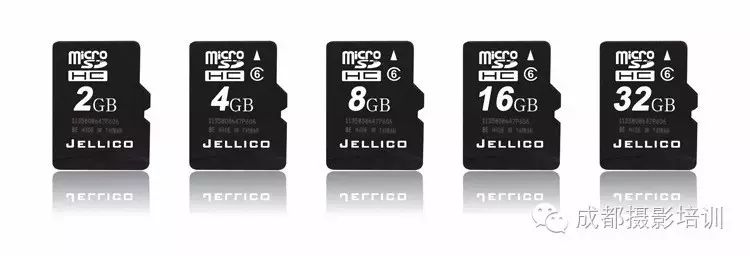
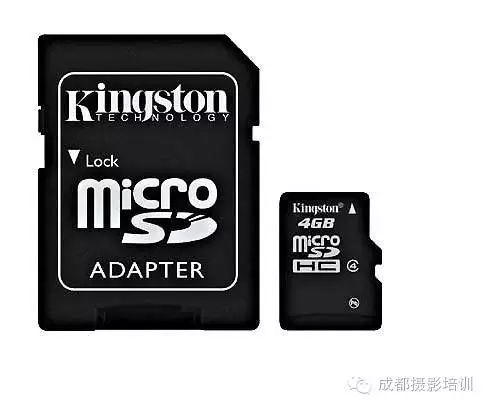
If you have a good-performing Micro SD card and do not want to purchase an SD card, you can add an SD card adapter (commonly known as a card sleeve) to use the Micro SD card in a camera that accepts SD cards. Although theoretically, the speed will not be affected, the stability may be slightly lower.
 WIFI Card
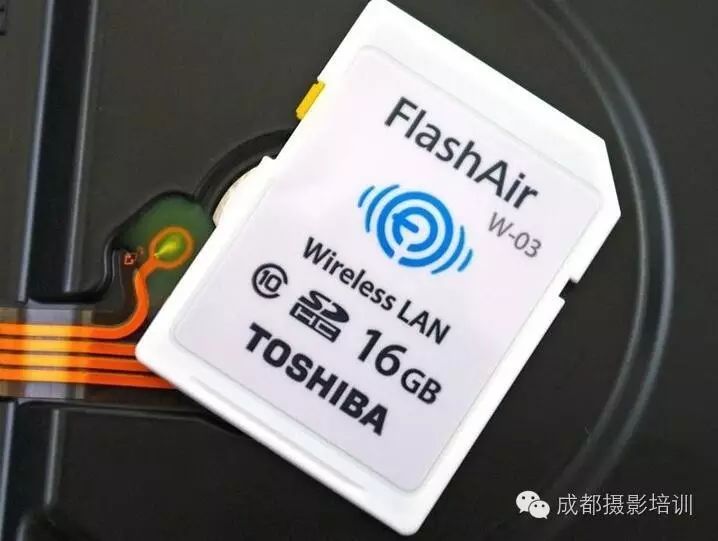
In addition to the above types of memory cards, let me introduce a special type of memory card, the WIFI card. A WIFI card looks like an SD card but has a built-in WIFI wireless network card. This storage card can be used in cameras that do not have WIFI functionality. Especially for some high-end models without WIFI, having a dual card slot, purchasing a WIFI card not only allows for backup, safety, and saving JPG small-sized photos, but also adds wireless transmission functionality.
 In conclusion, this is the information I have shared regarding memory cards and tips for selection. As a necessary companion for cameras, do not hesitate to purchase and equip your camera with a more suitable and higher-performing memory card.
Beginners should not think that photography is just about pressing the shutter and that related theoretical knowledge is irrelevant. Whether it is memory cards or various accessories related to the camera, everyone should invest time to understand them deeply, as knowing yourself and your equipment will make photography a truly passionate endeavor.