1. Purpose
To standardize the appearance inspection operations of PCBA (Printed Circuit Board Assembly), ensuring that the production process and final product quality meet specified requirements, this standard has been established.
2. Scope of Application
2.1 This standard applies to the appearance inspection of all self-produced and outsourced PCBA products of this company (except as specified otherwise).2.2 Special provisions: If revisions to this standard are required due to component characteristics or specific customer requirements, such revisions shall take precedence over this standard.
3. Terms and Definitions
3.1 Acceptance Criteria
Ideal Condition: An assembly state close to perfection, with optimal assembly reliability. This is the target condition.
Acceptable Condition: Although not reaching the ideal state, assembly reliability is guaranteed, and it is deemed qualified.
Rejected Condition: Defects that affect product functionality or major appearance are present, and it is deemed unqualified.
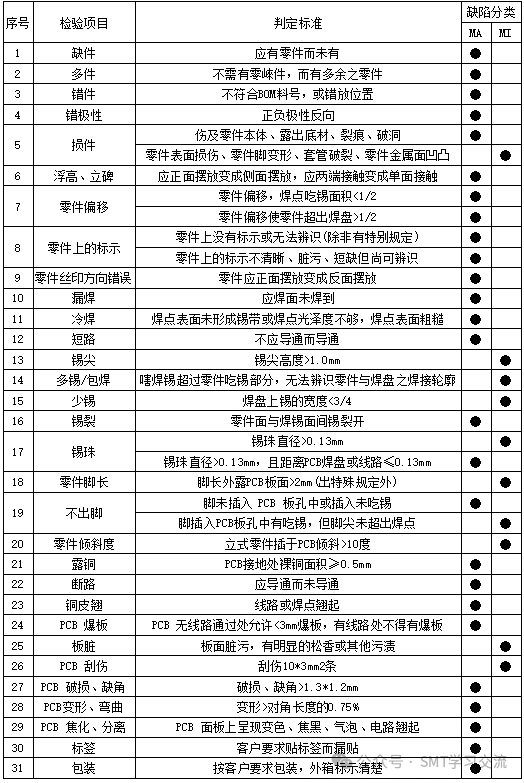
3.2 Definition of Defects
Critical Defect: A defect that may pose a hazard to personal safety, equipment safety, or property, denoted asCR.
Major Defect: A defect that leads to product functionality failure or significantly reduces reliability, denoted asMA.
Minor Defect: A defect that does not affect product functionality, only involving slight deviations in appearance or workmanship, denoted asMI.
3.3 Referenced Standards
IPC-A-610E “Acceptability of Electronic Assemblies”
Other relevant international standards and internal engineering documents of the company
4. Inspection Conditions
4.1 Lighting: The illumination in the inspection area should not be less than 800 LUX, and a magnifying lamp with more than 3x magnification should be used for inspection if necessary.
4.2 ESD Protection: Operators must wear anti-static wrist straps (well grounded) and clean gloves when handling PCBA.
4.3 Working Environment: The inspection work surface should be kept clean to avoid product contamination.
5. Inspection Equipment
Anti-static wrist straps, anti-static gloves, calipers, gauges, magnifying glasses, marble platforms,
6. Priority of Inspection Basis
In case of conflicts in standards, the following order shall be followed:
The latest engineering change documents, work instructions, and other special requirements issued by the company.
The latest version ofIPC-A-610E standard. Items not covered by this standard shall be governed by IPC-A-610E.
7. Acceptance Criteria
7.1 Sampling Plan
Sampling shall be conducted based on the normal inspection sampling plan in“GB 2828-2012”, with the inspection level set to “General Inspection Level II”.
Normal Inspection→ Tightened Inspection: Initiated when 2 out of 5 consecutive batches are rejected..
Tightened Inspection→ Normal Inspection: Restored when 5 consecutive batches are accepted.
Inspection Halt: Under tightened inspection, if 3 batches are accumulated or 2 consecutive batches are rejected, inspection shall be suspended until effective corrective measures are implemented, after which it will be restored to normal inspection.
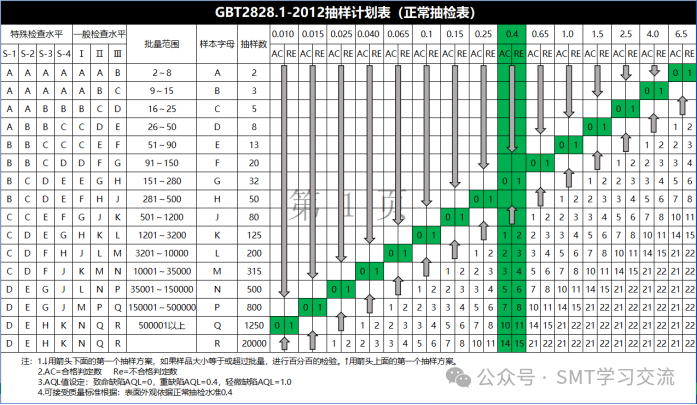
7.2 Acceptable Quality Level (AQL)(If the customer has special requirements, the customer’s requirements shall prevail)
Critical Defect:0
Major Defect:0.65
Minor Defect:1.5
8. Dispute Resolution and Functional Issues
8.1 For disputes regarding appearance standards, the Quality Department shall have the final interpretation and ruling.8.2 If defects involve product functionality, the Engineering Development Department and the Quality Department shall jointly analyze the cause and define responsibility. The repaired PCBA must be re-inspected and confirmed by the Quality Department.
9. PCBA Appearance Inspection.