As electronic products evolve towards higher reliability, miniaturization, and high density, the quality control of PCBA (Printed Circuit Board Assembly) has become increasingly important. Whether it is SMT (Surface Mount Technology) or THT (Through-Hole Technology), the assembly process must adhere to strict inspection standards to ensure the performance and reliability of electronic products. Below is a brief introduction to the general inspection standards for PCBA SMT/THT.
1. Appearance Inspection Standards
Appearance inspection is the first step in PCBA quality inspection, focusing on the following aspects:
-
PCB Body: The surface should be free of scratches, contamination, oxidation, cracks, and delamination.
-
Pads and Traces: No lifting, peeling, or breakage is allowed.
-
Silkscreen and Markings: Clear and readable, not affecting soldering and functional identification.
-
Component Polarity and Orientation: Directional components such as electrolytic capacitors, diodes, and ICs must be installed correctly.
2. SMT Inspection Standards
SMT components are small and densely packed, with inspection focusing on:
-
Component Position: The allowable deviation generally does not exceed 25% of the pad width and must not affect soldering.
-
Solder Joint Quality: Solder joints should be bright and full, covering ≥75% of the pad, with no cold solder, cracks, or solder balls.
-
Tombstoning and Bridging: Tombstoning of components and bridging of solder joints are serious defects that must be avoided.
-
Missing and Incorrect Components: No missing, misinstalled, or reverse-installed components are allowed.
-
BGA/QFN Components: X-Ray inspection is required to ensure no cold solder, misalignment, or voids in solder balls.
3. THT Inspection Standards
THT soldering has strong mechanical strength, with inspection focusing on:
-
Component Orientation: Insertion direction must be correct, with no reverse or incorrect insertion.
-
Pin Length: After soldering, the pins should generally protrude 0.5–2.0mm from the pad, and be trimmed smoothly without burrs.
-
Solder Joint Shape: Solder should be evenly wetted and form a “solder cone” shape, covering ≥75% of the pad.
-
Soldering Defects: No cold solder, voids, pinholes, or insufficient solder are allowed.
4. Functional and Dimensional Inspection
In addition to soldering quality, PCBA also requires inspection of dimensions and functionality:
-
Dimensional Specifications: Must conform to design drawings, with board warpage generally ≤0.75%.
-
Functional Testing: Ensure the circuit operates normally after power-on, with no short circuits or open circuits.
-
ESD Protection: Anti-static measures must be taken during inspection to avoid damage to sensitive components.
5. Common Inspection Methods and Equipment
-
Visual Inspection: Conducted using magnifying glasses or microscopes for appearance confirmation.
-
AOI (Automated Optical Inspection): Identifies incorrect components, misalignment, bridging, and other defects.
-
X-Ray Inspection: Used to check the soldering quality of BGA, QFN, and other invisible solder joints.
-
ICT (In-Circuit Testing)/FCT (Functional Testing): Used for electrical performance and functional verification.
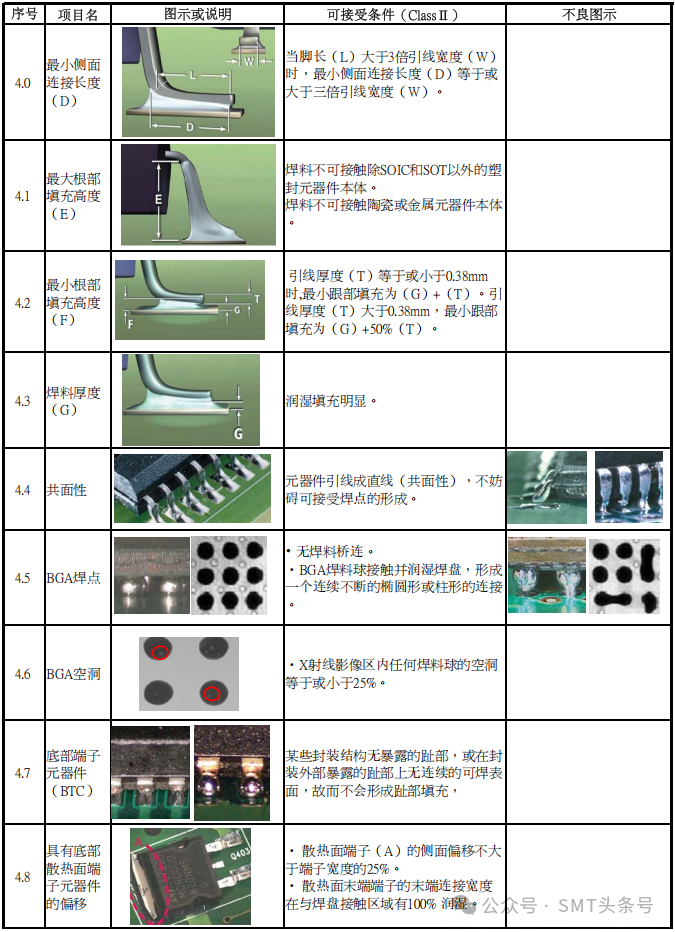
6. Additional General Inspection Standards for SMT/THT (Part II)
7. Conclusion
The general inspection standards for PCBA SMT/THT are an important foundation for ensuring the reliability of electronic products. In actual production, companies must not only adhere to international standards such as IPC-A-610 but also establish a quality control system that meets their own needs based on customer requirements and product application scenarios. Only by strictly implementing inspection standards can electronic products meet market demands in terms of performance, reliability, and lifespan.