This is the 1249 th push from Yanse Good Car 163.
The wave of intelligence is surging, and the Chinese automotive industry is ushering in a century of opportunities for leapfrogging in the new energy vehicle sector.
In 2024, China’s new energy vehicles will lead the world with production and sales exceeding 12 million units, capturing over 70% of the global market share. Meanwhile, the upstream “chip bottleneck” issue remains a sword hanging over the Chinese automotive industry.
Back to the second half of 2020, a global automotive “chip shortage” that lasted for three years swept the world, causing chip prices to skyrocket, forcing many vehicle manufacturers to reduce or halt production, which sounded the alarm for the Chinese automotive industry that heavily relies on chip imports.
 Qiu Yujing: Founder and Chairman of Xinchip Technology (left);
Huang Qing: Deputy Editor-in-Chief of NetEase Auto (right))
Subsequently, local chip companies in China rose to the challenge, launching a campaign concerning industrial safety. Among this wave, Xinchip Technology, established in 2018, has become one of the core forces.
Seven years later, Xinchip Technology has delivered impressive results:with over 8 million units shipped across the entire product line, covering more than 100 mainstream models, and serving over 90% of Chinese car manufacturers… From a fledgling startup to a unicorn valued at over 10 billion, Xinchip Technology has carved a bloody path in the Chinese automotive chip sector, but the road from “substitutor” to “rule maker” remains long.
Currently, domestic chips face challenges from geopolitical factors, technological barriers, and the pursuit of cost-effectiveness by OEMs. How can domestic automotive chip companies stand out and compete in the global market? NetEase Auto’s “Impromptu Dialogue” interviews Qiu Yujing, the founder and chairman of Xinchip Technology, to delve into the growth secrets of this “disruptor” and explore the breakthrough path for domestic automotive chips.
01 Breaking Through: Just Do It! Facing the “Three Soul Questions” from Customers
In the Chinese semiconductor industry, female leaders who start businesses as technical heads are rare, and Qiu Yujing is one of the outstanding figures.
In her work, she is capable and decisive, a true “doer”. She graduated with a bachelor’s degree from the Department of Radio Engineering at Southeast University, studied in the United States in 1996, and after obtaining her master’s degree from the University of Wisconsin-Madison, officially entered the chip industry in Silicon Valley.

Previously, she had two entrepreneurial experiences, but as a founder, this is her first time, which she describes as a journey of “ignorance is bliss”. Many difficulties cannot be fully anticipated before starting a business, but once on the journey, the only answer is: just do it!
In 2018, when Xinchip Technology was established, China’s automotive production accounted for one-third of the global total, but domestic automotive chips were virtually non-existent. No company could independently design and mass-produce high-performance cockpit chips, and local companies had almost zero market share in cockpit chips, with core automotive control chips monopolized by Japan’s Renesas, America’s Freescale, and Europe’s Infineon and NXP. Against this backdrop, Qiu Yujing chose to step out of her comfort zone and start a business.
In her view, with the rapid development of China’s new energy market, the country will certainly need its own automotive chips. At the beginning of the venture, the biggest challenge Xinchip faced was market awareness and customer trust. The automotive industry’s extreme requirements for safety and reliability made car manufacturers naturally wary of new brands. For example,facing the “three soul questions” from customers became a norm for Xinchip when expanding its client base:
“Who has used your chips? Have they been installed in vehicles? What if there are quality issues during mass production?”
A turning point soon arrived. In 2019, Xinchip Technology obtained ASIL D-level functional safety process certification and quickly completed the first 16nm automotive-grade SoC chip tape-out in China. In 2020, Xinchip Technology reached a cooperation agreement with FAW Group.
Qiu Yujing recalled: As one of China’s earliest automotive enterprises, FAW has always been determined to support the domestic supply chain and is willing to take on the responsibility of nurturing local companies. Xinchip was able to provide products that met their requirements, and the goals of both parties were highly aligned.
FAW became the first “door opener” for Xinchip Technology to enter mass production, and the subsequent “chip shortage” storm was another opportunity. More importantly, during the long verification period, quality and safety could be better proven.
Xinchip Technology withstood this test, and a series of products were mass-produced, such as the Xinchip X9 series cockpit chips that can meet various cockpit processor needs, from instrument clusters to in-vehicle infotainment systems, cockpit domain control, and integrated cabin control; the Xinchip E3 series filled the domestic market gap for high-end automotive-grade MCUs, being the first domestic high-performance MCU supporting mass production of LiDAR and the first automotive control chip used in active suspension, which has already been mass-produced in popular models like Li Auto’s L series and Leap Motor’s C10.
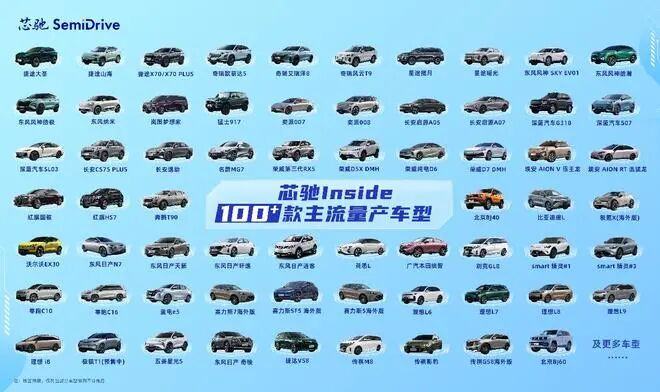
Chery, Changan, GAC, BAIC, Dongfeng Nissan, Li Auto, and other car manufacturers have successively joined Xinchip’s client list. As of now, Xinchip Technology’s total product shipments have exceeded 8 million units, gradually breaking the market monopoly of foreign enterprises and presenting a new leading trend as a “dark horse”.
02 Focus: Long-termism Anchoring Two Core Directions
Throughout Xinchip’s development journey,“focus” has been a consistent keyword. Since its establishment, it has concentrated its business on two major directions: intelligent cockpit chips and intelligent vehicle control.
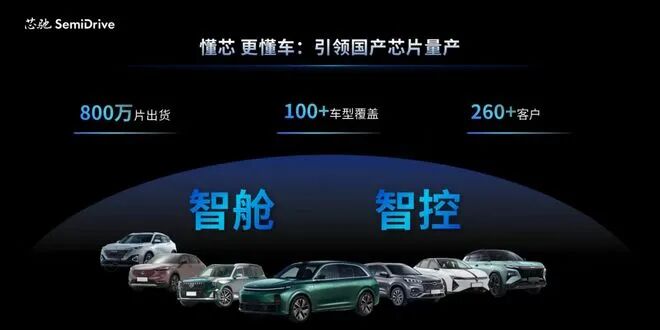
This “restraint” stems from Qiu Yujing’s profound judgment on the transformation of automotive electronic architecture. She believes that the cockpit and vehicle control chips, which are equivalent to the “brain” of the vehicle, are core components that automotive companies need the most stable supply chain for, which is why Xinchip initially anchored these two directions.
The characteristics of the automotive chip industry dictate that “focus” must go hand in hand with “long-termism”.
“Automakers invest hundreds of millions in a platform, with cycles lasting 3-5 years, requiring suppliers to have continuous product iteration capabilities to keep pace with model updates.”
A vehicle-grade chip typically takes 3-5 years from design to installation, and the chip’s lifespan must meet user needs for 10-15 years. Thisrequires automotive chip suppliers to have forward-looking product definition capabilities to meet the functional needs of vehicles several years down the line, and the chip products must meet three dimensions: reliability, safety, and longevity.
Therefore, Xinchip Technology has set very stringent quality standards, aiming for a zero defect rate for one million chips, which requires long-term technical accumulation and experience. Behind every data point are countless tests and verifications.
It is this persistence that has allowed Xinchip to gradually form advantages in two major fields—the cockpit business, as the “foundation”, has taken the lead in volume, followed closely by the MCU vehicle control chips, forming a “dual-wheel drive” pattern.
Currently, as the Chinese automotive market enters a new phase of “cost-performance competition”, car manufacturers require chips to be both top-performing and cost-effective. Xinchip’s solution is to precisely define products, rejecting luxury material stacking. Xinchip optimizes every aspect from a system perspective by communicating deeply with car manufacturers in advance to clarify the core needs of future models and achieve excellence in what is necessary.
This “precision” is further benefited by Xinchip’s full-stack self-research capabilities and platform design philosophy, as well as its ability to collaborate with upstream and downstream partners to build an ecosystem. For example, by focusing on full-scene, platform-based design, 90% of software can be reused, and 80% of chip hardware can be reused; additionally, by establishing joint innovation centers with multiple OEMs, deeply binding with partners to create an open “technology community” for ecosystem development, shortening development cycles, and achieving cost reduction and efficiency improvement, etc.
Through an open and win-win industrial ecosystem, Xinchip continuously drives the intelligent upgrade of the entire automotive industry through system-level technological cost reduction.
03 Breaking Out: From “Domestic First” to Global Layout
2022 was a critical turning point for Xinchip—this year, Xinchip Technology officially entered the stage of large-scale production. To ensure technological competitiveness, Xinchip has always prioritized R&D, with over 80% of its employees being R&D personnel, investing most of its revenue into R&D each year.
Data shows that in the first half of this year, Xinchip ranked first in the domestic automotive cockpit chip market (including instrument clusters, central control, and domain control chips), not only as the local intelligent cockpit SoC market leader but also as the local supplier with the most brands and models equipped.
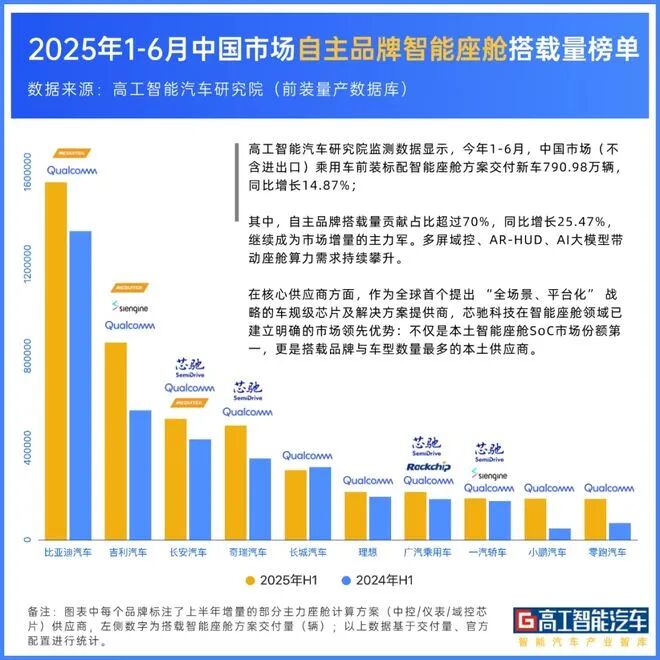 (Image source: GaoGong Intelligent Automotive)
“In the past, when automakers developed the first generation of intelligent models, they prioritized foreign chips for stability; now, as production scales up, supply chain security and cost control have become key. Our domestic chips, which have been validated through mass production of millions of units, naturally become the better choice.”
Facing the industry trend of “automakers developing their own chips”, Qiu Yujing is not anxious. In her view, the cockpit and vehicle control chips that Xinchip focuses on are general-purpose products. The R&D investment for a chip can reach hundreds of millions, and large-scale production is needed to spread costs. The value of independent chip companies lies in their ability to provide standardized, cost-effective products for the entire industry, achieving scale cost reduction.
As domestic automakers accelerate their “going global” efforts, Xinchip’s overseas layout has also been put on the agenda, while seizing opportunities for overseas automakers seeking domestic supply chains. “They also want to keep up with China’s pace of intelligence, and these supply chains will eventually synchronize with their global systems. Additionally, following domestic automakers “going global” is a natural path for us.”
In 2024, over 80% of the top ten domestic automakers in terms of export volume have established mass production cooperation with Xinchip Technology, including Chery, SAIC, Changan, Geely, Great Wall, etc. Currently, the models and brands that Xinchip has mass-produced and shipped overseas include Chery’s Jetour X70, Tiggo, Omoda, Exeed Yaoguang, Arrizo, Changan CS75 PLUS, smart #1, smart #3, Zeekr X, GAC Trumpchi, etc. Meanwhile, Xinchip has also achieved mass production cooperation with joint ventures such as Dongfeng Nissan, Dongfeng Honda, SAIC Volkswagen, and FAW Volkswagen, and has established deep cooperation with overseas automakers like Volkswagen and global Tier 1 suppliers like Aptiv. Overseas, Xinchip has set up offices in Germany and Japan to support local customers with local teams.
Regarding geopolitical risks, Xinchip Technology aims to speak with strength, “Automotive chips are not just about ‘lighting up’; the key is to maintain stability in the shipment of millions of units, which is our confidence.”
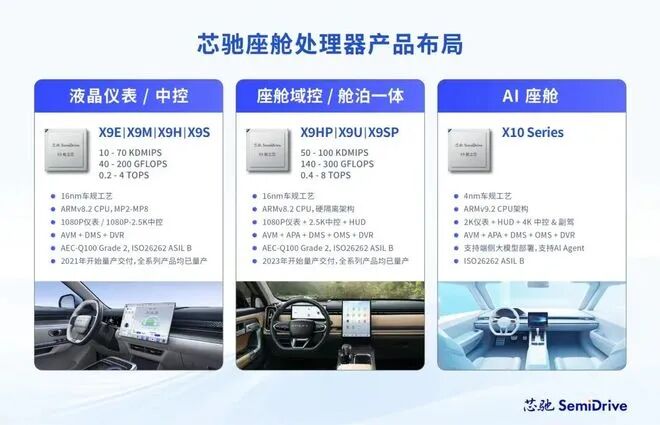
As AI large models become a new trend in the automotive industry, Qiu Yujing is actively seeking the next leap for domestic chips, which is to seize the new opportunities as traditional intelligent cockpits accelerate their upgrade to AI cockpits. The X9SP released by Xinchip Technology in 2023 has already achieved local deployment of AI algorithms, and the latest generation of AI cockpit chip X10 has redefined the latest standards for cockpit processors in the AI era.
She believes that deploying AI large models in vehicles is not simply about “stacking computing power”; it requires systematic solutions. For example, the chip’s bandwidth design must adapt to the data transmission needs of large models, and the toolchain must be optimized to enhance model running efficiency. Relevant products from Xinchip Technology are already in development and are expected to be launched next year.
In Qiu Yujing’s view, for domestic automotive chips to upgrade from “substitutor” to “rule maker”, three key levers are needed:First is technological accumulation,the experience of automotive-grade chips requires time to settle and cannot be rushed; second is ecosystem building,chips are not isolated and need to collaborate deeply with software and algorithm companies to form complete solutions that better serve automakers; finally, scale effectsare necessary, as only with more domestic chip companies emerging can a healthy competition and collaboration be formed, enhancing the overall voice of the domestic supply chain.
The seven years of Xinchip Technology reflect a vivid microcosm of the Chinese automotive chip industry transitioning from desolation to prosperity. There are no shortcuts to breaking through; only focus and persistence. In the wave of the new energy vehicle industry, such long-termism may be the key for domestic chips to move from “catching up” to “leading”.