1208 – Spiral Matrix
Clear and Understandable Development Approach
1. What does the program do?
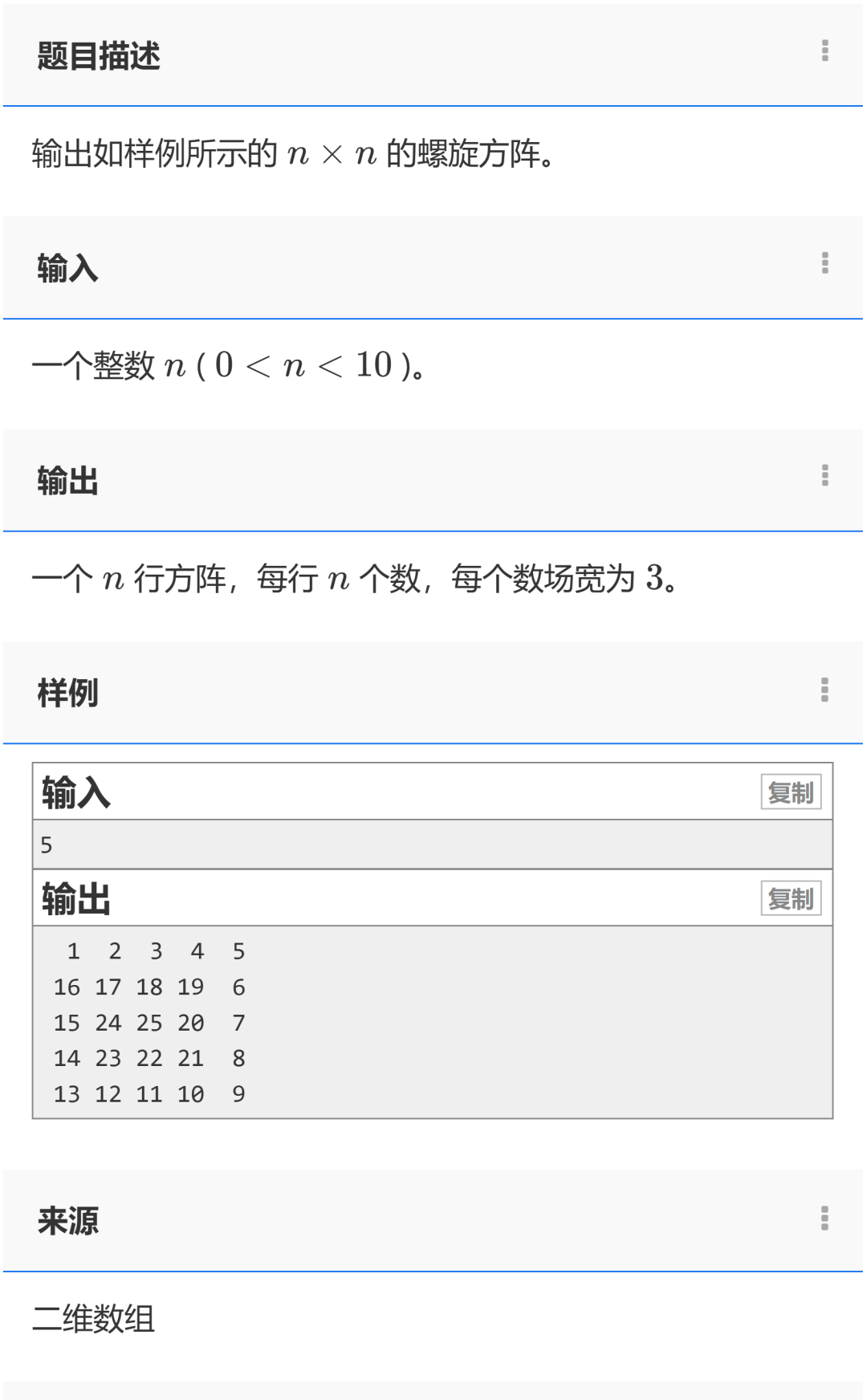
This program aims to generate a “spiral matrix”. What is a spiral matrix? Imagine filling numbers in a spiral pattern starting from the top left corner of the matrix, like a snail shell.
For example, a 3×3 spiral matrix:
text
1  2  3
8  9  4
7  6  5
2. How to do it?
The program adopts a “layered filling” approach:
-
Layered Processing: Imagine the matrix as an onion, peeling and filling layer by layer
-
The outermost layer is the first layer
-
The next layer is the second layer
-
And so on…
Fill each layer from four sides:
-
Step 1: Fill the top side (from left to right)
-
Step 2: Fill the right side (from top to bottom)
-
Step 3: Fill the bottom side (from right to left)
-
Step 4: Fill the left side (from bottom to top)
Incrementing Numbers: Each time a position is filled, the number increases by 1
3. An Example (3×3 Matrix)
-
First layer (outermost):
-
Top: 1,2,3
-
Right: 4 (since the top has filled 3, the right starts from the second row)
-
Bottom: 5,6 (from right to left)
-
Left: 7,8 (from bottom to top)
-
Second layer (inner layer):
-
Only the center position 9 remains
Reference Code
#include<bits/stdc++.h>  // Include all standard library headers to simplify programming
using namespace std;     // Use the standard namespace to avoid writing std::
int a[20][20], n;        // Define a 20x20 2D array a and integer n, a is used to store the spiral matrix, n is the size of the matrix
int main() {    int i, j, x = 1;     // Define loop variables i, j and counter variable x (starting from 1)
    cin >> n;             // Input the size of the matrix n (Note: here it should be cin >> n, the operator is written incorrectly)
    // Outer loop, controls the number of spiral layers, i starts from 1, the loop condition has a problem (it should be i<=(n+1)/2)
    for(i = i; j <= (n + i) / 2; i++) {        // Fill the current layer's top side (from left to right)
        for(j = i; j <= n - i + 1; j++) a[i][j] = x++;
        // Fill the current layer's right side (from top to bottom), but the initial value of j has a problem (it should be j=i+1)
        for(j = i + j; j <= n - i + 1; j++) a[j][n - i + 1] = x++;
        // Fill the current layer's bottom side (from right to left)
        for(j = n - i; j >= i; j--) a[n - i + 1][j] = x++;
        // Fill the current layer's left side (from bottom to top)
        for(j = n - i; j > i; j--) a[j][i] = x++;    }
    // Output the spiral matrix, but the initial condition of the loop has a problem (it should be i=1)
    for(i = i; j <= n; i++) {        for(j = i; j <= n; j++) cout << setw(3) << a[i][j];  // Output each element, width is 3
        cout << endl;  // After outputting each row, move to the next line    }
    return 0;  // Program ends normally
Program Documentation (For Beginners)
Program Objective
Create an n×n spiral matrix and output it in a formatted manner.
Detailed Explanation
1. What is a Spiral Matrix?
A spiral matrix is a matrix that fills numbers in a clockwise spiral pattern starting from the outer edge. The numbers start from 1 and increase sequentially.
2. Core Idea: Layered Filling
Divide the matrix into several layers like an onion, filling from the outside in layer by layer:
-
Layer 1: The outermost circle
-
Layer 2: The next inner circle
-
…
-
Last Layer: The center (if n is odd) or the innermost circle (if n is even)
3. How to Fill Each Layer?
Each layer is filled in four directional sequences:
-
Fill Right (top): Fill the top row of the current layer from left to right
-
Fill Down (right): Fill the rightmost column of the current layer from top to bottom
-
Fill Left (bottom): Fill the bottom row of the current layer from right to left
-
Fill Up (left): Fill the leftmost column of the current layer from bottom to top
4. Variable Explanation
-
<span>a[20][20]</span>: A 2D array to store the spiral matrix -
<span>n</span>: The size of the matrix input by the user -
<span>i, j</span>: Loop variables used to control rows and columns -
<span>x</span>: The current number to be filled, starting from 1
5. Key Calculations
-
<span>n - i + 1</span>: Calculate the boundary position of the current layer -
For example, when n=5, i=1 (first layer):
-
Upper boundary: i = 1
-
Lower boundary: n-i+1 = 5
-
Left boundary: i = 1
-
Right boundary: n-i+1 = 5
6. Output Format
-
Use
<span>setw(3)</span>to set the output width to 3 characters for alignment -
Move to the next line after each row is output
7. Learning Points
-
Operations on 2D arrays
-
Nested loops
-
Matrix boundary calculations
-
Output format control