This year, the best money I spent was on an entry-level 3D printer, the TuoZhu A1 mini. Perhaps this is the most worthwhile 800 yuan I spent this year.
I was truly shocked to find that the price of 3D printers has dropped to this level. Just as AI has rapidly integrated into everyday life, affordable 3D printing will undoubtedly quietly spark a new wave of technological revolution. 3D printing is not a new technology; it was born in the 1980s, just as AI emerged in the 1960s and computers were invented in the previous century. However, now is the moment when the singularity of AI and 3D printing arrives, akin to the personal computer revolution at the end of the 1960s.
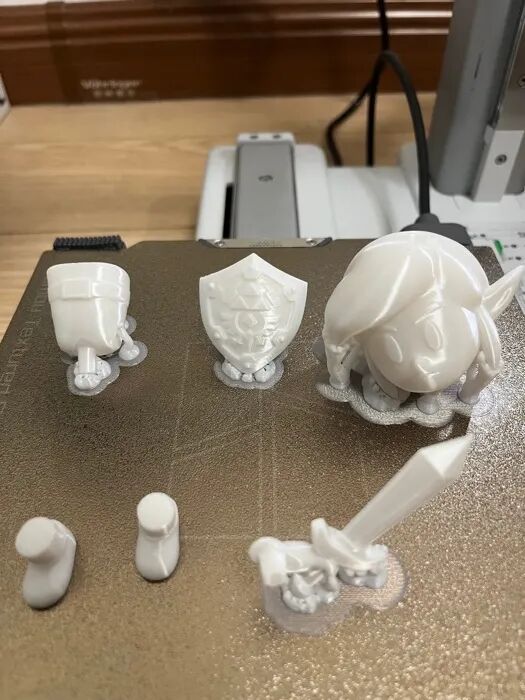
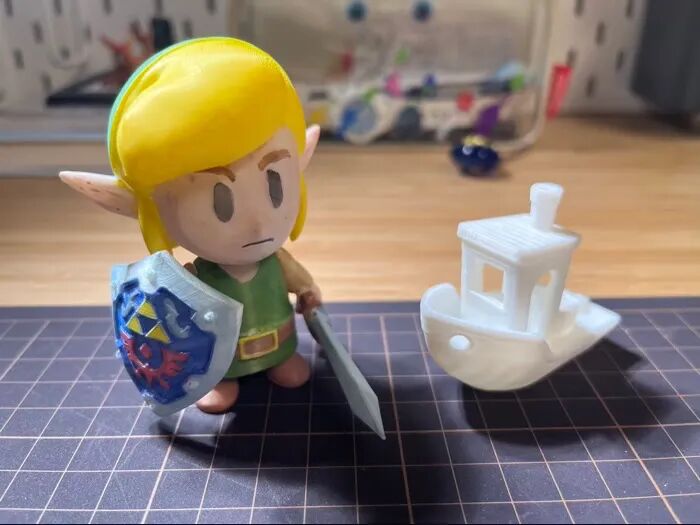
Image: Link from The Legend of Zelda: Link’s Awakening printed by myself
For the past two weekends, I have been trying to make small items with 3D printing: assembling a figurine of Link from “The Legend of Zelda: Link’s Awakening”, creating jointed toys, phone cases, stamps, and more. Starting with printing models configured by others, I learned to adjust 3D models and slicing myself, gradually gaining more design freedom.
Freedom was scarce in the industrial age. Henry Ford famously said, “Customers can choose any color they want, as long as it is black.” The mass production and economies of scale of Ford cars made products cheaper and better, with more variety, but the cost was greater centralization, seeking a greatest common divisor.
Thus, two products of the market economy were born: one is the product manager role. A product manager is supposed to find that greatest common divisor and provide products based on the economic priority of solutions.
The second is luxury goods. Since the greatest common divisor cannot satisfy everyone’s needs, and as Russell said, “The source of happiness lies in diversity,” customization, this scarce resource, has been packaged as luxury goods.
I previously wrote about the topic “Brands Floating in the Wind” 2502 articles | 4A Advertising Will Die, Brands Float in the Wind. Brands, born in modern industrial society, are essentially mechanisms to reduce user transaction costs. They generally represent two things:
-
The company’s product manager has found the most cost-effective greatest common divisor (centralization).
-
The company’s craftsmen and exclusive technology can provide you with scarce customized products (scarcity).
When centralization and scarcity do not exist, brands do not exist. In pre-industrial society, all manufactured goods were essentially custom products. Craftsmen needed to spend a lot of time designing according to the seller’s requirements, whether it was the Palace of Versailles or various artifacts in museums, all came from the demands of resource-rich patrons. Ordinary people could not enjoy these because they lacked the technical ability and resources to create products.
3D printing brings a significant reduction in cost and technical barriers, and decentralized, personalized manufacturing is becoming a trend again. You can achieve customized products at a cost of just a few dollars. Coupled with AI applications, the threshold for modeling has also drastically decreased: in the past, modeling required learning complex CAD operations, but now you can throw a description or an image into AI software like Tripo 3D, and it can help you create a 3D model, which you can adjust if you are not satisfied with certain aspects.
3D printing not only makes it easy to create customized products but also lowers the barriers to scaling. In ancient times, making molds for coins or crafts was generally done by carving wax into shape, then wrapping the model in clay, and firing it at high temperatures to melt the wax, forming the clay mold. It is not hard to imagine that carving was originally a craft, and if a mistake was made, it had to be redone, which also incurred high time costs. Not to mention that if the mold wore out, remaking it required aligning with the previous mold standards. Making copper coins and bronze artifacts were all high-cost projects.
In modern industry, making molds is also the largest investment, and multiple rounds of verification and review must be conducted before mold production is approved. The automotive industry must first create a clay model, then a cutting mold, and after extensive verification, can officially produce the mold.
However, with 3D printing, the trial and error costs of designing and manufacturing molds have been greatly reduced. Not only are materials like PLA and PETG inexpensive, but 3D printing software can be operated by one person, and the fast printing speed is also a time advantage. Currently, 3D printing is still primarily focused on plastics, but it is expected to soon be able to print metals and other materials, achieving the crossing of the chasm of low-end unstable technologies mentioned by Christensen in “The Innovator’s Dilemma.” Reference:Why do industry-leading companies that provide top-notch products lose market competition?
The reduction in mold costs means that the supply of products that can be offered is increasing.
Therefore, although we feel that jobs are becoming increasingly unstable in this era, we must also see that the cost of living is becoming lower. If our needs can be met in a cheaper way, it reduces our dependence on conventional manufacturing salaries, and spending less money to enjoy more is becoming a reality. What truly causes us pain is resource monopoly—such as real estate—and obsession—such as luxury goods.
If we do not consider the inflated housing prices caused by land monopolies, our living costs are indeed decreasing.
The reduction in living costs comes from various technologies that lower production costs, and lower production costs mean lower entry barriers. Lower entry barriers mean that more merchants can provide products, ultimately, the reduction of production barriers and channel barriers impacts the large enterprises that once held both ends and wielded the brand stick, giving most white-collar workers the feeling that—jobs are hard to find.
With technological progress, companies gradually do not need as many people, and at the same time, people gradually do not need companies. Or perhaps, they may not need such large companies; a very small team can accomplish what used to take hundreds of people to complete.
The slogan of WeChat public accounts is “Even the smallest individual has their own brand”, and conversely, brands will inevitably become symbols of small individuals, just like before the industrial age— individuals are brands.
The idea that individuals are brands is not hard to imagine: writers, painters, musicians, and other artists still operate this way. Perhaps with the cost reductions brought by technology, movie directors in the future will not need production companies.
The notion that individuals are brands means that taste and imagination are the most important things in the future world. Just as Alexandre Dumas relied on Maquet to conceive story outlines and complete the structure of drafts, Maquet was his human AI assistant. But what made Dumas, Dumas, was still his unparalleled literary talent and imaginative ability. 2520 articles | Using AI Like Dumas
Taste and imagination stem from the breadth of knowledge. The current problem with education is that it cultivates people towards AI, rather than cultivating Dumas. Modern schools were born during the industrial revolution, thus carrying the core ideas of centralization, standardization, and seeking the greatest common divisor.
Students educated under this ideology inevitably become too standardized, lacking imagination. When I visit art museums, my greatest impression of university students’ works isthe lack of vitality and imagination, all produced from the same mold, lacking taste. Perhaps it is because university teachers filter out those unconventional works, but regardless,the variables have no smooth outlet.
In contrast, Japan’s manga, music, and art lead the world because of the broad exposure brought by the relaxation of education in the 1970s, as well as the multi-channel marketization. For example, the dramatic changes and endless innovations in Japanese manga come from the mutual borrowing and learning among different artists, while the opportunities created by the segmentation of the manga magazine market. 2450 articles | “Bakuman”: We Are All Apprentices of Life Whether in the early days of personal computers or home game consoles,the mutual imitation of creativity and market competition are necessary driving forces.
Our students indeed perform well in standardized tasks like mathematics and science, but their taste is indeed lacking.
These days, schools like to say “home-school collaboration”, which essentially means that schools are rigidly controlled by the education bureau, and any change relies on families.
Of course, there is no need to be pessimistic; life will still find a way out. Just as in Chinese music, there are cases like Jackson Wang, who replicated the Korean music industry model to go global, we can observe that many creative industries in China are still actively communicating and evolving with the outside world, and progress is indeed happening. Crossing the river by feeling the stones, bumps are inevitable, but we will eventually move towards an excellent future.