Click the blue text to follow us
This year, the consumer-grade 3D printing sector has quietly heated up. Shenzhen Snapmaker Technology has received Series B investment from Meituan and Hillhouse Capital; Creality has submitted its prospectus to the Hong Kong Stock Exchange; even drone giant DJI has entered the fray by investing in Smart Pie Technology. As of now, the primary market investment and financing events in the entire 3D printing field have reached a high point not seen in the past five years. Behind all this is the significant reduction in the usage threshold due to AI technology, along with the strong rise of Chinese hardware companies in the global market. What was once a niche geek hobby is now flying into the homes of ordinary people.
Capital Influx and Sector Heating Up
In addition to Meituan and Hillhouse jointly investing in Snapmaker Technology, Creality, also from Shenzhen, has submitted its prospectus to the Hong Kong Stock Exchange, aiming to become the “first stock in consumer-grade 3D printing.” Founded in 2014, this company received its only external financing in 11 years in 2021, with investors including Tencent Investment and Shenzhen Capital Group. According to the prospectus, Creality’s post-investment valuation is approximately 6.5 billion yuan. In 2024, the company is expected to record total revenue of 2.288 billion yuan, with a compound annual growth rate of 30.4% over the past three years.From a 20㎡ studio to a Hong Kong IPO, Creality’s brilliance and concerns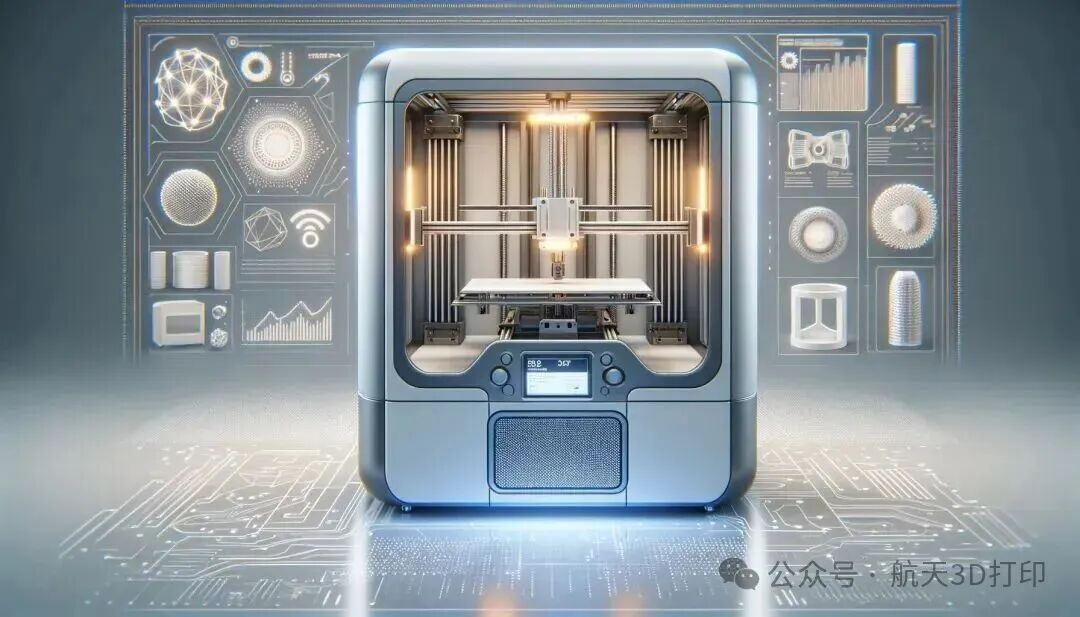 Investors have revealed that 3D printing brands in Shenzhen have generally crossed the 1 billion yuan annual revenue mark, with the top three expected to exceed 2 billion yuan this year, and the entire industry has seen a compound growth rate of over 30% in the past three years.Star projects in the industry, such as Tuo Zhu Technology, have valuations exceeding 30 billion yuan. DJI’s investment in Smart Pie Technology has further fueled this trend, marking a new high in mainstream capital’s attention to Chinese consumer-grade hardware. As the certainty of leading projects increases and the financing window closes, institutions that missed early layouts are accelerating their search for the next target.
AI Reducing Barriers and Technological Breakthroughs
The rise of the consumer-grade 3D printing sector is closely linked to the development of AI technology. For a long time, this industry was limited by modeling barriers, making it difficult for ordinary users to participate. Until recent years,generative AI modeling tools have become popular, allowing users who do not understand modeling to generate 3D models directly usable for printing through simple operations like text and images.Ordinary users can unlock 3D trendy toys in just three steps: generate 3D style images using AI image generation tools; use 3D modeling software for one-click modeling; and finally import the model file into a 3D printer for direct printing. Various “3D printing hacks” are circulating on social media, allowing for easy printing of complex mechanical parts, exquisite artworks, or practical daily items. As long as there is imagination, one can DIY various favorite anime character 3D figurines, directly enhancing emotional value.A simpler method is to visit the MakerWorld community under Tuo Zhu Technology, where users can directly choose models shared by creators for “one-click printing.” The platform also incentivizes creators through a reward system, reportedly investing a huge budget to motivate creators, with annual incentives totaling hundreds of millions of yuan, and top creators earning over 500,000 yuan annually.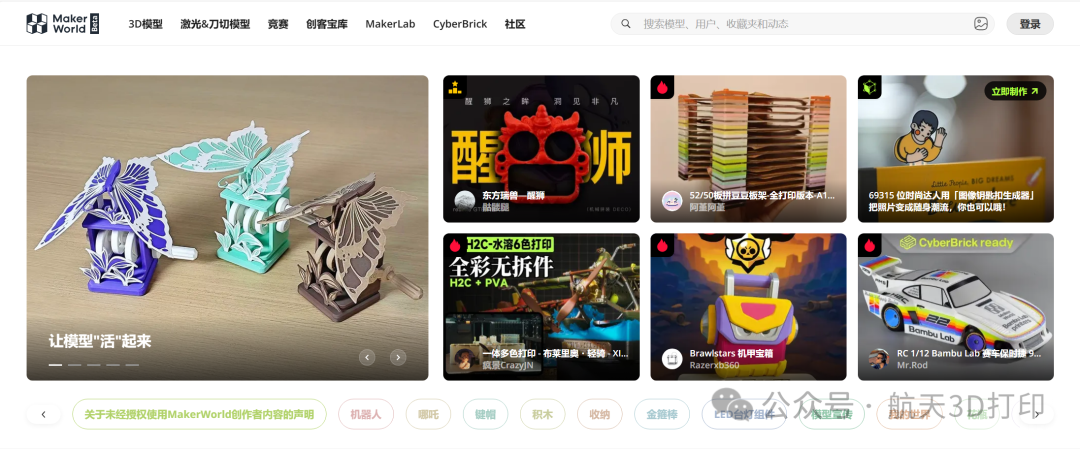 Technological breakthroughs at the hardware level are equally exciting. Snapmaker’s U1 raised $220,000 (approximately 1.44 million yuan) on Kickstarter, setting a global crowdfunding record for 3D printers. Its success lies in addressing two major pain points in the industry:low efficiency in color switching during printing and material waste issues. Through an innovative design that combines a power unit with four tool heads, it switches colors like a multi-color pen, reducing the four-color printing time from 20-30 hours to 5-6 hours.
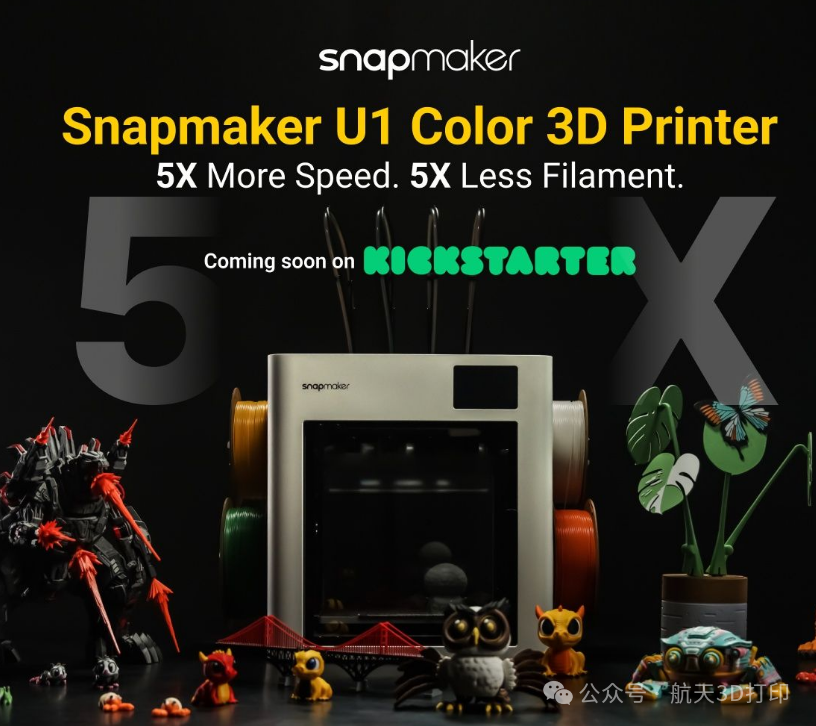 At the same time, the drop in prices is accelerating product adoption. Currently, the price of consumer-grade 3D printers has decreased by 60% compared to three years ago, with mainstream brands focusing on products priced between 2,000 and 3,000 yuan, making them more affordable for consumers.
DJI’s Entrepreneurship and Talent Competition
In this wave of 3D printing enthusiasm, a notable phenomenon is that “DJI-related entrepreneurship” has become a hot topic in the venture capital circle. Tuo Zhu Technology’s CEO, Tao Ye, was previously the head of DJI’s consumer drone division, and the founding team consists mostly of DJI’s core members. In terms of business strategy, Tuo Zhu also adopts a similar “rapid iteration + price reduction” strategy as DJI. Just like many investors who missed out on DJI in the past, many are now looking for similar targets after Snapmaker’s new product crowdfunding was a hit. Following media reports, a dozen investment intention letters from top institutions have been sent to Snapmaker Technology.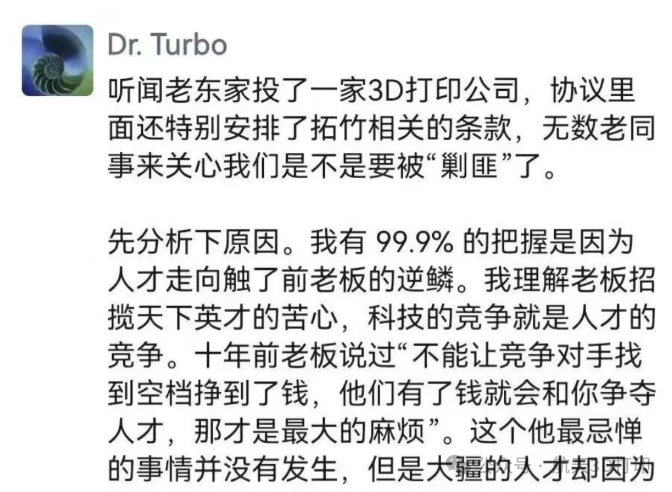 After the news of DJI’s investment in Smart Pie broke, Tao Ye stated in his social media that his former employer’s decision was a “firepower strike” against Tuo Zhu, and he believes that Tuo Zhu’s growth has made it a scapegoat for the changes in talent movement from DJI.
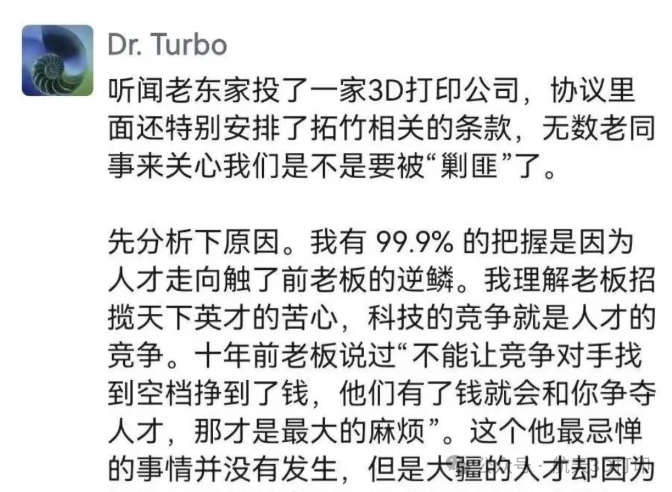 The changes in talent movement can be divided into two aspects: entry and exit. On the entry side, Tuo Zhu and Ying Shi have a high overlap in talent demand with DJI, leading to significant competition in recruitment. On the exit side, DJI employees are frequently poached by other tech giants also based in Shenzhen.In response to talent loss, DJI has its own strategies. Tuo Zhu’s head stated that the company has been on DJI’s non-compete list since its inception. In fact, rumors about DJI’s non-compete agreements for frontline employees can be traced back to 2021. Unlike the broader imaging market, 3D printing may not have been a sector DJI planned to enter. However, whether motivated by talent acquisition or seeking growth points, DJI’s entry has made the industry’s final landscape unpredictable.
Comments on Aerospace 3D Printing
The current explosion of consumer-grade 3D printing is essentially a typical example of “technological inclusivity.” AI has solved the cognitive barrier of “not knowing how to use it,” hardware innovation has addressed the performance bottleneck of “not being easy to use,” and price reductions have overcome the cost barrier of “not being affordable.” When these three dimensions break through simultaneously, a niche sector has the potential to enter the mass market.With the entry of giants and capital support, the competitive dimensions of this industry are rising. The next stage of victory may not lie in the hardware itself, but in ecosystem building: whoever can provide users with a richer model library, a more active creator community, and a more complete experience loop from design to printing will truly win the market.
Note: If you need to reprint or quote this article, please indicate the source. Feel free to add the author’s WeChat to discuss more industry dynamics.