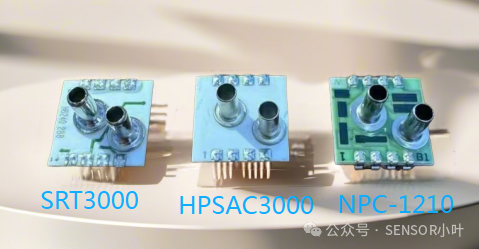
Since the launch of the SRT3000 constant current excitation pressure sensor, we have received a lot of positive feedback from end customers. In this issue, we will continue to look at several other important parameters of the SRT3000 pressure sensor — thermal hysteresis, bridge impedance, accuracy, repeatability, and long-term stability.
1) Thermal Hysteresis
Thermal hysteresis refers to the maximum offset value of the sensor’s offset drift within the calibrated operating temperature range.The thermal hysteresis parameter of the SRT3000 pressure sensor is 0.05% FSS.
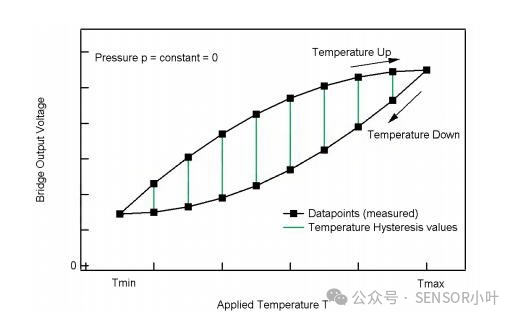
Figure 1: Thermal Hysteresis
As shown in the figure, it describes the difference in output when the temperature passes through the same point from high to low and from low to high in a pressure-free environment. Thermal hysteresis is closely related to testing conditions, such as dwell time and the selected measurement temperature range.
All piezoresistive pressure sensors’ full-scale output also varies with temperature, and the SRT3000 pressure sensor has undergone temperature compensation before leaving the factory.
2) Bridge Impedance
Bridge impedance refers to the resistance value of a Wheatstone bridge composed of four resistors on a single silicon substrate.
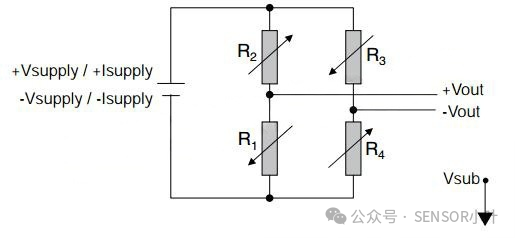 The SRT3000 pressure sensor consists of a Wheatstone bridge made up of these four resistors, with an input impedance of 2.5-6KΩ and an output impedance of 3-6KΩ.
 3) Overall Accuracy
The calculation of overall output accuracy applies to models that have been calibrated and compensated or have undergone signal processing. It indicates the comprehensive performance of all error factors of the sensor. Temperature error is generally defined between the minimum and maximum temperatures, commonly referred to as the compensated temperature range. The root mean square of the sum of each error factor is generally used as the output error indicator, and these factors mainly includeTCS, TCZTCR, temperature hysteresis, pressure hysteresis, pressure non-linearity, etc.
4) Long-term Stability
Long-term stability indicates the drift of output error over time under normal operating conditions. Typically,the determination of this indicator for pressure sensors is obtained through life testing. The long-term stability drift is merely a technical indicator and cannot be simply compared across different actual product applications due to varying usage environments. Therefore, the actual long-term usage drift largely depends on system drift, application, and the pressure environment to which the sensor is exposed.The long-term stability parameter of the SRT3000 pressure sensor is 0.1% FS.
5) Repeatability
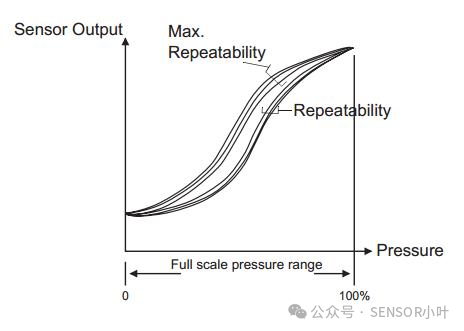
As shown in the figure, the repeatability indicator compares the results of multiple measurements of a product in the same environment. It is an important indicator of product stability,and the repeatability parameter of the SRT3000 pressure sensor is 0.1% FS, demonstrating excellent consistency.
Thus, all relevant indicators of theSRT3000 pressure sensor have been updated.