
Hardware·AI
Author | Dong Jing
Editor | Hardware AI
According to Morgan Stanley’s prediction,2026will be a critical year for explosive growth inAItechnology hardware, primarily driven by strong demand forAIserver hardware.
On November 3,according to Hardware AI news, Morgan Stanley stated in its latest report thatAIserver hardware is undergoing a significant design upgrade driven byGPUandASIC. The upcoming releases ofGB300,Vera Rubinplatform, andKyberarchitecture from NVIDIA, along withAMD‘s Heliosserver rack project, will bring higher computing power and cabinet density.
Morgan Stanley emphasized in the report that as NVIDIA’sVera Rubinplatform launches in the second half of2026, cabinet demand is expected to surge from about28,000units in2025to at least60,000units in2026. More importantly, to support higher power-consumingGPUs, the value of power solutions may increase more than10times by2027, and liquid cooling solutions will become standard, leading to a continuous rise in the value of each cabinet. Additionally, components such asPCB/substrates andhigh-speed interconnectswill also undergo significant specification upgrades.
This indicates that the entireAIserver hardware supply chain’s value is being reassessed. The industry maintains a positive rating on severalAIhardware supply chain companies, believing that the next generation ofAIserver design upgrades will bring substantial profits to related manufacturers.
01
Explosive Growth in AI Server Rack Demand
Morgan Stanley’s report clearly points out that the growth momentum ofAIhardware is shifting from theH100/H200era to a new cycle driven byNVIDIA‘sGB200/300(Blackwellplatform) and the subsequentVera Rubin(VRseries) platforms.
According to NVIDIA’s product roadmap, the power consumption and performance of itsGPUsare undergoing leapfrog upgrades.
FromH100‘s700W TDP, toB200‘s1,000W, and then toGB200‘s1,200W, all the way to theVera Rubin(VR200) platform launching in the second half of2026, where the maximum TDP of itsGPUswill soar to2,300W, and theVR300(Kyberarchitecture) in2027will reach as high as3,600W.
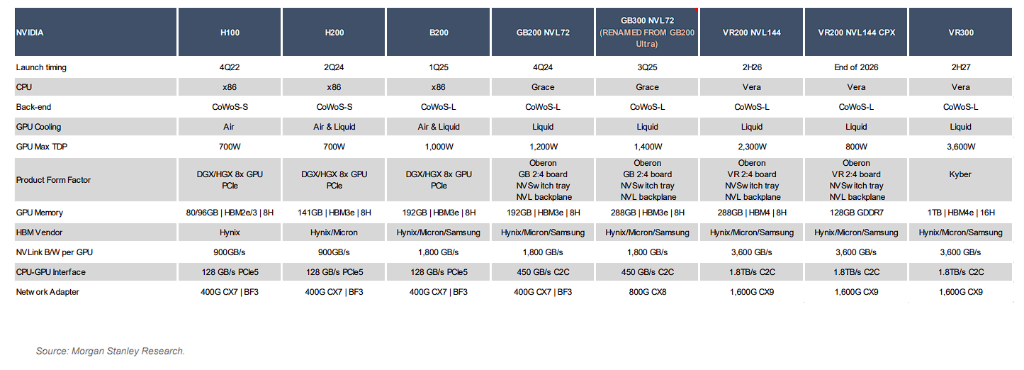
(NVIDIA product roadmap)
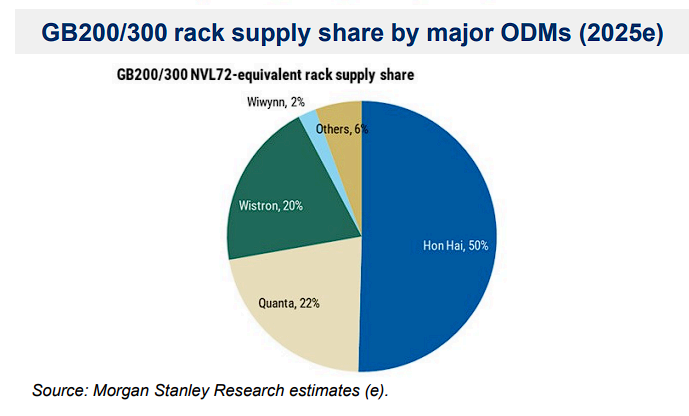
Morgan Stanley believes that this increase in computing density directly drives a comprehensive innovation in server cabinet design and components.Morgan Stanley predicts that demand for AI server cabinets based on NVIDIA’s platform will leap from about28,000units in2025to at least60,000units in2026, achieving over100%growth. Meanwhile, AMD’s Helios server rack project (based on the MI400 series) has also made good progress, further intensifying market demand for advanced AI hardware.The report emphasizes that as cabinet design shifts from single GPU upgrades to integrated designs for entire rack systems, ODM manufacturers with strong integration capabilities and stable delivery records, such as Quanta, Foxconn, Wistron, and Wiwynn, will dominate the supply of GB200/300 cabinets.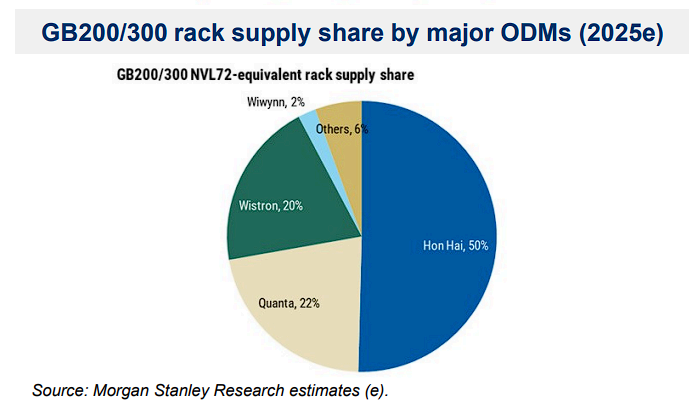
02
Power Consumption and Cooling Bottlenecks
Igniting the Value of Power and Liquid Cooling Solutions
One of the most notable points in the report is that the power consumption and cooling challenges brought about by the upgrade ofAIhardware are transforming into significant opportunities for power and cooling suppliers. This is seen as one of the fastest-growing segments in this upgrade cycle.
In terms of power supply, as the total power consumption of a single cabinet increases dramatically, traditional power architectures are becoming unsustainable.
The report predicts that power architectures will transition to800Vhigh-voltage direct current (HVDC) solutions. This transition will greatly enhance the value content of power solutions.
Morgan Stanley expects that by2027, the value of power solutions designed forRubin Ultracabinets (usingKyberarchitecture) will be more than10times that of the currentGB200server cabinets. At the same time, by2027, the value of power solutions corresponding to each watt of power consumption inAIserver cabinets will also double compared to the current stage.
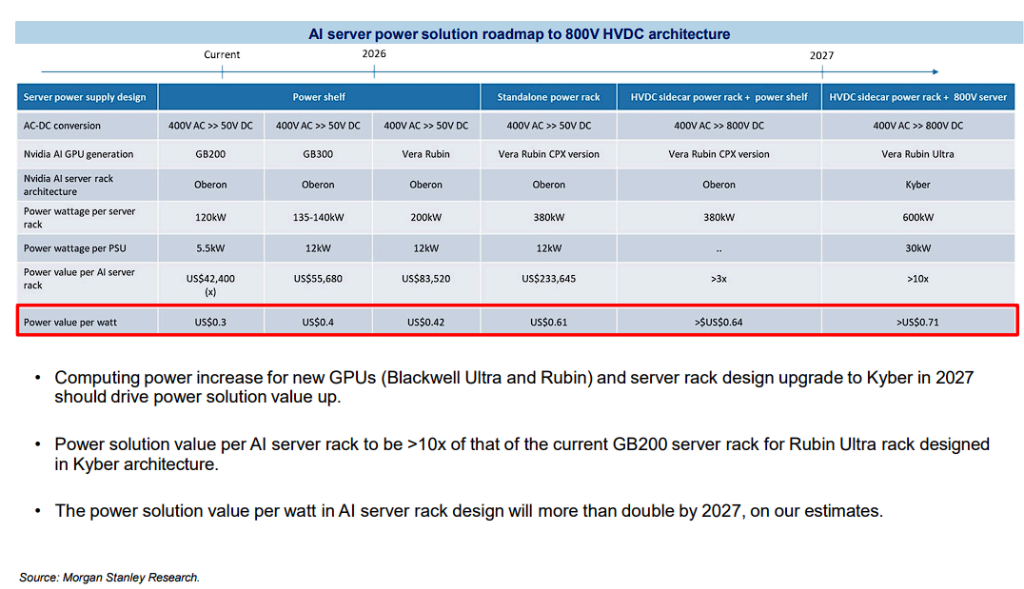
In terms of cooling, liquid cooling has transitioned from an alternative solution to a necessity. The report points out that as theGB300platform’s TDP exceeds1,400W, liquid cooling has become standard equipment. This directly increases the value of cooling components. Specific data shows:
The total value of cooling components for aGB300(NVL72) cabinet is approximately49,860USD. By the next generationVera Rubin(NVL144) platform, due to further increases in cooling demands for compute trays and switch trays, the total value of cooling components per cabinet will increase17%, reaching55,710USD. Among them, the value of cooling modules designed for switch trays will increase by67%.
Morgan Stanley states that this clearly indicates that key component suppliers in the liquid cooling supply chain, such as cold plate modules, cooling fans, and quick connectors (NVQD), will directly benefit.
03
Comprehensive Upgrade of the Value Chain
PCB/Substrate and High-Speed Interconnects Rising in Value
In addition to power and cooling, the report also emphasizes the profound impact ofAIplatform upgrades on printed circuit boards (PCB) and various interconnect components. Each iteration ofGPUscomes with higher requirements for the number ofPCBlayers, material grades, and dimensions.
According to Morgan Stanley’s compilation of NVIDIA’sGPUevolution roadmap:
ABFsubstrates: The number of layers increases from12layers (12L) inH100to14layers inBlackwell(B200), and then to18layers inVera Rubin(VR200), with corresponding increases in dimensions.
OAM(OCPAccelerator Module) motherboards: PCBspecifications upgrade from18layers of HDI(high-density interconnect) inH100to22layers of HDI inGB200/300, and may reach26layers of HDI inVR200.
CCL(copper-clad laminate) materials: are transitioning from ultra-low loss (Ultra low-loss, M7) to extreme low loss (Extreme low-loss, M8) grades to meet higher data transmission rate requirements.
Morgan Stanley believes that these technical detail upgrades mean that the manufacturing process ofPCBboards is becoming more complex and valuable. The increased demand for high-layer HDI boards and high-gradeCCLmaterials will bring structural growth opportunities for PCB and upstream material suppliers with corresponding technical capabilities.
The report clearly states that the design upgrades ofAIGPUsandASICservers will strongly support the capacity expansion wave in thePCB/substrate industry.
At the same time, Morgan Stanley states that data and power interconnect solutions are also being upgraded to match higher data transmission speeds and capacity requirements.