【Key Points】
● We have developed a film sensor that can measure sweat ions with high sensitivity in a non-contact manner by using micro-textures that mimic rose petals.
● It has been proven to have a water retention capacity up to 3 times higher than traditional products, and its self-cleaning performance has improved by about 2 times, allowing for stable data collection even during exercise. It can also measure within a 2 mm space without the need for adhesives on the skin, reducing the risk of rashes during prolonged wear.
● It is expected to be applied in the early prediction of dehydration and heatstroke, as well as in human-machine interfaces such as prosthetics and exoskeletons.
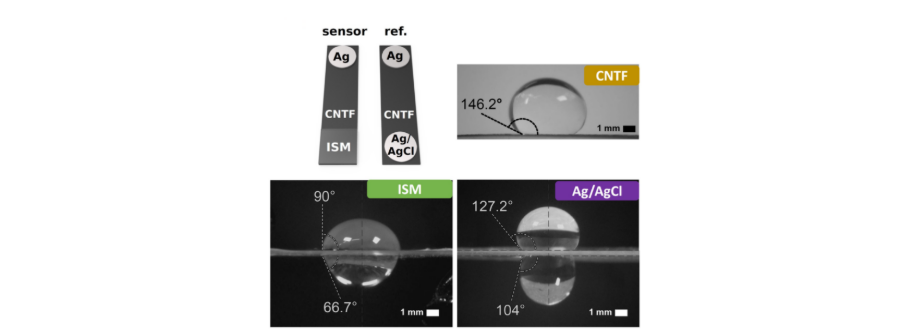 Figure 1: Ion-selective membrane (ISM) electrochemical sensor and reference electrode established on a carbon nanotube forest (CNTF) sponge. The differences in interaction with water can be observed by measuring the contact angle of water droplets. CNTF exhibits superhydrophobicity, while the Ag/AgCl reference electrode shows moderate adhesion, and the ISM shows low adhesion. In this study, we aim to improve adhesion by introducing microstructures into the ISM.Electrolyte balance disturbances during physical activity or childbirth can lead to dehydration, cramps, and fatigue. Traditional sweat sensors cannot retain moisture and must be in direct contact with the skin, which can cause skin irritation and reduce measurement accuracy during prolonged or dynamic use.The research team focused on the natural property of rose petals to repel excess moisture while retaining a small amount of water (the rose petal effect). By reproducing this microstructure on the ion-selective membrane (ISM), the research team developed a non-contact sweat sensor that is gentle on the skin while retaining moisture. This bionic sensor is expected to be used for real-time humidity status monitoring in medical, sports, and industrial fields.
1) What We Learned from Previous Research
The sodium content in sweat is considered an indicator of dehydration and muscle function decline. However, the traditional ion-selective membranes used in sweat sensors are hydrophobic and cannot adequately retain sweat, necessitating firm attachment to the skin. Therefore, it is necessary to apply adhesives on the skin, but prolonged use of adhesives has been reported to cause dermatitis and hygiene issues.
(2) New Attempts, Revelations, and Newly Developed Methods for This Purpose
This study faithfully transferred the wrinkles and protruding structures on the surface of rose petals (Rosa rubiginosa) to the polyvinyl chloride (PVC) ion-selective membrane (ISM) using polydimethylsiloxane (PDMS) molds. The main features of the resulting bionic ISM are:
〇 Significant reduction in contact angle, enhancing sweat adhesion
The contact angle of untreated ISM is 90°, but it is reduced to 76.8° on the bionic membrane with petal-like wrinkles, confirming that sweat droplets can be reliably retained in both upward and downward positions. Due to increased adhesion near the boundaries, a stable liquid film can form independently of the direction of gravity.
〇 Improved water retention and self-cleaning mechanism
In fixed tests, the maximum water retention rate of the bionic ISM (Sensor A/B) increased to about three times that of the untreated membrane. Additionally, in dynamic tests, it continued to retain water droplets for over 4 cycles even after a 15 mg load, exhibiting “self-cleaning” behavior by resetting the channels through bulk discharge when exceeding the threshold.
〇 Na⁺ sensitivity increased by 1.1-1.2 times, surface area increased by 16-22%
SEM image analysis showed that due to the introduction of wrinkles/protrusions, the effective surface area of Sensor A’s film increased by 16% compared to the theoretical value, while Sensor B’s effective surface area increased by 22%. Sensor A mimics the outer surface of the petal, exhibiting good water adhesion, while Sensor B mimics the inner surface of the petal, demonstrating excellent self-cleaning performance. This rough 3D structure improved the sensitivity for OCP measurements using NaCl solution by approximately 1.1 to 1.2 times, achieving performance close to 76% to 82% of the theoretical value of the Nikolsky-Eisenman formula.
〇 Response time of less than 1 second even at a 2 mm non-contact gap, stable measurements
When NaCl solution circulates in a 3D-printed flow path with a gap of 0.5-2 mm, the response time is about a second (<1 s) even at the widest 2 mm, and the self-cleaning mechanism minimizes drift in the potential waveform.
〇 Demonstration of wearable device using CNT sponge electrodes
The ISM and Ag/AgCl reference electrode were integrated on a CNT sponge and tested as a wrist-worn device during a 20-minute treadmill test (8 km/h). Even in the presence of bubble contamination and low sweat flow, the signal remained within the threshold range, and FFT analysis detected no noise matching the frequency of motion, with drift during operation similar to static conditions.
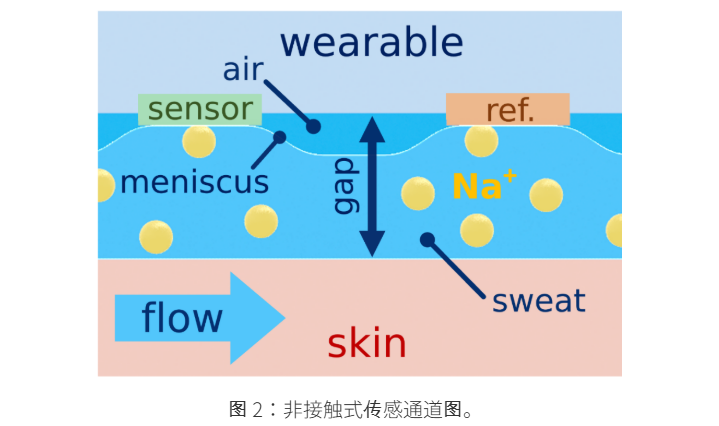
Due to enhanced adhesion, the sensing electrode and reference electrode can attract sweat through surface tension. This allows for adjustable gaps to provide greater comfort and sweat recirculation during use.
These results are significant as a new wearable sensor technology that can alleviate the burden on the skin during prolonged wear and achieve high-precision measurements.
(3) Chain Reactions and Social Impact of the Research
It can prevent heatstroke and manage athletes’ hydration in real-time, contributing to the prevention of accidents in medical and sports fields. Furthermore, long-term use for the elderly and patients with skin diseases is expected to expand the home monitoring market, as it does not require adhesives, and incorporates electrolyte feedback into human-machine interfaces such as prosthetics and exoskeletons, enhancing safety and comfort.
(4) Challenges and Future Prospects
The current fine transfer limit of the PVC film is about 5μm, making it difficult to fully reproduce sub-microscopic structures. Additionally, the mechanical durability of the CNT sponge electrodes needs to be improved, and a mass production process must be established. In the future, we will combine it with AI sweat data analysis to develop personalized optimized dehydration prediction algorithms.
(5) Comments from Researchers
This research demonstrates that naturally occurring designs can be wisely applied to advance technology and improve our quality of life. By mimicking natural microstructures, the performance of sensors under real conditions has been enhanced. Our goal is to develop bio-integrated tools that everyone can use for smarter and more effective healthcare.
 Amisco: Recognized as a listed company in the “Shenzhen Brand Development White Paper (1980-2025)”Significant milestones achieved in sensor core components—ultra-fine electromagnetic coil technology in the field of global electrophysiological navigationJapanese Society of Cardiovascular Surgery: Design of Amisco coil magnetic guidance system and magnetic-electric fusion positioning technology in cardiac electromagnetic navigation solutions