Fundamental Exploration
Evolution of AI Hardware Strategy: In-Depth Analysis from ByteDance’s “Doubao Phone” to Google’s “Project Aura” Glasses
1. ByteDance’s Terminal AI “Trinity” Strategy: Exploration Centered on “Doubao Phone”
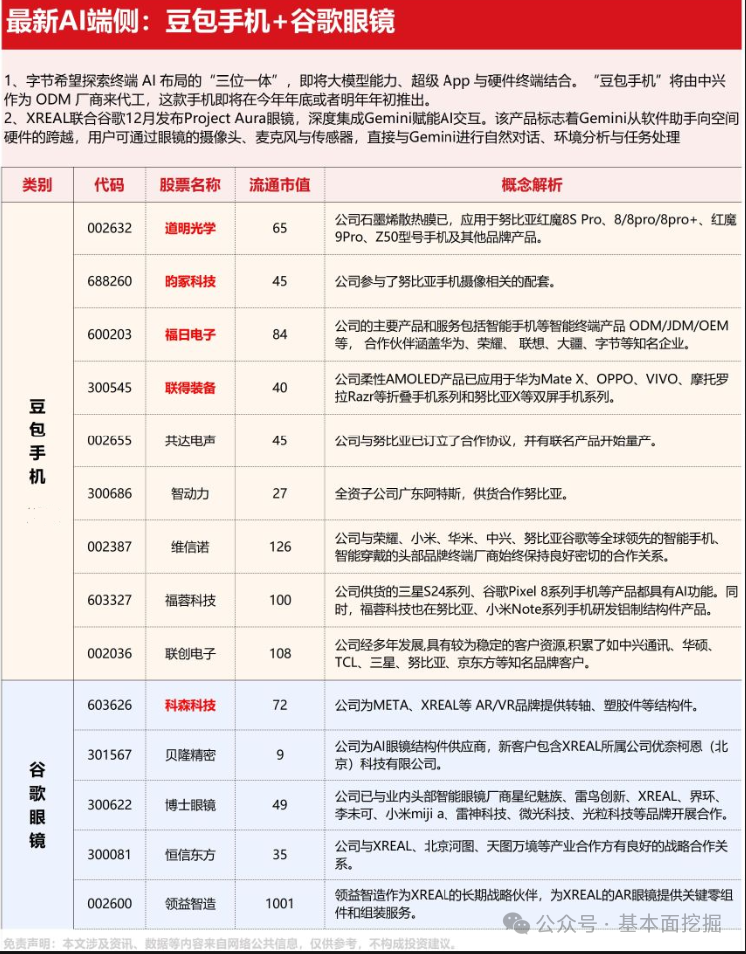
1. Core Objectives and Organizational Structure:ByteDance is actively exploring a “trinity” model for terminal AI deployment, aiming to achieve a deep closed loop of large model capabilities, super application ecosystems, and proprietary hardware terminals. The core hardware carrier of this strategy is rumored to be the AI phone currently under development—”Doubao Phone”.
The core leading team for this project is the Ocean Team, which is responsible for AI hardware within ByteDance. This team is part of the larger ByteDance AI product team Flow. The head of the Ocean business is Kayden, reporting to Flow head 朱J. The composition of this team reflects ByteDance’s long-term accumulation and integration in the hardware field, combining core strengths from hardware teams acquired over the years, including Smartisan, VR headset PICO, and smart headphones OlaDance, and in 2024, it absorbed some senior professionals from the former Honor mobile company.
2. “Doubao Phone” Project Details and Collaboration Model:According to market information, the “Doubao Phone” project was initiated in the first half of 2024, with domestic communications giant ZTE serving as the ODM (Original Design Manufacturer), responsible for hardware design, development, and production. ByteDance focuses on its core strengths—deep integration of large model functions and customization of part of the operating system.
The product is planned to be launched by the end of 2025 or early 2026, but the initial strategic positioning is clearly defined as for internal testing and validation only, with no plans for public sale at this time. This indicates that ByteDance’s exploration in the hardware field is still in a cautious stage of strategic validation and internal iteration.
3. Strategic Evolution Path and Market Background:ByteDance’s entry into mobile phone manufacturing was not part of its initial vision. At the project’s inception, ByteDance’s positioning was as an AI technology supplier, seeking to collaborate with existing mobile phone manufacturers to embed the Doubao large model as a system-level capability. ZTE’s Nubia brand was one of the potential partners. However, mainstream mobile phone manufacturers generally view large models as the core competitiveness of the next generation of smartphones, preferring to develop independently or maintain complete control, which hindered the advancement of ByteDance’s collaboration model.
In this context, ByteDance chose to shift to independent development to ensure complete control and deep integration of AI capabilities. This move is a key practice of the strategic goal proposed by ByteDance CEO Liang Rubo at the 2025 all-hands meeting to “explore new UI interaction forms,” aiming to create a new paradigm of human-computer interaction centered around AI through the combination of software and hardware.
4. Market Feedback and Risk Warning (Important Supplement):In response to market rumors about the “Doubao Phone,” ByteDance has officially stated that “the related information is inaccurate,” and “there are currently no plans to launch its own mobile phone products,” reiterating its strategy of “continuously exploring how to open its AI capabilities to various hardware manufacturers, including mobile phones.”
Rigorous Analysis: There is a significant difference between ByteDance’s official denial and market reports. This reflects two possibilities:
- Strategic Adjustment: The project may be in a highly dynamic planning stage, with internal disputes or strategic shifts.
- Information Management: The qualitative nature of “internal testing” places it within the realm of commercial secrets, and official denial is standard practice to avoid prematurely exposing strategic intentions.
Regardless of whether it ultimately emerges as a branded mobile phone, ByteDance’s strategic direction of deepening the integration of AI capabilities with hardware terminals is certain. The “complete solution attempts” with ODM manufacturers like ZTE are already underway, and even without a branded phone, this deep cooperation model itself may bring new business increments to supply chain partners like ZTE.
2. Google’s “Project Aura”: AI Glasses as an Entry Point for Spatial Computing
1. Project Overview and Technical Core:Unlike ByteDance’s mobile phone path, Google has chosen augmented reality (AR) glasses as a more forward-looking form for the implementation of AI hardware. In December 2024, Google will jointly release AI glasses codenamed “Project Aura” with leading company in the AR glasses field, XREAL.
The core feature of this product is that it is equipped with Google’s AndroidXR platform and deeply integrates the Gemini AI large model as its “intelligent brain.” This marks the evolution of Google’s AI capabilities from traditional mobile software assistants to spatial intelligences that can perceive and understand the physical world. Users can interact directly with Gemini using natural language through the glasses’ camera, microphone, and sensors, achieving environmental understanding, information retrieval, and task processing.
2. Industry Chain Cooperation and Technical Specifications:As a company that has held the top global AR market share for four consecutive years, XREAL’s hardware strength is key to this collaboration. The Project Aura glasses will adopt XREAL’s 70° ultra-wide field of view optical solution, equipped with its self-developed X1S chip and Qualcomm’s computing unit, aiming to achieve a balance between lightweight design and strong computing power. This collaboration is a key move for Google’s AI ecosystem to expand into the spatial computing field, while XREAL leverages Google’s AI and platform ecosystem to jointly define the next generation of XR human-computer interaction benchmarks.
3. Strategic Significance:Project Aura’s ambition is to become a super entry point for AI to connect with reality, pushing consumer-grade AR devices from entertainment and information tools to intelligent terminals with productivity. With Gemini deeply empowering scenarios such as search, creation, and analysis, these glasses are expected to redefine the interaction between humans and the digital and physical worlds.
3. Conclusion and Comparative Analysis
1. Comparison of Strategic Paths:
- ByteDance: Chooses the smartphone as a mature platform with a large user base as an entry point, attempting to quickly validate the feasibility of its “trinity” business model by reshaping the mobile operating system and interaction logic. The path is relatively pragmatic, facing fierce competition in a saturated market.
- Google: Chooses AR glasses as a cutting-edge, future-oriented computing platform, laying out the next generation of human-computer interaction entry points and positioning itself in the spatial computing track. The path is more disruptive, but the challenges of market education and ecosystem building are also greater.
2. Differences in the “Trinity” Layout:ByteDance’s “trinity” aims to tightly bind its content ecosystem (Douyin, Toutiao, etc.), large model (Doubao), and hardware terminals to build a highly self-consistent closed-loop system for services and experiences. Google’s layout is more open, with its AndroidXR platform aiming to empower hardware partners like XREAL, with the underlying layer provided by Gemini offering universal intelligent services, forming a “platform + model + open hardware ecosystem” alliance system.
3. Common Direction:Despite differing paths and forms, both validate a core trend:the implementation of large model capabilities is inevitably moving from purely software services to deep integration with hardware terminals. Whether it is Apple, Google, or ByteDance, tech giants are realizing that only by mastering terminal entry points can they fully unleash the potential of AI and ultimately establish an insurmountable ecological moat.
Risk Warning: Any opinions expressed herein are solely personal thoughts and do not constitute investment advice. Any actions taken based on this information are at your own risk. Investment carries risks; please proceed with caution.
 Click the blue text to follow us