Recently, Professor Han Zhiwu’s research group from the team of Academician Ren Luquan at Jilin University published a research paper titled “Hypersensitive Pressure Sensors Inspired by Scorpion Mechanosensory Mechanisms for Near Body Flow Detection in Intelligent Robots” in Science Advances.
The researchers drew inspiration from scorpions to develop a new type of biomimetic pressure sensor that helps hexapod intelligent robots successfully evade “predators” and pursue “prey”—both simulated by moving cardboard boxes of different sizes. Thanks to the scorpion’s characteristic sensory structure and the integration of deep learning neural networks, this hypersensitive biomimetic sensor can identify moving objects of different shapes by recognizing fluctuations in the near-body flow field, achieving an accuracy rate of over 85%.
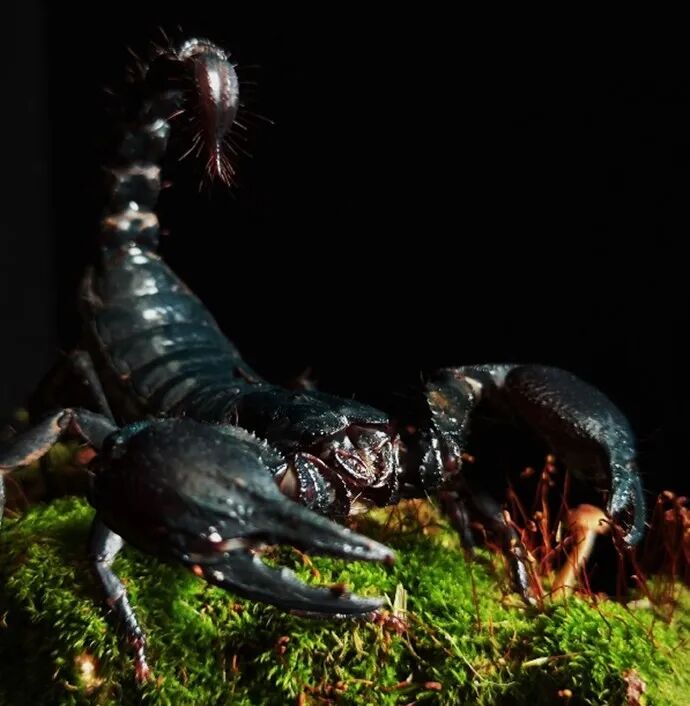
In this study, Professor Han Zhiwu’s research team was inspired by the fine trichobothria sensory receptors on the scorpion’s pedipalps and the slit sensilla located at the distal joints of the tarsus to design a high-performance piezoresistive pressure sensor.
They analyzed the microscopic structure of the scorpion’s mechanosensory receptors using electron microscopy and explored the scorpion’s high-precision perception mechanism through electrophysiological experiments and DIC technology. They introduced stress traps in the sensor design to simulate the stress concentration perception mechanism of the slit sensilla, while developing a bending suppression unit to mimic the claw-like features of the trichobothria.
These structures are arranged on the top and bottom layers of the semiconductor chip, with the former significantly enhancing pressure sensitivity by increasing the overall energy flow into the sensitive unit, and the latter greatly reducing the chip’s “balloon effect” through the bending suppression unit, thereby optimizing the sensor’s linearity. Experimental results show that the sensor’s sensitivity reaches 65.56 mV/V/kPa, with a linearity of up to 0.99934, allowing for precise measurement of airflow, pressure, height, and the identification of flow field patterns.
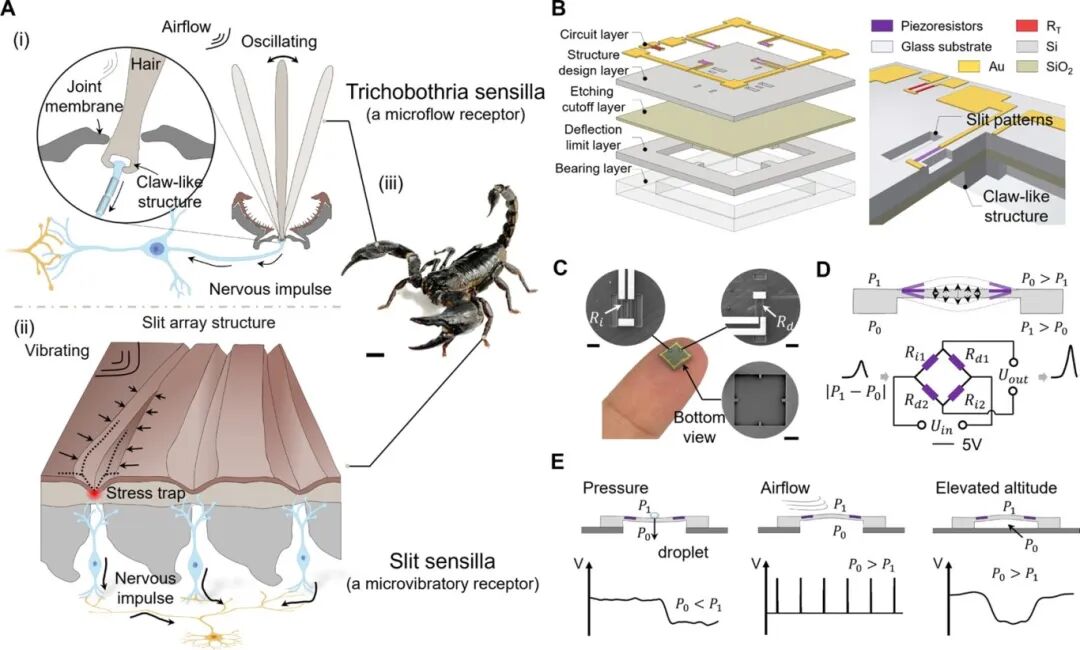
Figure 1 – High-precision pressure sensor inspired by scorpion receptors: (A) Scorpion’s surface perception system; (B) Structure of the biomimetic piezoresistive pressure sensor; (C) Physical object and SEM image of the biomimetic sensor; (D) Working principle of the biomimetic sensor; (E) Multi-physical quantity detection capability of the biomimetic sensor.
Professor Han Zhiwu and his team further integrated this sensor with a deep learning network, applying it to a hexapod robot that mimics scorpion movement. This robot, based on the sensor’s precise perception capabilities, identifies and tracks moving targets, demonstrating scorpion-like stress response behaviors.
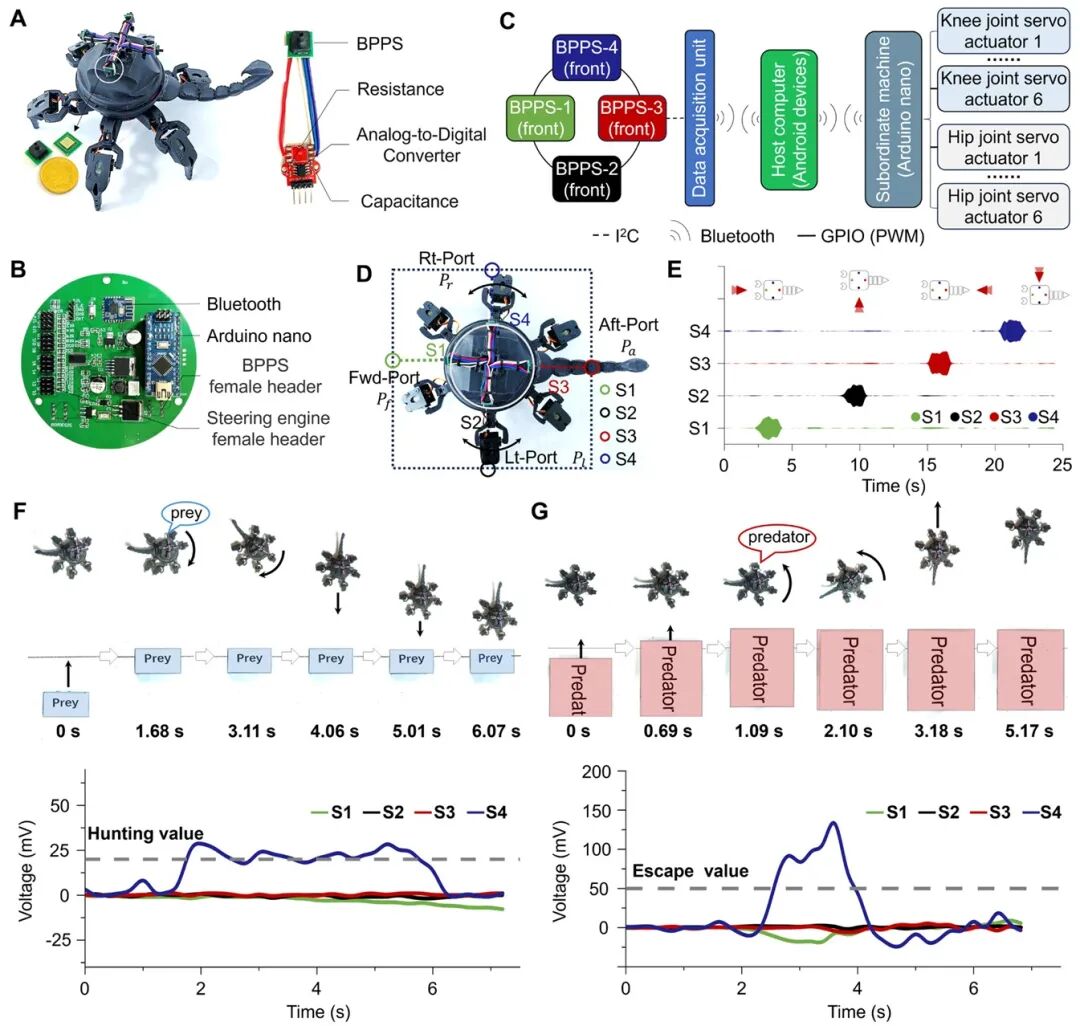
Figure 2 – Near-body flow field detection by the scorpion-like hexapod robot: (A) Scorpion-like hexapod robot equipped with biomimetic sensors; (B) PCB design; (C) Schematic diagram of the principle; (D) Arrangement of the biomimetic sensors; (E) Response of the biomimetic sensors to objects approaching from different directions; (F) “Hunting” behavior of the scorpion-like hexapod robot; (G) “Evading predators” behavior of the scorpion-like hexapod robot.
 This article is contributed by the author’s team at the invitation, and the views expressed herein are solely those of the authors, and do not represent the position of Science/AAAS.
 Share
Share Bookmark
 View
View Like
Like