Bluetooth location services are the fastest-growing solutions in the field of Bluetooth technology, and they are increasingly used in areas such as item tracking, indoor positioning, indoor navigation, and asset tracking. The Bluetooth Alliance is continuously iterating on Bluetooth technology, improving the accuracy of positioning technologies, from the early purely signal strength-based Beacon positioning to the multi-antenna angle positioning supported by Bluetooth 5.1. Tai Ling Microelectronics has also made early investments and in-depth research and development in Bluetooth positioning, and currently offers several chips that support Beacon positioning, Mesh + Beacon, and Bluetooth 5.1 angle positioning technologies. Additionally, they are about to launch centimeter-level positioning chips based on Bluetooth technology. This issue introduces the positioning solution from Tai Ling’s partner, Hui Xun Technology.
From a solution perspective, the current Bluetooth positioning systems on the market can be roughly divided into three types: active Bluetooth positioning systems, passive Bluetooth positioning systems, and integrated active-passive indoor positioning systems.
The active Bluetooth positioning system locates by scanning iBeacon base stations with handheld devices (such as smartphones and tablets). It uses high-performance Bluetooth positioning algorithms to support high-precision indoor positioning navigation for various mobile terminals, featuring real-time positioning, path planning, reverse car searching, etc. This Bluetooth positioning system focuses on indoor path planning and navigation applications and can be widely applied in places such as hospitals, parking lots, tourist attractions, office buildings, exhibition halls, museums, train stations, amusement parks, and supermarkets.
The passive Bluetooth positioning system relies on positioning algorithms, Bluetooth gateways, and Bluetooth positioning tags (such as badges, wristbands, tags, etc.). After the gateway receives the information sent by Bluetooth devices, it calculates through the server to provide real-time information on the location of people and items on the display platform. This positioning system is mainly used for backend monitoring of the usage of people or items in the front end, widely applied in scenarios such as factory asset positioning, visitor management in organizations, nursing homes, etc.
The integrated active-passive indoor positioning system combines the advantages of the above systems. The system integrates Bluetooth positioning algorithms, Bluetooth gateways, Bluetooth positioning tags, and iBeacon among a series of hardware, minimizing the use of Bluetooth gateways. Relatively speaking, the integrated active-passive positioning system solution can greatly reduce the cost of deploying positioning hardware while serving both active and passive positioning, offering high cost-effectiveness. The system uses Bluetooth 5.0 technology for data transmission, characterized by long coverage distance, high real-time performance, and large concurrency, making it widely applicable in places like museums, chemical plants, exhibition halls, logistics warehouses, and nursing homes.
【About Shanghai Hui Xun】
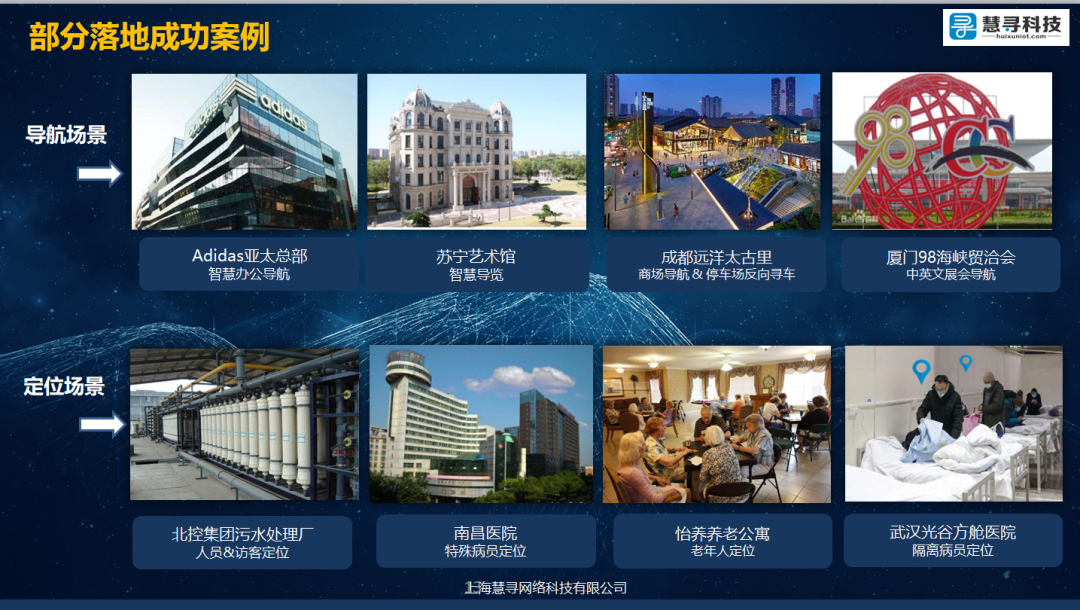
Shanghai Hui Xun Network Technology Co., Ltd. is a technology company that provides integrated solutions for smart indoor location services based on IoT technology and low-power Bluetooth technology, aimed at enterprise clients. Major products include: mall navigation & reverse car search in parking lots, smart museum guides (precise push based on location), indoor-outdoor integrated positioning for personnel/assets, and personnel positioning in chemical plants.
【Some Successful Cases of Indoor Positioning Scenarios】
【About Tai Ling】
Tai Ling Microelectronics (Shanghai) Co., Ltd. was established in 2010 and is a semiconductor design company dedicated to the research and development of high-performance, low-power wireless IoT system-level chips. The company is headquartered in the Zhangjiang Hi-Tech Park in Shanghai and has several subsidiaries in the Asia-Pacific region, as well as subsidiaries or offices in North America and Europe. The chips developed and sold by the company include traditional Bluetooth, Bluetooth Low Energy, Zigbee, 6LoWPAN/Thread, Apple HomeKit, and 2.4GHz proprietary protocols, covering industries such as smart lighting, smart home, wearable devices, wireless peripherals (HID), new retail, wireless toys, wireless audio and headphones, industrial control, smart cities, and other IoT and consumer electronics-related products.
The core standard of Bluetooth 5.1 has added direction-finding capabilities, which will significantly enhance the accuracy and performance of Bluetooth location services. Furthermore, future higher-level Bluetooth standards will further strengthen positioning-related functionalities. Tai Ling Microelectronics keeps pace with the latest Bluetooth standards, providing IoT connection chips that comply with the latest Bluetooth standards. For instance, Tai Ling already has two generations of chip products that support AoA/AoD functionality, and interested customers can find relevant information and demonstration codes on Tai Ling’s official website.