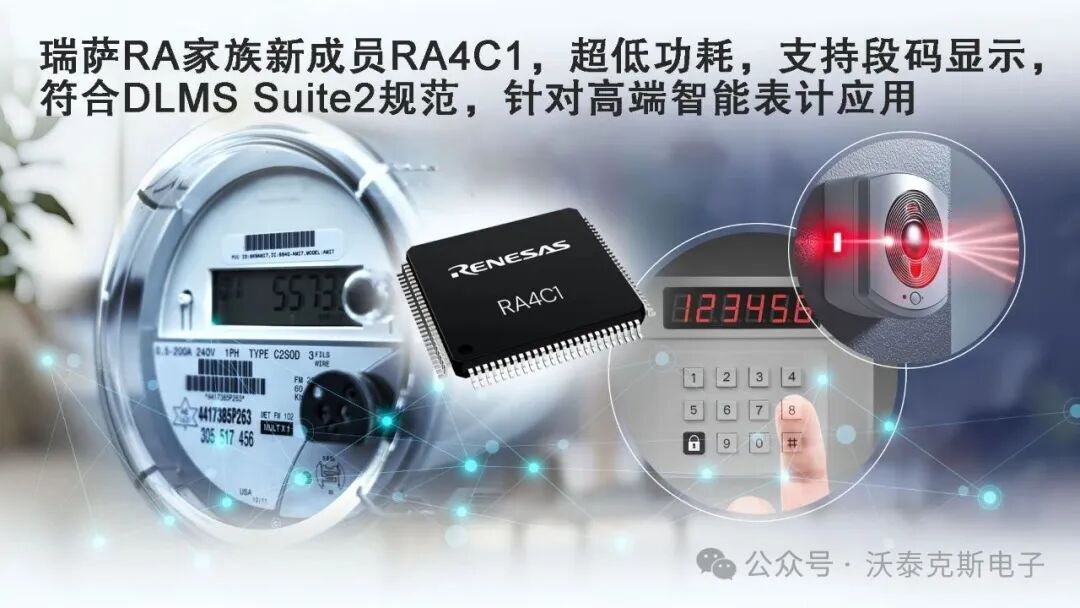
Recently, Renesas Electronics announced the launch of the RA4C1 microcontroller (MCU) product line based on the 80MHz Arm® Cortex®-M33 processor, featuring ultra-low power consumption, advanced security features, a rich set of communication interfaces, and support for segment LCDs, making it an ideal choice for metering applications and other battery-powered applications requiring stringent security.The RA4C1 MCU is designed for battery-powered applications that require strict security and ultra-low power consumption, covering the metering field including electric meters, gas meters, water meters, and industrial flow meters, while also extending to scenarios such as smart locks, thermostats, building control systems, and industrial user interfaces.
At an operating frequency of 80MHz, the RA4C1 MCU has a mode power consumption of only 168µA/MHz, which is leading in its class. With all SRAM data retained, the standby current can be as low as 1.79µA, effectively extending battery life. It supports an input voltage as low as 1.6V, allowing customers to design battery-powered applications that use smaller batteries or achieve higher performance with the same battery size. It is equipped with a real-time clock (RTC) with an independent power domain, facilitating battery-powered time data backup.
The RSIP-E31A features a built-in RSIP-E31A security engine, providing an isolated subsystem managed and protected by dedicated control logic, enhancing system security. It supports a 256-bit hardware unique key and a true random number generator (TRNG), along with key management capabilities to generate encapsulated keys. It supports SHA algorithms, AES hardware acceleration, and ECC with NIST and Brainpool curves with key lengths of up to 384 bits, meeting advanced encryption requirements. It has achieved PSA Level 1 certification and complies with the European Cyber Resilience Act (CRA) compliance extension, demonstrating Renesas’s ongoing commitment to cybersecurity and adherence to upcoming European regulations.
It has a rich set of communication interfaces and peripherals, including CAN FD, LPUART, SCI, SPI, QSPI, I²C, etc., to meet various communication needs. The peripherals integrate a low-power ADC, an on-chip temperature sensor with 1% accuracy, and an on-chip LCD controller for driving low-power segment displays, enhancing system functionality and flexibility.
The RA4C1 MCU meets the security regulations of the DLMS Suite2 for metering applications, helping meter manufacturers expand into more markets. DLMS (Device Language Message Specification) is the core communication standard in the smart metering field, and its compliance directly affects product export capabilities and technological competitiveness. It features 512KB of dual-area on-chip flash memory, enabling easy and secure software updates to meet the long-term operational needs of metering systems. It is equipped with 96KB of SRAM and 8KB of data flash for on-chip data storage, enhancing system data processing capabilities.
It provides all the necessary infrastructure software for development, including multiple RTOS, BSPs, peripheral drivers, middleware, connectivity, networking, and security stacks, as well as reference software for building complex AI, motor control, and cloud solutions, thereby helping customers accelerate application development. It supports Renesas’s original development tools (e2studio, E2/E2 Lite) and simultaneously launches the RA4C1 evaluation board to help users easily evaluate the features of the RA4C1 and develop embedded system applications. Collaborating with Arm ecosystem partners, it offers rich onboard features and customizable popular ecosystem plugins to turn ideas into reality.
The launch of the RA4C1 solidifies Renesas’s leading position in ultra-low power MCUs and industrial security, with its power consumption metrics (168µA/MHz) and security certification (PSA Level 1) setting new standards for the industry. It aligns with the global trend of smart grid upgrades, especially meeting the high security and low power requirements of power metering systems under China’s “dual carbon” goals. It complements Renesas’s RL78 and RX series, completing the MCU layout from 8-bit to 32-bit across all scenarios.