Click the video to watch the highlights
Introduction
News Today
Currently, Beijing United Family Hospital has accumulated over a thousand cases of robotic surgery experience. As AI and medicine gradually integrate, the hospital is actively exploring how to apply AI technology in clinical practice to enhance the precision and safety of surgical procedures, pushing surgery towards intelligence.
The rapid development of artificial intelligence and robotics is reshaping the model and efficiency of medical services, bringing unprecedented opportunities for transformation in the healthcare industry.
On November 9, the “2025 Great Wall General Surgery Forum” hosted by United Family Healthcare and the China Medical Foundation was successfully held at Beijing United Family Hospital.
This forum focused on the core theme of “New Perspectives on Robotic Surgery and Artificial Intelligence in General Surgery,” highlighting the systematic application of robotic surgery and the latest breakthroughs and practical experiences of AI in key areas such as preoperative planning, intraoperative decision-making, precise navigation, and postoperative management.
Ma Peien, Vice President of Medical Affairs at United Family Healthcare, told the “Medical Community Think Tank” that surgical robots and artificial intelligence are cutting-edge technologies that are currently attracting significant attention in the healthcare industry. United Family has been committed to promoting the clinical application of these technologies through rigorous validation and practice.
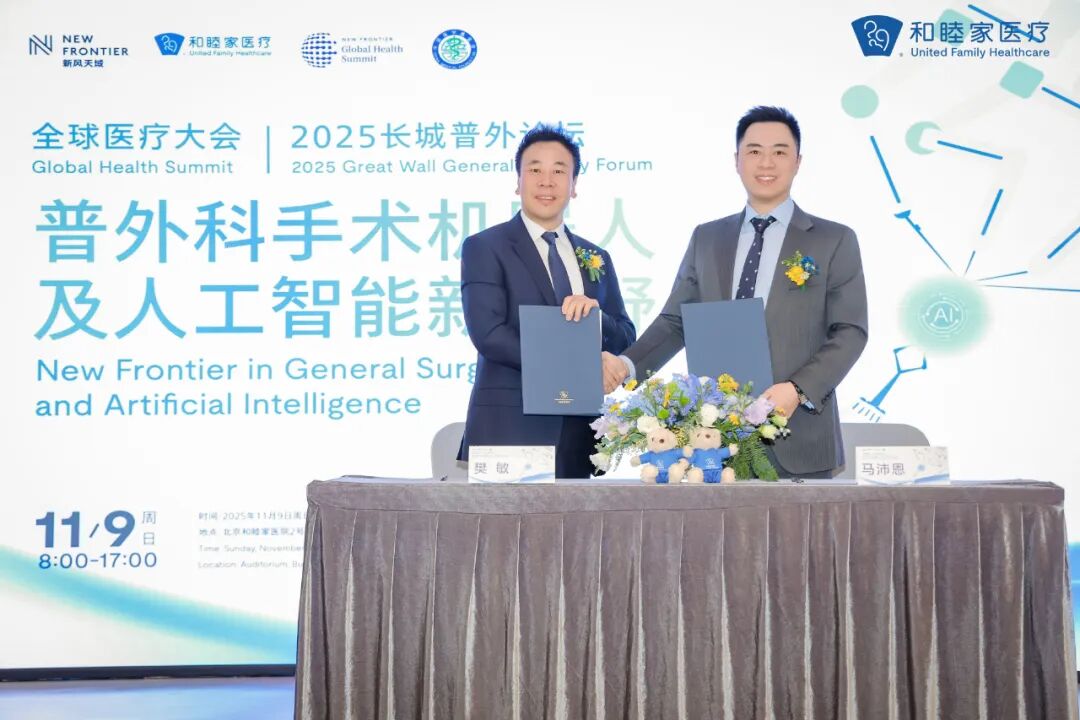
United Family Healthcare and AIS magazine have signed a strategic cooperation agreement to jointly build the internal publication “AI Surgery Chinese Edition”.
“In the future, United Family will continue to increase investment in artificial intelligence and robotics, continuously innovating and optimizing to provide patients with higher quality medical services and promote the intelligent development of the healthcare industry.”
Deepening the Application of Surgical Robots
As one of the earliest non-public medical institutions in China to conduct robotic surgery, Beijing United Family Hospital has been continuously expanding its technological advantages in this field in recent years.
Currently, United Family has three Da Vinci robots, one single-port robot, one Mako orthopedic robot, and one Ion bronchoscope robot, which have been widely applied in various fields such as urology, gastrointestinal surgery, hepatobiliary and pancreatic surgery, thyroid surgery, head and neck surgery, gynecology, thoracic surgery, and pediatric surgery. To date, over a thousand robotic surgeries have been completed.
United Family Hospital is also continuously introducing more advanced equipment, such as the latest generation of the “Da Vinci Xi” surgical robot, which will better meet the needs of complex surgeries, further reduce surgical risks, shorten patients’ postoperative recovery time, and enhance the patient experience.
In addition, in its advantageous fields such as urology and general surgery, Beijing United Family Hospital has been hosting relevant academic conferences for many years, inviting top experts from home and abroad to give academic lectures, perform surgical demonstrations, and share experiences. The hospital not only provides a platform for domestic peers to connect with international cutting-edge technologies but also further strengthens its influence both domestically and internationally.
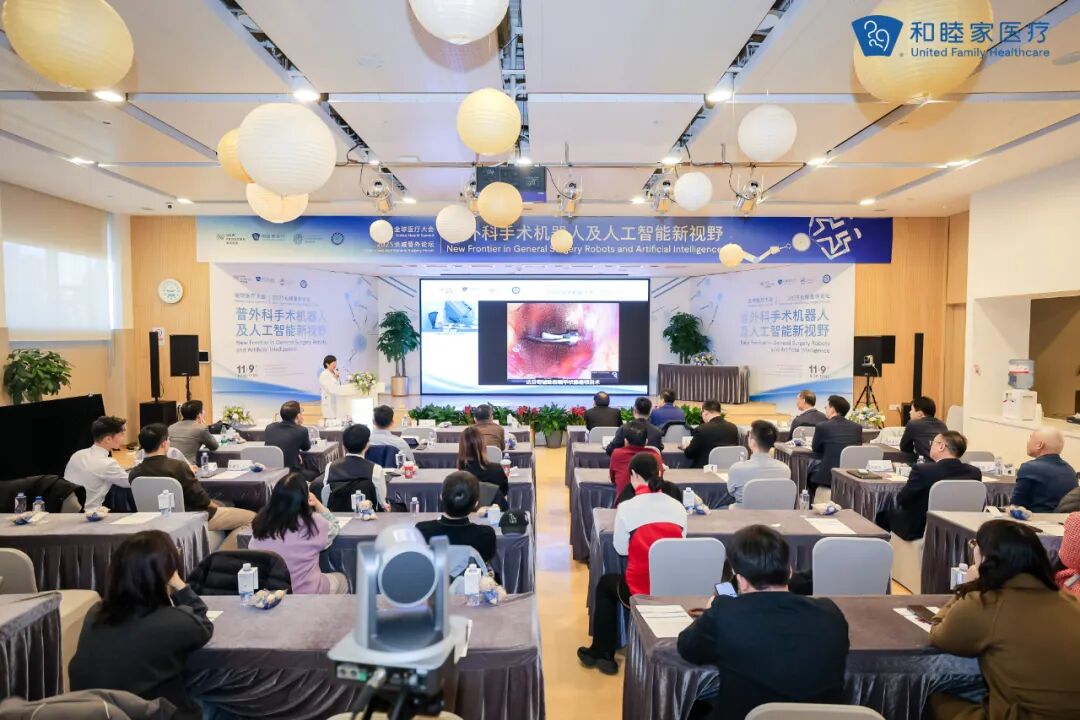
Conference scene
Hua Surong, Deputy Director of General Surgery at Beijing United Family Hospital, introduced that in terms of surgical operations, traditional open surgery is flexible but limited in vision and precision; laparoscopic surgery has a clear view but suffers from a lever effect, unstable movements, and operational blind spots.
“Surgical robots, with their flexible mechanical arms and advanced algorithms, can achieve more precise and stable operations. They can effectively filter out subtle tremors from the surgeon’s hands, avoiding errors caused by human factors, thus providing patients with a higher quality surgical experience,” said Hua Surong.
For example, in thyroid surgery, Beijing United Family Hospital has developed various “scarless neck” approaches such as axillary, periareolar, and transoral surgeries. These surgical methods, combined with the high-precision operations of surgical robots, not only ensure radical and aesthetic outcomes but also significantly reduce blood loss and hospital stay compared to traditional surgeries, truly achieving “return to life in three days post-surgery.”
Focusing on AI Technology: New Explorations in Surgery
Integrating AI has become a common consensus among medical institutions to enhance competitiveness and service quality.
Ma Peien introduced that about two years ago, United Family established an internal artificial intelligence team to provide continuous internal drive. Its self-developed “Mu Yi AI” currently provides clinical support for doctors and patients in pre-diagnosis, diagnosis, and post-diagnosis stages.
In recent years, United Family Hospital has also increased collaborations with external technology companies, research institutions, and universities on AI medical projects. For instance, in August this year, United Family Hospital reached a strategic cooperation with Alibaba’s Damo Academy, where both parties will explore multi-disease AI screening services for a broad population based on the “one scan, multiple checks” medical AI technology developed by Damo Academy, combined with United Family’s international diagnosis and treatment standards and multi-site coverage advantages.
At the same time, United Family is also collaborating with renowned institutions such as the Hong Kong University of Science and Technology and Tsinghua University, along with industry partners and top hospitals at home and abroad, to jointly promote innovative research on cutting-edge technologies.
In addition to applying AI technology in traditional fields such as imaging and pathology, in 2017, United Family began exploring the application of three-dimensional imaging reconstruction technology in Da Vinci robotic surgery, completing the world’s first surgery using holographic imaging to locate cancer thrombus and assist in the robotic removal of testicular cancer thrombus.
Currently, AI is still in the preliminary development stage of assisting surgeries, with many clinical pain points. Hua Surong told the “Medical Community Think Tank” that since 2018, he has been deeply engaged in innovative applications of AI in medicine, winning the world championship twice at the International Conference on Medical Image Computing and Computer-Assisted Intervention (MICCAI) in 2023 and 2025, and sharing the team’s research results at several international academic conferences.
Click the video to watch the highlights
One of the directions Hua Surong is researching is the AI recognition technology for the recurrent laryngeal nerve in laparoscopic thyroid surgery based on deep learning. Injury to the recurrent laryngeal nerve is one of the most concerning complications of thyroid surgery, as the nerve’s location is concealed and its path varies. Traditional surgery relies entirely on the surgeon’s experience for identification, and a slight mistake can lead to nerve damage, resulting in hoarseness or even breathing difficulties.
Observing this clinical pain point, Hua Surong and his team developed an AI system for the recurrent laryngeal nerve, achieving two major technological breakthroughs: dynamic recognition and edge computing optimization. Currently, this technology has applied for an invention patent and is undergoing clinical research at Peking Union Medical College Hospital and Beijing United Family Hospital.
Hua Surong recalled that the initial attempt to apply AI in surgery was aimed at reducing common errors in surgical procedures, such as patient voice loss due to nerve damage or bleeding due to ruptured blood vessels.
He pointed out that even experienced doctors find it difficult to maintain consistent physical and mental states during long surgeries. Moreover, surgeons often face the risk of collateral damage, and upon reviewing surgical videos afterward, it is found that over 90% of these situations are preventable.
“The advantage of AI is that it can continuously provide assistance and reminders throughout the surgical process, compensating for the shortcomings of human doctors and paying real-time attention to every detail during surgery, such as the position of gauze, the orientation of nerves and blood vessels, thereby reducing the cognitive burden on doctors,” said Hua Surong.
Aiming for Innovative Technology Applications to Attract Medical Talent
Ma Peien told the “Medical Community Think Tank” that Beijing United Family Hospital and its affiliated New Wind Tianyu Group have regarded technological innovation as a core concept since their establishment, firmly believing that technology is the key force to enhance medical quality and ensure patient safety. For example, in the application of surgical robots and artificial intelligence, United Family not only made early layouts but also aims to become a leader in the private medical sector.
However, this does not mean blindly pursuing technology. Ma Peien emphasized that United Family maintains a cautious attitude towards the application of innovative technologies, insisting on a patient-centered approach and believing in the need to systematically integrate cutting-edge technologies into the entire diagnosis and treatment process.
“For instance, when evaluating AI products, it is essential to collaborate with clinical teams to clarify clinical pain points and opportunities,” he explained. When technology is implemented clinically, the hospital also designs a systematic training process to ensure that all relevant personnel involved in the diagnosis and treatment process can continue to learn and adapt flexibly.
Taking the Da Vinci surgical robot introduced by United Family as an example, considering that robotic surgery involves not only the surgeon’s operation but also multiple stages such as preoperative preparation, intraoperative cooperation, and postoperative care, the hospital provides specialized training not only for surgeons but also for anesthesiologists, intensive care unit doctors, and nursing teams.
Click the video to watch the highlights
In terms of innovative technology applications, Ma Peien also mentioned that United Family not only focuses on the clinical application of cutting-edge technologies but also looks at medical services that public hospitals have yet to perfect or develop. The “Medical Community Think Tank” has learned that United Family is currently laying out palliative care services to serve special groups such as patients with advanced tumors and elderly patients with terminal diseases.
Due to United Family’s systematic innovative layout and open attitude, the hospital has attracted many outstanding medical talents in recent years. Hua Surong, who has achieved significant results in both clinical and academic fields in surgery, is one of them. He officially joined Beijing United Family Hospital in April this year and sees patients in general surgery and gastrointestinal surgery departments.
He admitted that United Family, with its international background and innovative mechanism, has many unique advantages, especially in the fields of surgical robots and artificial intelligence. “It not only supports clinical research, patent transformation, and exploration of new technologies but also provides doctors with a broad development space and resource support.”
On this new platform, Hua Surong plans to conduct deeper explorations in these innovative fields. For example, exploring more application scenarios of artificial intelligence in surgery, promoting more innovative technologies from the laboratory to clinical practice through clinical research and patent transformation, and providing patients with higher quality, more precise, and minimally invasive clinical services.
This article is reproduced from the WeChat public account: Medical Community Think Tank
Written by: Guo Xuemei