Today is Monday, let’s talk about something simple and discuss ISO again.
We have previously discussed the topic of ISO; in digital cameras, ISO affects the sensor’s gain, while in film, ISO affects the sensitivity of the emulsion on the film.
Today, we will first talk about the sensor’s ISO, specifically regarding native ISO and extended ISO.
01 Native ISO and Base ISO
a Native ISO and Base ISO
First, let’s clarify what the basic ISO and native ISO of a sensor are.
In fact, there are many interpretations of the term native ISO; some say it is a range, while others say it is a fixed value (the minimum value within the former range).
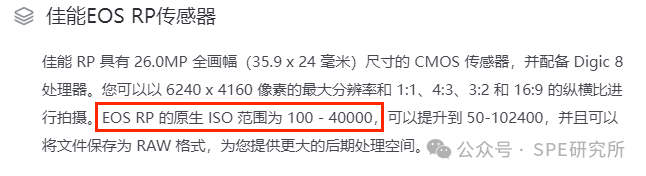

To avoid ambiguity, in this article, we will refer to this range as native ISO, and the minimum value of this range as base ISO.
For example, according to the definitions here:
The base ISO of the EOS RP is ISO 100, and the native ISO is 100 – 40000.
In previous articles, we discussed that ISO in the digital world refers to the sensor’s gain.
When taking photos, the sensor adjusts the ISO (gain factor, which can be understood as sensitivity to light) to achieve proper exposure.
As shown in the figure below, the sensor’s exposure gain module automatically adjusts the gain (ISO) through detection to ensure that the image output by the sensor is clear and visible.
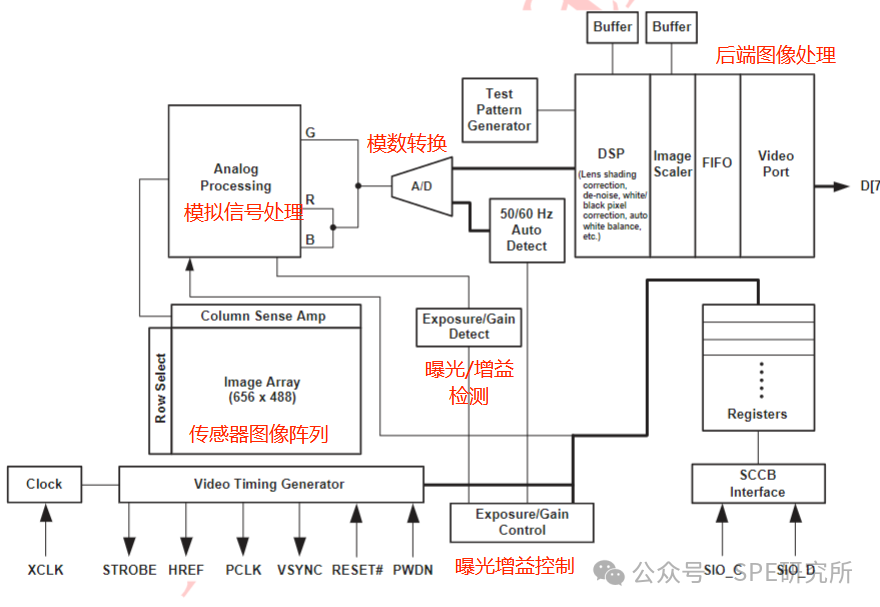
Thus, we can infer that the base ISO, which is the minimum value in the range, represents the situation with the least gain.
On the other hand, native ISO refers to the range of gain achievable in the front-end processing section.
b ISO and Image Quality
In the previous discussion of the exposure triangle (【Photography Insights】 Exposure Triangle and Aperture Size), it was also mentioned that the higher the ISO, the higher the noise.
This should be further clarified: when at base ISO, noise is at its lowest.
The principle behind this is that when designing the sensor, developers optimize the noise at base ISO to be as low as possible, while other ISOs are the result of hardware amplification based on base ISO.
Therefore, the lower the base ISO, the less noise there is, and the higher the maximum quality limit.
Moreover, the larger the range of native ISO, the more it determines the imaging effect at different sensitivities (especially high sensitivity).
For example, comparing Canon’s 5D Mark IV (ISO 100-32000, expandable to 102400) and Nikon’s D850 (ISO 64-25600, expandable to 102400).
We can see in the figure below that at low ISO, the D850 has the largest dynamic range, but as the ISO increases, the 5D Mark IV gradually surpasses it:
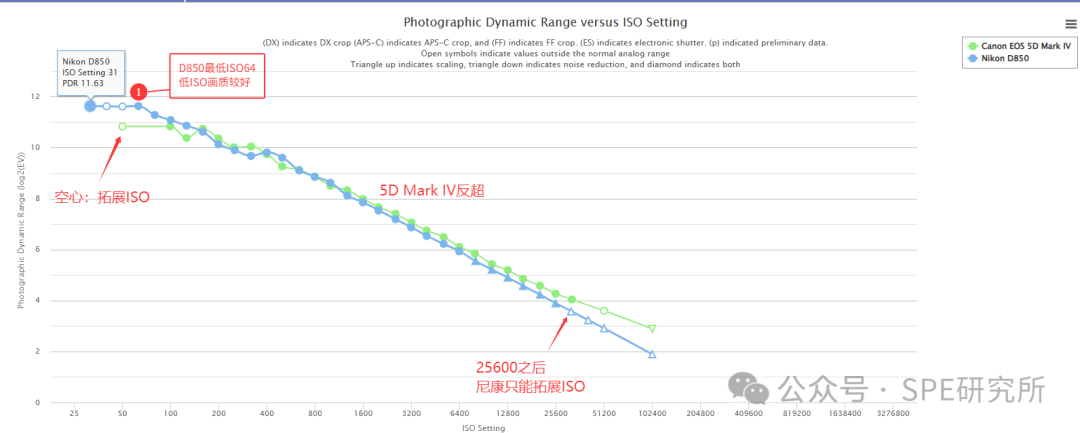
In summary, when shooting landscapes or starry skies where shutter speed is not a critical factor, using base ISO can yield better image quality.
However, when photographing sports or animals, one must consider the imaging performance at high sensitivity.
When choosing a sensor, please analyze based on specific needs and budget.
c Dual Native ISO
Let me briefly mention dual native ISO.
(In fact, according to the previous introduction, it should be called dual base ISO, but let’s stick to the commonly used term here)
Dual base ISO, as the name suggests, refers to sensors that have two optimized gain circuits, selecting different gain circuits for amplification under different lighting conditions.
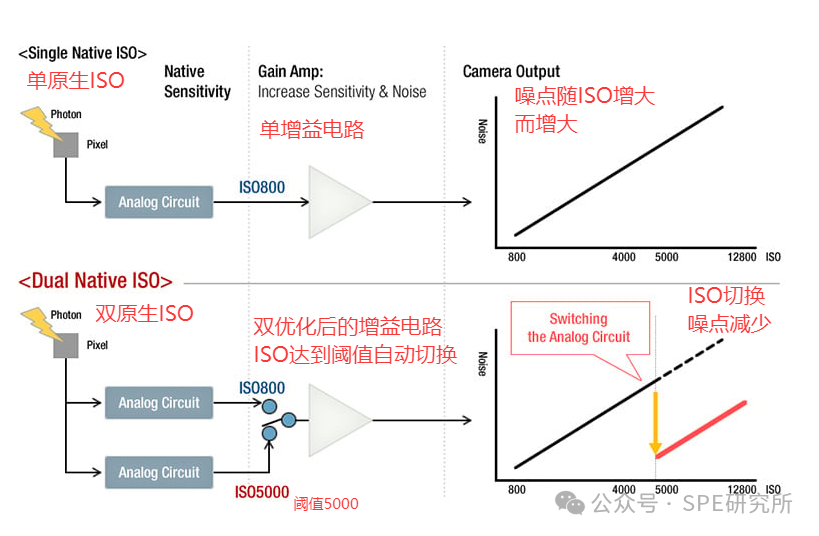
For example, in well-lit environments, the camera uses the low ISO circuit for amplification.
When the light is poor and the ISO reaches a threshold, it will automatically switch to the other circuit designed for low-light ISO processing.
Let’s take a look at the Canon R5 Mark II:
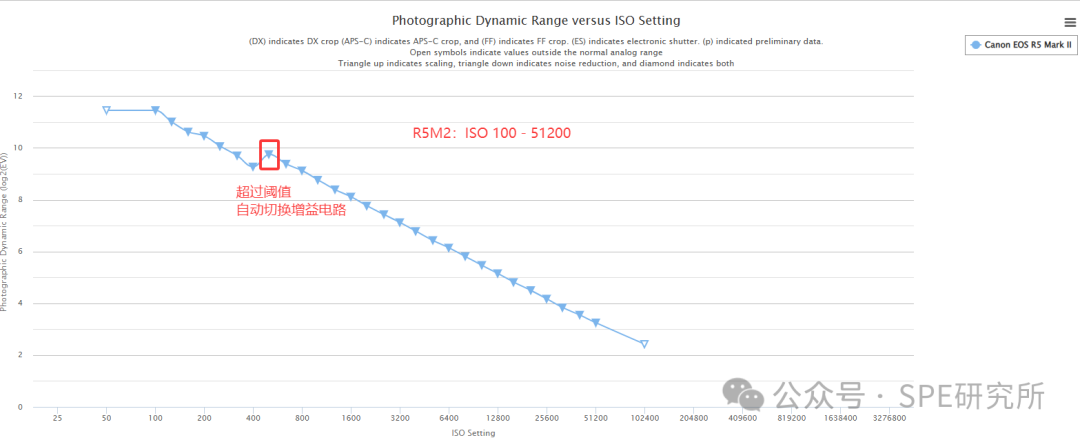
When the ISO reaches a certain value, we can see that its dynamic range improves, which is the result of switching to another image processing circuit.
Of course, this also requires higher-level processors and circuit designs, which means a higher price… you know what I mean.
02 Extended ISO
a What is Extended ISO
Having discussed native ISO, let’s talk about extended ISO.
As mentioned earlier, the range of native ISO is the ISO range that hardware can handle.
If a wider range is needed, then “when hardware is insufficient, software compensates”.
That is, the ISO range is extended beyond the hardware processing range through software digital processing.
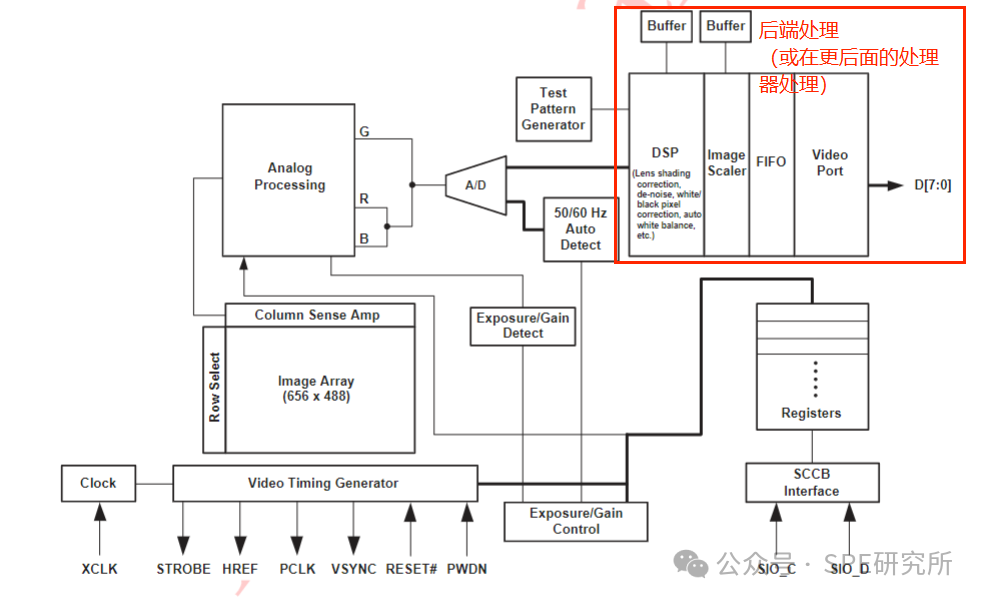
For example, to extend the minimum ISO from 100 down to 50, you simply divide the data of ISO 100 by 2.
To extend ISO from 25600 up to 102400, you multiply the data of ISO 25600 by 4.
Of course, the backend may also perform noise reduction and other processing, but we won’t go into detail here.
b The Impact of Extended ISO
First, let’s talk about upward extension.
As we discussed earlier, when amplifying, not only the effective signal itself is amplified, but noise is also amplified. The noise at high sensitivity is already quite noticeable, and further amplification exacerbates the issue. Therefore, upward extension of ISO is only recommended in extremely low light conditions, when handheld shooting is necessary, and when flash or tripod cannot be used (or when a sufficiently short shutter speed is required) to “capture” the image.
On the other hand, downward extension of ISO does not introduce greater noise; it can be used in large aperture photography (shallow depth of field portraits) or long exposure situations as an emergency measure. However, since downward extension also uses algorithmic processing, it may result in the loss of weaker detail during processing, leading to a loss of detail in the final image. Therefore, downward extension of ISO is also only recommended for emergency use; if conditions allow, it is advisable to use an ND filter.
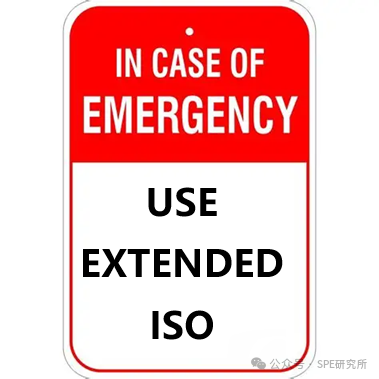
In summary, extended ISO provides another option in emergency situations.
03 Conclusion
To summarize briefly.
In the digital world, ISO is essentially the sensitivity gain value.
The minimum gain is the base, determining the highest point of image quality.
The ISO range is native, clarifying the applicable range.
Dual native ISO has two circuits that switch upon reaching a threshold.
When hardware capabilities are insufficient, software algorithms come into play.
Upward extension leads to more noise, while downward extension results in detail loss.
The choice of ISO camera depends on needs and budget.
That’s all for today, thank you all.
About Me
This public account is a certified photography account, but it also covers programming, photography, and the geek world.
The author is an electronics engineer who loves photography; in addition to viewing photography from an electronic design perspective, I will also introduce various interesting gadgets or knowledge related to electronics.
Of course, if you are also interested in cats, feel free to follow me.
Talking about photography, sharing cat stories, and occasionally rambling.
Technology, programming, and landscape photos will be shared as they come.
If you are interested in my articles and cat photos, please follow me.
And don’t hesitate to like and share, thank you!!