
The 2025 North America Embedded World Exhibition showcased innovations that are transforming the landscape of embedded and edge technologies. From applications of artificial intelligence and advancements in Neural Processing Units (NPU) to next-generation cybersecurity and wireless IoT connectivity, the event highlighted how leading companies are shaping the next generation of intelligent interconnected systems.
VDC Research’s insights provide an in-depth analysis of the most significant market trends, technological highlights, and strategic developments driving growth in the embedded ecosystem. The report also includes perspectives from innovative companies such as Advantech, Arm, foundries.io, GitLab, Green Hills Software, Infineon, Intel, LDRA, Microchip Technology, NXP Semiconductors, QNX, Qualcomm, STMicroelectronics, TE Connectivity, Tria Technologies, ZEDEDA, and more, all of which are shaping the future of embedded, IoT, and edge computing. The report highlights are as follows.
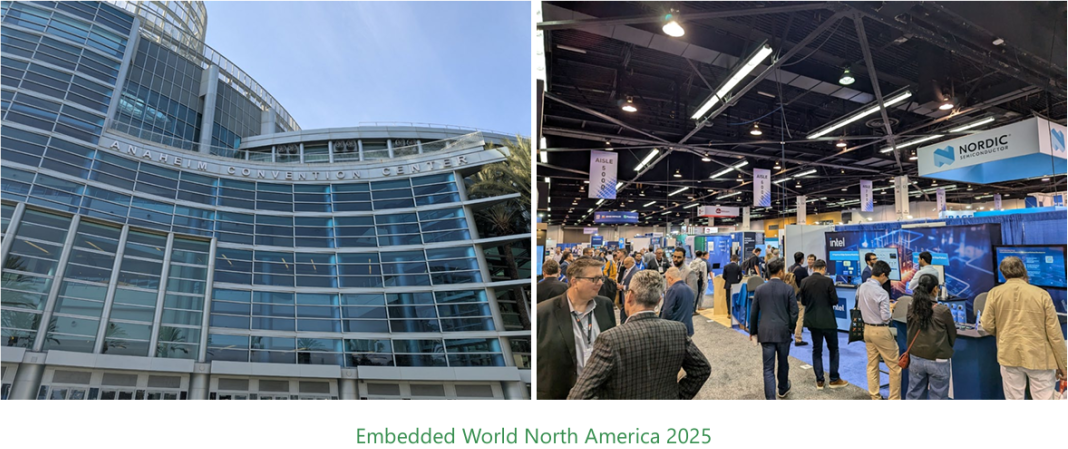
The 2025 Embedded World North America Exhibition (ewNA) was successfully held in Anaheim, California, significantly expanding in scale compared to last year, attracting over 250 exhibitors and nearly 3,800 attendees. The exhibition focused on the latest developments in embedded technology and the IoT ecosystem, with the VDC research team summarizing five major trends and announcing the “Embeddy” awards.
Main Observations:
1. Software Empowerment Determines Hardware Value: The success of AI hardware platforms relies on supporting SDKs, development tools, model libraries, and other software support. Advantech and Infineon showcased integrated development environments and AI suites to accelerate edge AI deployment.
2. NPU Becomes Key for Low Power and High Performance: The Neural Processing Unit (NPU) is rapidly growing in MCUs/SoCs, with manufacturers like ST and Microchip integrating NPUs through in-house development or partnerships to enhance edge AI performance.
3. DDR4 Phase-Out Drives Design Changes: The gradual discontinuation of DDR4 memory forces embedded systems to transition to DDR5 or alternative solutions, prompting system-level design adjustments involving processors, thermal management, and reliability.
4. Miniaturization Continues to Evolve: The rise of the OSM module standard has led Tria, GOWIN, and u-blox to launch ultra-compact computing modules, FPGAs, and wireless modules to meet the demands of industrial, medical, and wearable devices.
5. Wireless Connectivity and Security Upgrades: High-precision GNSS, Bluetooth LE audio, and the Matter protocol are driving IoT innovation; simultaneously, DevSecOps toolchains like LDRA, Peridio, and GitLab are enhancing security and efficiency from development to deployment.
2025 Embeddy Award Winners
Hardware Category: STMicroelectronics won for its STM32N6 MCU, which integrates NPU, GPU, and large-capacity RAM, supporting real-time visual and audio AI applications.
Software Category: LDRA was awarded for its integrated verification tool for aviation functional safety and cybersecurity, helping developers meet stringent standards such as DO-326B/DO-178C.
This exhibition highlighted the importance of software-hardware collaboration, AI edge computing, security, and agile development in the embedded field, indicating that future technological innovations will increasingly focus on system-level optimization and rapid implementation.
Report Link (Read Original)
https://www.vdcresearch.com/Coverage/IoT-Tech/reports/views/25-Embedded-World-NA.html
END
【Click above👆🏻to search for more content within the account】

Follow us for more exciting content

 Share, like, and arrange to see more?