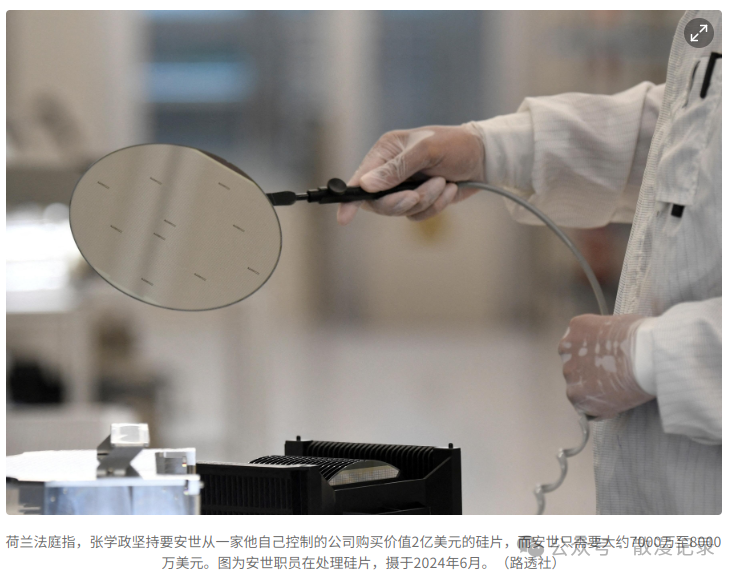
1. Background of the Incident
Nexperia, originally a semiconductor company under Philips in the Netherlands, was fully acquired by China’s Wingtech Technology in 2019 for approximately 34 billion RMB, becoming its subsidiary. Since then, Nexperia has rapidly grown to become a leader in automotive-grade power semiconductors, holding a 9.4% share of the global market, with nearly 40% of Europe’s automotive chips relying on its supply, serving clients including BMW, Volkswagen, and Tesla.
2. Outbreak of the Incident: “Takeover” under Geopolitical Tensions
On September 29, 2025: The U.S. Department of Commerce introduced the “50% Penetration Rule,” stipulating that if a subsidiary of a company listed on the Entity List is more than 50% owned, that subsidiary will also be subject to export controls.
On September 30, 2025: The Dutch government invoked the Cold War-era “Materials Availability Act” (established in 1953 and never used) to forcibly take control of Nexperia’s headquarters in the Netherlands, citing “serious management deficiencies” and “national security risks,” suspending the position of Chinese CEO Zhang Xuezheng and freezing his assets and intellectual property.
This move effectively aligns with the U.S. strategy to curb technology transfer to China, bringing globally critical chip companies under control when they are Chinese-owned.
3. Chinese Countermeasures and Global Supply Chain Shock
On October 4, 2025: The Chinese Ministry of Commerce issued an export control order, prohibiting Nexperia’s factories in China from exporting specific components abroad.
Approximately 70% of Nexperia’s products are packaged in Dongguan, China, directly cutting off chip supplies to global automotive companies.
The global automotive industry is in crisis:
16 European automotive companies jointly warned of imminent shutdowns;
Volkswagen’s inventory is only sufficient for 3 weeks;
The American Automotive Innovation Alliance also expressed concerns.
Bidirectional supply chain disruption:
The Netherlands halts wafer supply → China cannot package;
China halts finished products → Global chip shortage.
4. Easing of Tensions and Progress in Negotiations
On October 30, 2025: The U.S. and Chinese leaders met in Busan, with the U.S. announcing a one-year suspension of the “50% Penetration Rule.”
On November 1, 2025: China granted exemptions for eligible Nexperia exports, facilitating the resumption of supply.
On November 13, 2025: Dutch Minister of Economic Affairs Karremans stated that a senior delegation would visit China for consultations, seeking a “mutually acceptable solution.”
However, as of mid-November, the Netherlands had not resumed wafer supply to Nexperia’s factories in China, and global automotive companies still faced the risk of production halts within weeks.
5. Deeper Impacts
1. Accelerated Global Supply Chain Restructuring
European and American automotive companies are urgently turning to alternative suppliers such as TSMC and Nexperia;
The trends of “nearshoring” and “friendshoring” are strengthening, leading to decreased efficiency and increased costs;
Power semiconductor prices are expected to rise by 10%-20%.
2. Opportunities for Chinese Industries
Companies like BYD Semiconductor, Yangjie Technology, and Suzhou Goodix are accelerating domestic replacements;
Research and development of third-generation semiconductors (silicon carbide, gallium nitride) is speeding up;
Nexperia China has implemented RMB settlement since October, with BMW and Volkswagen already accepting it, promoting the internationalization of the RMB.
3. Damage to International Rules and Trust
The Netherlands’ use of a 70-year-old Cold War law to forcibly take over a company has been criticized for “lacking contractual spirit”;
The West’s approach of “security generalization” undermines global investor confidence;
Experts warn: If mishandled, this could become a “landmark negative case” in China-Europe economic and trade relations.
6. Future Outlook
The Nexperia incident has transcended corporate disputes, evolving into a microcosm of the technological competition and industrial chain security between China, the U.S., and Europe. Although all parties have released signals of easing tensions, the fundamental contradictions remain unresolved:
Will the Netherlands return control and resume wafer supply?
Will the U.S. permanently cancel the “Penetration Rule”?
Can China and Europe establish a systemic framework to avoid similar conflicts?
As scholars have noted: “Whoever controls core production capacity holds the bargaining chips.” This incident once again proves that the autonomy and control of the industrial chain have become core issues of national strategic security.