The optical skin sensor can distinguish between skin and the surfaces of different objects, and is widely used in wireless headphones, smartwatches, and other wearable devices.
For example, in the case of TWS wireless Bluetooth headphones, the optical skin sensor only plays music when the user is wearing the headphones. When the user removes the headphones and places them on a table or in a pocket, the music immediately pauses.
This article will introduce how to use the Everlight skin sensor to implement skin detection functionality.
Everlight Skin Sensor with Two IR Emission Wavelengths
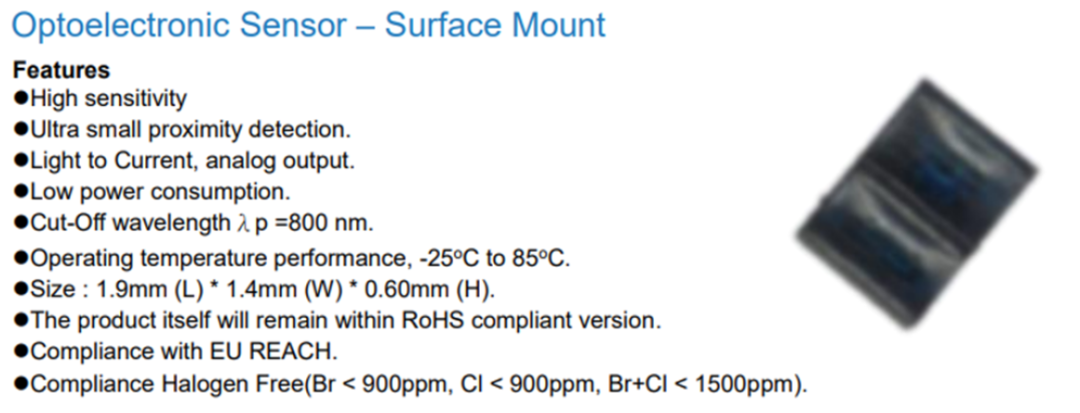
The Everlight skin sensor B-PM1914B3/L973-A-3R consists of two infrared LEDs and one photodiode, featuring first (1040nm) and second (1450nm) infrared LEDs with different wavelengths, along with corresponding infrared sensing devices. The reflected light is monitored by the photodiode.
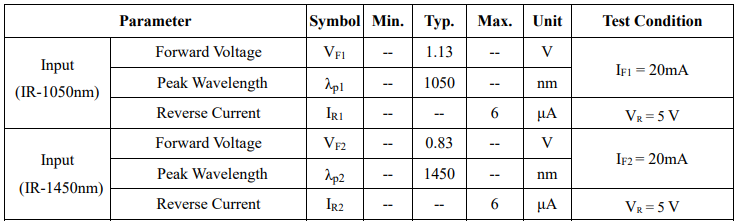
Skin sensors generally have a thin film interference filter or lens that overlaps with the first and second infrared LEDs, to narrow the emission angle of the light from the skin sensor. This reduces sensitivity and helps improve the accuracy of the skin sensor.
The spectral response of human skin is characterized by peaks and valleys
For example, the reflectance of a person’s skin is relatively high at a wavelength of 1065nm (approximately 50-60%), while it is relatively low at a wavelength of 1465nm (approximately 5-10%). Therefore, a sensor that emits light at 1065nm and 1465nm and measures the amount of light reflected by the target object at these wavelengths can monitor the presence of skin.
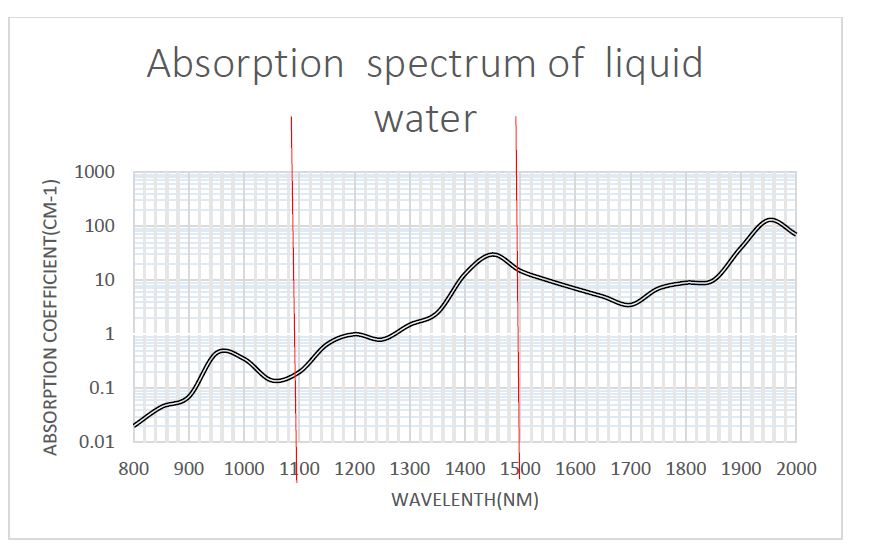
As shown in the figure above, compared to 1050nm, 1450nm has a higher absorption rate for moisture-containing objects. Utilizing this characteristic, by appropriately positioning the skin sensor against the surface of the object to be tested, the ratio R of the reflected light at 1050nm to that at 1450nm can be monitored and compared with a threshold TH (for example, 3 or another suitable value).
When the ratio R is less than TH, it can be determined that the object being tested is not skin. When the ratio R > TH, it can be determined that skin is present.
To help avoid false positives when non-skin objects are present, it may be necessary to control the light output of the skin sensor. Specifically, suppressing false positives can be achieved by narrowing the emission angle range of the light. This helps to avoid noise in the skin sensor readings.
For inquiries regarding the Everlight skin sensor, please contact Chao Yi Electronics.