Author: John Markoff, Source: Today’s Headlines (ID: headline_today)

For over a decade, Silicon Valley’s tech investors and entrepreneurs have been obsessed with social media and mobile apps, which help people find new friends, hail rides home, or crowdsource reviews for a product or movie. Today, Silicon Valley has found its next new inflection point. And it doesn’t require people to “like” anything.
The new era in Silicon Valley is centered around artificial intelligence and robotics, and many believe this shift will ultimately yield scalable returns in the personal computer industry or commercial internet, just as the previous two eras spread computer technology globally. Computers have begun to speak, listen, and see the world, and they have grown legs, wings, and wheels, allowing them to move freely in the world.
This shift was validated this month at Lowe’s home improvement store in the U.S., where a prototype garage checker developed by Bossa Nova Robotics quietly glided through the aisles, using computer vision to automatically complete a task that humans have performed manually for centuries.
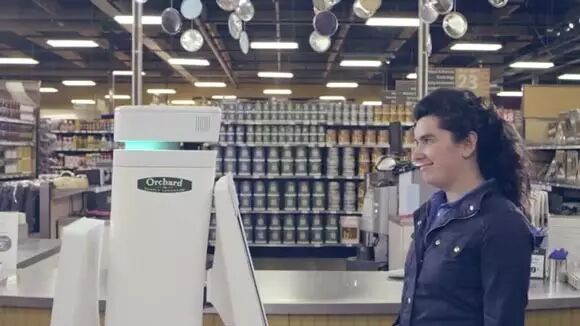
This robot skillfully gives way to customers, avoids unexpected obstacles in the aisle, and chirps softly to alert people of its presence. As it glides leisurely down the aisle, it can recognize barcodes on shelves and use lasers to check which items are out of stock.
Silicon Valley financiers and entrepreneurs are diving into artificial intelligence with great enthusiasm. The region now has at least 19 companies designing self-driving cars and trucks, up from just a handful five years ago. Additionally, there are over six categories of mobile robots that are being commercialized, including robotic waiters and aerial drones.
“We witnessed a slow accumulation of investment in robotics, followed by a sudden explosion—there seem to be a dozen companies promising large-scale funding rounds, focusing on specific opportunities in the robotics field,” said Martin Hitch, CEO of Bossa Nova (based in San Francisco, USA).

According to market research firm CB Insights, investment in artificial intelligence startups rose from $145 million in 2011 to $681 million in 2015, more than quadrupling. CB Insights estimates that new investments this year will reach $1.2 billion, a 76% increase from last year.
“Whenever a new perspective emerges, Silicon Valley rushes in and grabs hold of it,” said Jen-Hsun, CEO of chipmaker Nvidia. Nvidia manufactures graphics processors for the video game business but decisively pivoted to artificial intelligence applications last year. “But you have to wait for good ideas, and good ideas don’t come along every day.”
In contrast, investment in social media startups peaked in 2011 before plummeting. That year, venture capital firms completed 66 deals related to social media, investing $2.4 billion. According to CB Insights, there have only been ten investments in social media so far this year, totaling $6.9 million. Last month, LinkedIn, the world’s largest professional social network, was acquired by Microsoft for $26.2 billion, highlighting that social media has become a saturated market segment.
Even Silicon Valley’s largest social media companies are now entering the field of artificial intelligence, just like other tech giants. Facebook is using artificial intelligence to improve its products. Google will soon compete with Amazon’s Echo and Apple’s Siri, devices that can listen, answer questions, and place e-commerce orders at home. Microsoft President Satya Nadella recently appeared at the Aspen Ideas Conference, calling for humans to collaborate with artificial intelligence systems to enhance humanity with designed machines.
The automotive industry is also establishing a foothold in Silicon Valley to learn how to manufacture cars that can drive themselves. Tech companies and automakers claim that increasingly powerful sensors and artificial intelligence software will enable cars to start self-driving with the push of a button in ten years—though recent Tesla accidents have raised questions about how quickly self-driving technology will replace human drivers.
The new era of artificial intelligence in Silicon Valley emphasizes the region’s ability to reshape itself and quickly follow recent technological trends.
“This is at the core of Silicon Valley culture, which can be traced back to the Gold Rush era,” said long-time tech observer and Singularity University faculty member Paul Saffo. “Silicon Valley is built on the idea that there is always a way to restart and find new beginnings.”

Technological change is driving talent into the competitive field of artificial intelligence.
“This is absurd,” said Richard Socher, chief scientist at software maker Salesforce, who teaches a course on machine intelligence techniques known as deep learning at Stanford University. “Because today’s students know very little about artificial intelligence, there are many who want students to drop out midway.”
Silicon Valley’s pursuit of reinvention can be traced back to the mid-1970s when it rose from the ashes of a severe decline in the aerospace industry to become a consumer electronics manufacturing center for memory chips, video games, and digital watches. The early 1990s slump in the personal computer market was replaced by the subsequent World Wide Web and the global expansion of internet consumers.
Ten years later, in 2007, just as mobile phone innovation was about to shift from Silicon Valley to Europe and Asia, Apple launched the first-generation iPhone, reshaping the mobile communications market and ensuring that Silicon Valley—at least for the next generation—remains the world’s center of innovation.

In this latest transformation, some new perspectives on artificial intelligence first emerged from the work of cognitive scientists and computer scientists in Canada (such as Geoffrey Hinton, Yoshua Bengio, and Yann LeCun) over the past decade. The three are pioneers of the new technology known as deep learning. Deep learning is a machine learning method that effectively addresses the challenges of pattern recognition, such as vision and speech. Based on a comprehensive understanding of how the human brain works, deep learning helps technicians make rapid progress across a wide range of artificial intelligence fields.
There is much discussion about how far the prosperity of artificial intelligence will go. For some technicians, today’s technological advances lay the groundwork for truly intelligent machines that will soon possess human-level intelligence.
However, Silicon Valley faced setbacks before investing in artificial intelligence. In the 1980s, the early wave of entrepreneurs believed that artificial intelligence was the wave of the future that would spawn a wave of startups. The products of those startups had little commercial value, leading to disillusionment and disappointment, resulting in what is now referred to as the “AI winter.”

The current revival of artificial intelligence is unlikely to be a flash in the pan, several investors say, believing that its economic potential in terms of new efficiencies and applications is enormous.
“There will not be another AI winter,” said Shivon Zilis, an investor at Bloomberg Beta focused on machine intelligence startups.
John Shoch, a senior venture capitalist at Alloy Ventures in Palo Alto, California, said that deep learning has significant implications for the success of artificial intelligence companies. He stated, “You have a new set of tools that allows you to delve into a range of new problems, which will expand the boundaries of applications.”
For others, like Jerry Kaplan, who helped found two artificial intelligence companies in the 1980s—Symantec became a securities company, while Teknowledge ultimately failed—the new enthusiasm in Silicon Valley is unsettling, as it exhibits a blind optimism reminiscent of earlier times when artificial intelligence was overly hyped and ultimately did not develop.
“In the face of Silicon Valley’s enthusiasm for artificial intelligence, I sometimes hesitate, feeling like an atheist at a revival meeting,” he said.
Recommended Reading:Scan the QR code below to follow the Internet Observer and read “Historical Messages”!
The “Hundred Schools of Thought” in the Internet Age
Learning marketing from big brands: Why does it get worse the more you learn?
Highlights: The legendary entrepreneurial experiences of tech giants before they became famous
Analyzing the operational breakthroughs of three Q&A community products: Zhihu, Baidu Knows, and Douban from the perspectives of market, users, and products
About the Internet Observer (ID: hulianwangguanchajun)
In-depth observation of the internet industry, sharing the latest news, interesting anecdotes, and sharp insights daily. Whether right or wrong, it doesn’t matter; what’s important is that I am an internet observer with an attitude.

Long press the QR code to scan and follow ↑↑↑
…………………………………………………………